



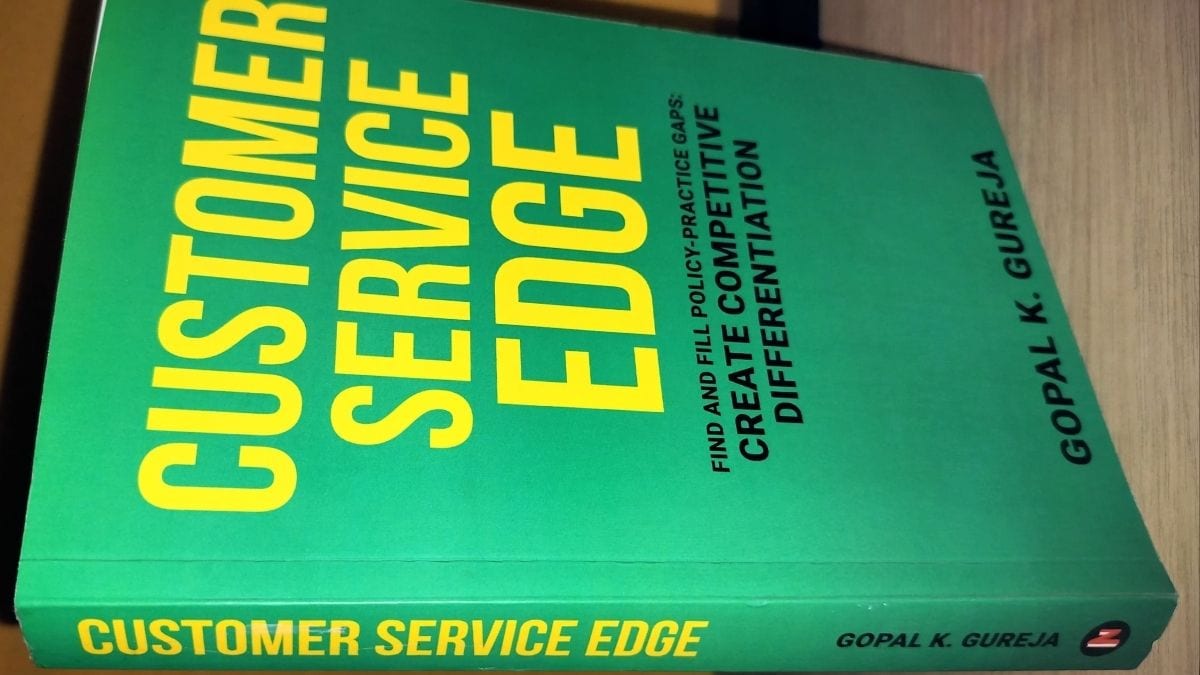
Gopal K. Gureja’s Customer Service Edge: Find and Fill Policy-Practice Gaps presents a rigorous and insightful exploration of a fundamental limitation in contemporary business practice-the persistent gap between organisational intent and operational reality.
Drawing upon extensive empirical research and decades of professional experience, Gopal K. Gureja delivers a compelling critique of how customer-centric policies often fail in execution, and more importantly, how such failures can be systematically addressed.
A seasoned customer service professional and author, Gureja has been closely associated with the evolution of after-sales service management in India throughout his corporate career, bringing both practical insight and strategic depth to his analysis.
The central premise of the book revolves around a critical inquiry: why do clearly articulated customer service policies fail to translate into consistent practice?
In an era where customer-first rhetoric dominates corporate communication, Gureja exposes the uncomfortable truth that many organisations remain disconnected from the actual experiences they deliver.
Supported by findings from a structured study involving 200 respondents, the book identifies multiple underlying causes of this disconnect, including ineffective communication channels, inconsistent leadership behaviour, inadequate review systems, low employee engagement, and conflicting organisational signals.
Among the book’s most significant conceptual contributions is the notion of cultural schizophrenia. This term encapsulates a condition wherein an organisation’s professed commitment to customer satisfaction is not reinforced by its internal processes, operational frameworks, or managerial priorities.
Such misalignment creates an environment of contradiction, where employees are uncertain about expectations and customers encounter inconsistency in service delivery. Gureja effectively demonstrates that this internal dissonance is not incidental but systemic, and if left unaddressed, it undermines both credibility and competitiveness.
The discussion on communication further strengthens the book’s analytical depth. Gureja argues that communication failures, whether in clarity, consistency, or feedback mechanisms, are among the most critical contributors to the policy–practice gap.
Particularly noteworthy is his observation on feedback management. When customers or employees provide input but are not informed about how it is processed or acted upon, organisations inadvertently create dissatisfaction rather than engagement. This overlooked psychological dimension highlights the importance of closing not just operational gaps, but also perceptual ones.
Equally important is the author’s emphasis on institutional discipline as a corrective framework. Gureja calls for a renewed commitment to organisational discipline, where policies are not merely declared but actively reinforced through structured processes and leadership accountability.
This discipline involves careful management of employee-related issues to enhance engagement, ensuring that relevant knowledge is available at the point of action, and maintaining visible and sustained involvement of senior leadership. The emphasis on leadership is particularly significant, as it reinforces the idea that customer-centricity must be embedded at the highest levels of decision-making.
What distinguishes Customer Service Edge from conventional management literature is its strong practical orientation. The book goes beyond theoretical diagnosis and provides actionable strategies to improve service quality, strengthen customer retention, and align internal operations with declared policies.
It addresses key functional areas such as training, process optimisation, internal coordination, and backend support systems, all supported by real-world case insights that enhance its applicability.
The writing is marked by clarity, precision, and intellectual coherence, making the book accessible to both practitioners and academic readers. Gureja’s ability to integrate empirical research with experiential knowledge lends the work both credibility and relevance. His arguments are not only persuasive but also grounded in observable organisational realities.
Customer Service Edge stands as a significant contribution to the discourse on customer service management. It challenges organisations to critically examine the gap between what they promise and what they deliver, and to adopt a disciplined, organisation-wide approach to bridge this divide. By focusing on the imperative of aligning policy with practice, Gureja offers a strategic framework for achieving sustainable competitive differentiation.
Customer Service Edge: Find and Fill Policy-Practice Gaps
Author: Gopal K. Gureja
Publisher: notionpress.com
Price: ₹545
Pages: 412
