



A group of young military officers plot to overthrow the Japanese government on the anniversary of Japan’s World War II surrender, capture power, bin the pacifist post-war constitution, restore the national army and revive the military spirit of imperial Japan.
Readers of Kyuzo Kobayashi’s 1978 novel August Without the Emperor found it a good read, and viewers of its film version thought it good entertainment. That was all. Few thought the scenario either possible, especially after the failed Yukio Mishima insurrection, or probable in Japan where post-Hiroshima pacifism had struck deep roots.
Though surrounded by three hostile powers—a rising China, old enemy Russia and a missile-armed North Korea—Japan had been sleeping under the American nuclear umbrella and maintaining only a self-defence force.
No longer. Coups are still as likely in Japan as the sun rising in the west or England turning republican, but the polity that had abjured militarism after the World War has been turning militaristic under its first woman PM. Doubling the share of military spend in the GDP this year, Sanae Takaichi is getting Tomahawk missiles and anti-missile systems, large ammunition stocks, unmanned systems, newer warships, jets and military satellites, and building fortified facilities across the southwestern islands. She’s also encouraging the Mitsubishis, Kawasakis, Komatsus, Fujitsus and Toshibas to turn some of their gizmo factories into gunsmithies so to speak.
Last week she came out with a white paper that read like a call to arms. Japan has till now held that it would strike back only if attacked. Now it argues that it must be allowed to pre-empt an imminent enemy attack by delivering a first strike. Japan wants a deterrent capability.
Elsewhere in the world, too, countries are upping their arms, or seeking strong partnerships. NATO’s European members are getting doomsday nightmares, thinking Uncle Sam would fold up his nuclear umbrella and go home when the Russians finally arrive. They have all started building more missiles, tanks, guns, warships and fighter jets. Atom-armed France has announced a ‘forward deterrence’ doctrine, offering expanded nuclear cooperation and war-jet deployments to its European allies. Britain has decided to invest £8.4 billion to build Dreadnought nuclear submarines that would also create jobs.
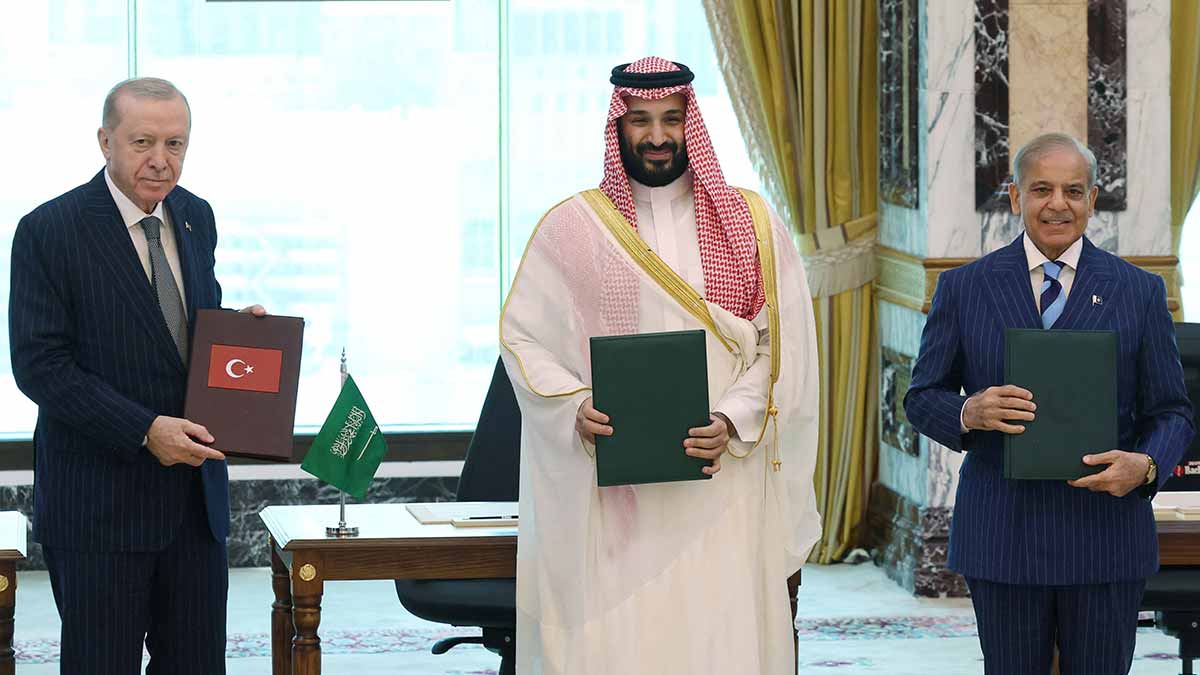
Nearer home, Turkiye, Saudi Arabia and Pakistan signed a triple alliance last week saying that an attack on any one of them would be treated by the other two as an attack on either of them. They think they would be safer with Turkiye’s NATO-quality arms, Saudi’s petro-money and Pakistan’s nuclear umbrella and combat-scarred military. They hope more of the wealthier Arab states would join them in what could evolve into an Islamic NATO.
What is common to all these petrified states? They have all been pact-bound partners or non-NATO allies of the US but are no longer certain that American security guarantees would work any longer. For two reasons. One, they saw how friendship with the US has made many of the Gulf states targets of Iranian missiles in the on-going West Asian war. Two, they are seeing the decline of American power and prestige under a president who has deluded himself into thinking that he is making America great again.
Most of us laughed when Paul Emil Erdman wrote fictitiously about The Last Days of America in 1981. They smirked when Gore Vidal wrote essays about The Decline and Fall of the American Empire in 1992. Now we wonder who will have the last laugh.
