



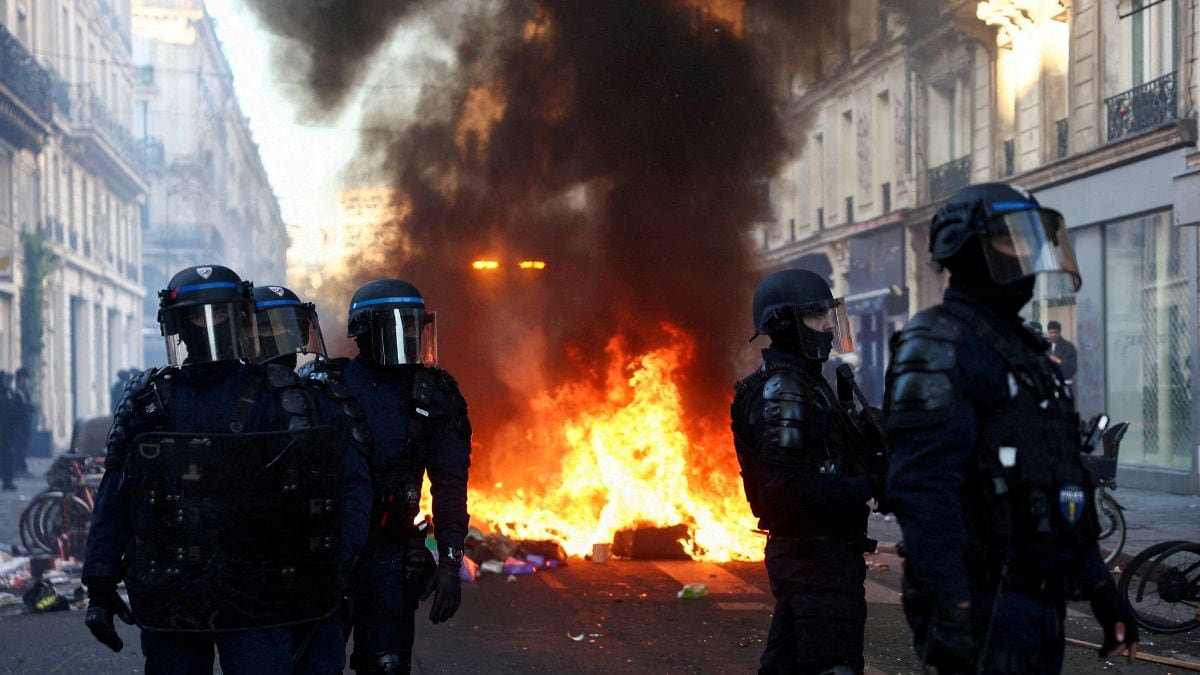
French authorities imposed overnight curfews and tight gathering bans across Paris and several other cities last night, in an attempt to contain the worst street violence in decades. In Paris, curfews covered the Place de la République and the Les Halles commercial district, while public gatherings were barred from 8pm across central government zones and transit hubs. Similar local restrictions were applied in Marseille, Nice, Lille, Bordeaux, Lyon and smaller northern towns.
The measures follow a weekend of rioting that produced more than 2,400 arrests, nearly 1,000 injured officers and damage to between 2,000 and 3,000 businesses, with losses running to hundreds of millions of euros. Limoges lost its 19th-century city hall to arson, and rioters stormed Marseille's municipal building. Marseille Mayor Benoît Payan accused the national government of abandoning France's second city to looters and demanded full compensation.
The unrest began as high school blockades and swelled into a "convergence of struggles" as labour unions, climate activists and revived gilets jaunes (the yellow-vest protest movement) joined in. Nearly a million people took to the streets, driven by squeezed purchasing power, rising fuel prices and declining public services. Most marched peacefully. Masked breakaway groups burned vehicles, ransacked commercial districts and attacked state property.
The speed of the escalation exposed a failure of intelligence. Security services had expected about two lakh marchers, and more than five lakh appeared, leaving 60,000 deployed officers overwhelmed. Interior Minister Laurent Nuñez conceded that police had "lost control" in several major cities and offered his resignation, which President Emmanuel Macron refused. Justice Minister Gérald Darmanin admitted that the government had "undeniably failed", citing blind spots over ultra-left networks. Prime Minister Sébastien Lecornu responded with a police investigation, partial unemployment funding for affected workers and a promise of legislation to make rioters pay for the damage.
Macron's eight-minute address from the Élysée Palace offered "anger and shame" but no new policy and no fiscal concession. Rivals from the Greens, the radical left, the centre-right and the far right described a president overwhelmed, arrogant and isolated. His approval rating has fallen to 15 per cent, and he has lacked a working parliamentary majority since the dissolution of the National Assembly in 2024. The economic realities offer little relief. National debt stands at 119 per cent of GDP, the worst since 1946, and borrowing costs now exceed those of Greece. Earlier French leaders bought social peace with public money. Macron must rely on policing, which has deepened public anger.
With the presidential election six months away, the posturing has been swift. Lecornu accused Jean-Luc Mélenchon's La France Insoumise of exploiting student frustration and stoking chaos for electoral gain. Mélenchon rejected the charge and demanded that the prime minister either prove it or apologise. The far-right National Rally cast itself as the sole defender of order. Party president Jordan Bardella called Macron's response lamentable, while Marine Le Pen, the current frontrunner to succeed him, released a presidential-style video addressed to a divided nation. Analysts and former allies say the centrist coalition built around Macron has largely collapsed.
The crisis has also crossed the Atlantic. At a rally in Kansas and in remarks at the White House, Donald Trump blamed Macron's immigration policies, claiming that "migrants have taken over" and that Paris would soon become a "Muslim city". Vice President JD Vance and House Speaker Mike Johnson shared images of the burning Limoges city hall as a warning against open borders. French authorities rejected the framing, attributing the looting to ultra-left agitators and criminal groups rather than immigrant communities.
