



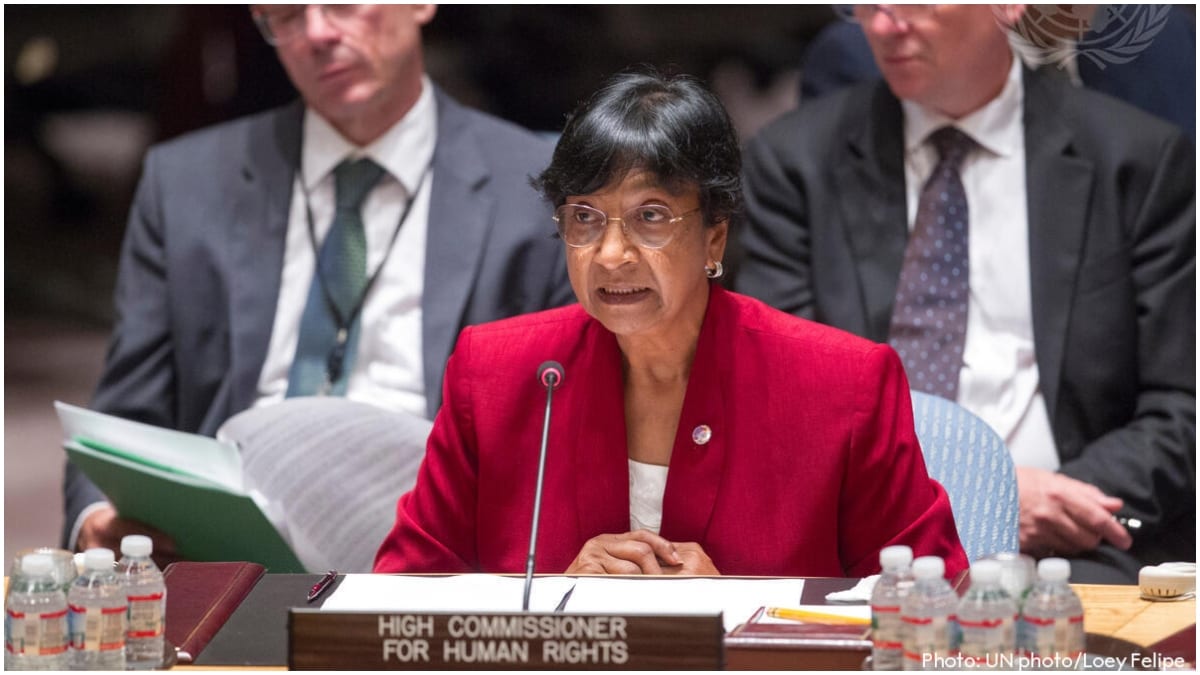
South African jurist of Indian origin Navanethem Navi Pillay, a former UN human rights chief and a judge at the International Court of Justice, won the Nobel Peace Prize on Friday for her contributions to promoting peace and international law. The United Nations human rights office on Friday welcomed the news of Navi Pillay's Nobel Peace Prize win, acknowledging her longstanding advocacy for human rights.
"It is amazing news, we need more dedication and commitment to human rights," Shabia Mantoo, spokesperson for the UN human rights office, told reporters in Geneva.Navi Pillay was the former head of the United Nations Commission of Inquiry on the Occupied Palestinian Territory and a former International Criminal Court judge.
In September last year Pillay oversaw the publishing of a report by the UN Commission of Inquiry that concluded that Israel had committed genocide in Gaza and that top Israeli officials including Prime Minister Benjamin Netanyahu incited these acts - accusations that Israel called scandalous.
Here are five facts about the Indian origin jurist that may interest you:
1. Navanethem Pillay was born on September 23, 1941, in Clairwood, Durban, Natal (now KwaZulu-Natal). Navanethem Pillay earned a Bachelor of Arts (BA) from Natal University, South Africa, in 1963, followed by a Bachelor of Laws (LLB) in 1965. She obtained a Master of Laws (LLM) from Harvard University in 1982. It was in 1988 that she earned a Doctor of Juridical Science (SJD) from Harvard University. Her doctoral thesis was titled 'The Political Role of the South African Judiciary'.
2. As per the website SA History Online, after completing her university degrees, Pillay commenced her legal career by serving her articles in Durban under the guidance of Narainsamy Thumbi Naicker, a banned member of the South African Indian Congress (SAIC) and the Natal Indian Congress (NIC) who was also under house arrest.
3. Judge Pillay was the first woman to start a law practice in Natal Province, the International Criminal Court (ICC) said. When she opened her own practice in the province in 1967, she became the first Black woman to do so. She spent nearly three decades practising law.
4. Judge Pillay defended many anti-apartheid campaigners before being elected by the United Nations General Assembly as a judge at the International Criminal Tribunal for Rwanda (ICTR), where she served for eight years, including four years as president. "In the direct aftermath of the Genocide in Rwanda and during the subsequent 20 years, the ICTR has been at the forefront of the global fight against impunity, prosecuting those considered most responsible for the gravest crimes committed in 1994," the United Nations said in a report.
5. The offices she held include the Vice-Chair of the Council of the University of Durban-Westville. She was appointed to the post by then President Nelson Mandela in 1995. In 1997, she was appointed to the Rules Board for Courts by the Minister of Justice. That same year, she was appointed by the Secretary-General of the United Nations to the Expert Group Meeting on Gender Persecution.
