



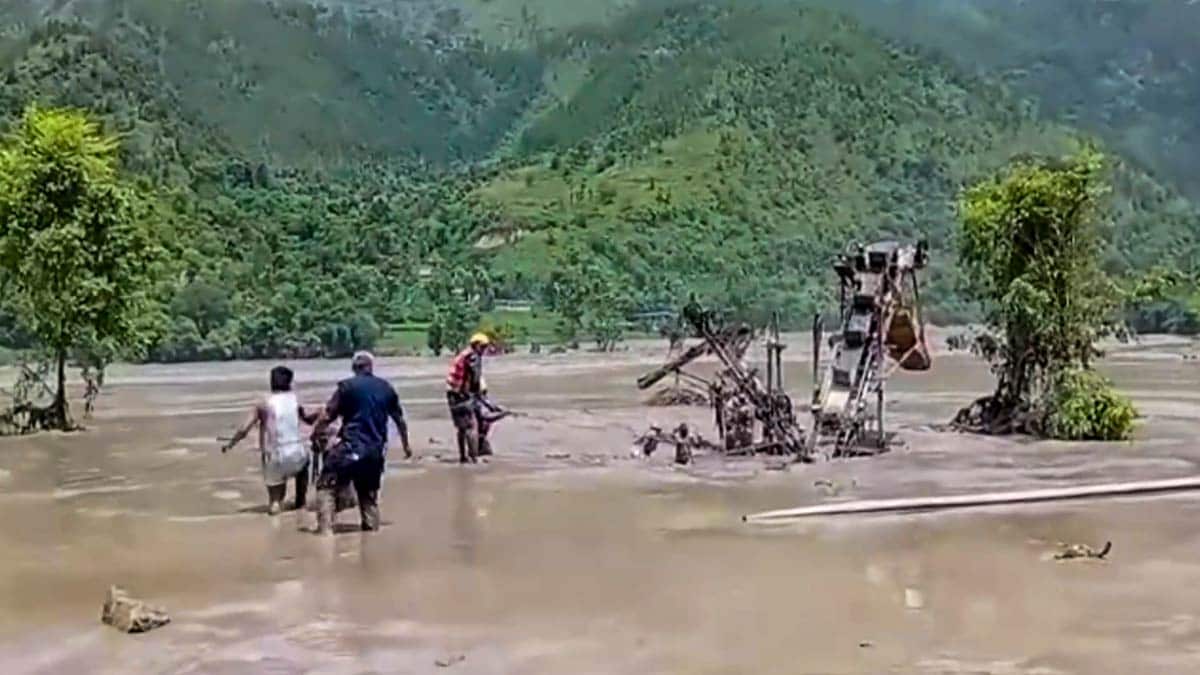
On the morning of 26 August 2026, the Himalayas delivered a brutal reminder of their volatility. A massive ice-rock-slope failure on Langtang Lirung, near the Nepal–China border, unleashed a cascading torrent through the Lhende Khola, Bhotekoshi and Trishuli river corridors, overwhelming towns, highways, bridges and hydropower projects in its path. Within hours, a landscape bustling with traders, workers and pilgrims—including Indians travelling the Kailash Mansarovar route—was transformed into a disaster zone.
Initial speculation pointed to an earthquake. Subsequent scientific assessments, however, established a crucial distinction: the seismic signal was generated by the landslide rather than causing it. Satellite imagery and field analyses indicated that an estimated 142 million cubic metres of ice, rock, sediment and debris collapsed from around 5,200 metres. The mass surged downhill at speeds exceeding 160 km/hr, temporarily dammed the river and then breached in a catastrophic outburst.
By the end of September, official figures recorded 1,453 confirmed deaths, more than 5,200 people missing and over 13,700 rescued through ground operations and thousands of helicopter sorties. But as the immediate search-and-rescue effort gives way to recovery, a quieter and deeply painful crisis has emerged: finding the missing and identifying the dead.
A disaster reinterpreted: From “flood” to “cascading slope failure”
The Bhotekoshi catastrophe has forced a rethink of how Himalayan disasters are understood.
Early reports described the event as a glacial lake outburst flood, or GLOF. Later technical assessments point towards a far more complex chain of events: a rock-slope failure that entrained glacier ice, producing a high-velocity rock-ice avalanche; rapid blockage of the valley; temporary damming; and a subsequent debris-laden surge that behaved less like a conventional flood and more like a hyper-concentrated flow.
This distinction matters because it changes how risk must be monitored.
World Weather Attribution’s rapid analysis concluded that while the underlying geological structure determined where and how the slope failed, long-term warming and changing precipitation patterns likely reduced slope stability. Ice-filled fractures may have weakened, permafrost thawed, and rock-ice interfaces altered. Climate change, therefore, appears to have acted as a destabilising multiplier on a landscape already affected by the 2015 earthquake, glacier retreat and inherent geological fragility.
If the trigger was not a conventional GLOF but a high-altitude slope failure with cascading hydrological consequences, early-warning systems designed primarily around river levels and glacial lakes will be inadequate. Monitoring must move higher up the mountain, while infrastructure planning must account for cascading geological and hydrological hazards.
The rescue and humanitarian imperative
Nepal’s security forces and emergency services carried out daring rescue operations, including the extraction of workers trapped for days in inundated hydropower tunnels. Yet the work of the International Committee of the Red Cross (ICRC) and the Nepal Red Cross Society has drawn attention to another, often overlooked, dimension of disaster response.
For families, the disappearance of a loved one creates an agonising psychological state known as “ambiguous loss”—a suspension between hope and grief that can be more destructive than confirmed bereavement. In such circumstances, locating a missing person or establishing the identity of recovered remains is not simply an administrative task. It is the first step towards closure.
Working with the Indian Red Cross Society to trace missing foreign nationals, the ICRC has focused on Restoring Family Links, missing-person data management and forensic support. More than 1,400 bodies have been recovered, but identification has been painfully slow because of hard-packed debris, remote terrain and formidable logistical challenges. DNA samples have reportedly been collected from nearly 1,900 relatives, yet only 112 victims have so far been formally identified and returned to their families.
Thousands of specialised body bags, protective equipment and forensic-management protocols have been provided by the ICRC. This may lack the drama of helicopter rescues or airlifts, but they are no less important. Restoring identity to the dead is an essential act of human dignity—and a prerequisite for families to begin rebuilding their lives.
The critical dimension: Disaster victim identification
Rescue is only the first phase.
Nepal’s difficulty in locating missing people and identifying recovered bodies highlights a critical but frequently neglected component of disaster management: Disaster victim identification (DVI).
Establishing the identity of the dead and reconnecting them with their families requires specialised forensic capability, trained personnel and systems that can function under extreme conditions.
Countries such as the UK, Australia, Germany, the US, Japan and Switzerland have developed sophisticated DVI systems combining police, forensic medicine, forensic anthropology, odontology, DNA laboratories and disaster-response agencies. The internationally accepted Interpol DVI framework is based on four stages: examination of the scene, collection of post-mortem data, collection of ante-mortem data and reconciliation of the two.
Fingerprints, dental records and DNA are the principal scientific identifiers. Medical records, scars, tattoos, implants and personal effects provide additional evidence.
The ICRC brings particularly valuable humanitarian and forensic experience to such situations through its Humanitarian Forensic Action (HFA) programme– pioneered in the early 2000s. It has developed its expertise from managing the remains of the Iran-Iraq war, earthquakes in Haiti and Chile, and conflicts across Africa. Its systems enable ante-mortem information collected from families to be systematically matched with post-mortem information from recovered remains, including cases where bodies are decomposed, fragmented or skeletal. Its experience also extends to cross-border and prolonged missing-person cases.
The International Commission on Missing Persons (ICMP) provides complementary expertise in large-scale DNA matching. Its database systems can integrate missing-person records, family DNA samples, forensic recovery information and laboratory results, allowing remains to be compared against extensive family-reference databases.
The lesson is clear: forensic capacity cannot be improvised after a mass-fatality event. It has to exist before one occurs.
Six lessons for countries sharing the Himalayan landscape
The Bhotekoshi disaster cannot be treated as an isolated Nepalese tragedy. The Himalayas constitute a single, interconnected ecological system. Rivers originating in Nepal feed directly into India, as demonstrated when the National Disaster Response Force placed downstream districts in Bihar and Uttar Pradesh on high alert.
The disaster therefore offers six urgent lessons for countries sharing the Himalayan Landscape, including India:
1. Build transnational early-warning systems
Real-time information on glacial lakes, landslide dams, river levels and slope instability should be systematically shared among India, Nepal, China and Bhutan.
Existing bilateral mechanisms tend to be ad hoc and reactive. What is required is a standing Himalayan Early Warning Network, with standardised protocols, shared telemetry and joint situation rooms during high-risk periods.
2. Shift monitoring to the peaks
Conventional flood gauges downstream cannot provide adequate warning of high-altitude slope failures.
Remote sensing, satellite surveillance, seismic arrays and AI-enabled anomaly detection must increasingly monitor upper mountain slopes and glacierised catchments, rather than relying primarily on river levels in the plains. In a disaster such as Langtang Lirung, the warning available after a surge reaches downstream gauges may be measured in minutes.
3. Design infrastructure for cascading risk
Hydropower projects, mountain highways and border infrastructure must be designed for multi-hazard cascades.
A slope failure many kilometres upstream can destroy infrastructure far downstream. Engineering standards that focus primarily on hydrological extremes may not adequately account for geo-mechanical triggers. Site selection and structural design must therefore incorporate slope stability, permafrost degradation and debris-flow modelling.
4. Establish multinational disaster response protocols
Standing operational arrangements should connect regional armed forces, disaster-management agencies and Red Cross societies, enabling rapid cross-border assistance.
The Bhotekoshi response demonstrated impressive national efforts but also exposed fragmentation: delays in information concerning foreign nationals, uneven consular access and logistical bottlenecks at the Gyirong border. Pre-negotiated access corridors, joint exercises and shared emergency stockpiles could substantially reduce such friction.
5. Create digital pilgrim and tourist tracking
Voluntary digital travel-registration systems for high-risk Himalayan pilgrimage routes could greatly accelerate post-disaster tracing.
Among those missing are foreign tourists, hydropower workers and pilgrims whose movements may never have been formally recorded. A lightweight, privacy-respecting registry linked to mobile numbers and emergency contacts could dramatically improve the speed and accuracy of family tracing.
Such a system would not require intrusive surveillance. Its purpose would be simple: to ensure that, when disaster strikes, authorities know who is in the affected area and whom they should contact.
6. Build forensic capacity before disaster strikes
The greatest lesson from the identification crisis is that forensic capacity must be treated as part of disaster preparedness rather than as a post-disaster requirement.
The joint ICRC–Nepal Red Cross preparedness initiatives developed before the disaster provide an important foundation. But the scale of the tragedy exposed the limits of available surge capacity. Forensic teams, cold-storage facilities, DNA laboratories and trained personnel were overwhelmed.
The region therefore needs pre-positioned forensic hubs, shared databases and standard operating procedures for mass-fatality management. Mortuary and temporary body-storage facilities should be identified in disaster-prone areas in advance. Regular multi-agency DVI exercises should be conducted, with standing arrangements involving Interpol, the ICRC and ICMP for rapid international assistance.
From vulnerability to resilience
The Himalayas are changing under the combined pressures of warming temperatures, fragile geology and rapid human development. Abandoning mountain infrastructure is neither practical nor realistic. But continuing development without accounting for changing geological risks is a recipe for repeated tragedy.
True resilience will require risk-informed engineering, transnational scientific cooperation and sophisticated early-warning technology. It will also require a broader understanding of what constitutes the end of a disaster.
Emergency response does not end when floodwaters recede or when the last survivor is evacuated. It ends only when the missing are accounted for, the dead are identified and human dignity is restored.
For India, the stakes are particularly high. Millions of pilgrims, tourists and workers move through Himalayan corridors every year. Critical energy and transport infrastructure is also linked to transboundary rivers. New Delhi therefore cannot afford to regard Bhotekoshi as merely ‘Nepal’s problem’.
The mountains do not recognise national borders. Disaster preparedness cannot afford to either.
The question is no longer whether another Himalayan slope will fail. It is whether our institutions—national, regional and global—will be ready when it does.
(Lt Gen Philip Campose (Retired) is a former Vice Chief of the Indian Army. He has authored a book titled ‘A National Security Strategy for India: The Way Forward’)
(The opinions expressed in this article are those of the author and do not purport to reflect the opinions or views of THE WEEK.)
