



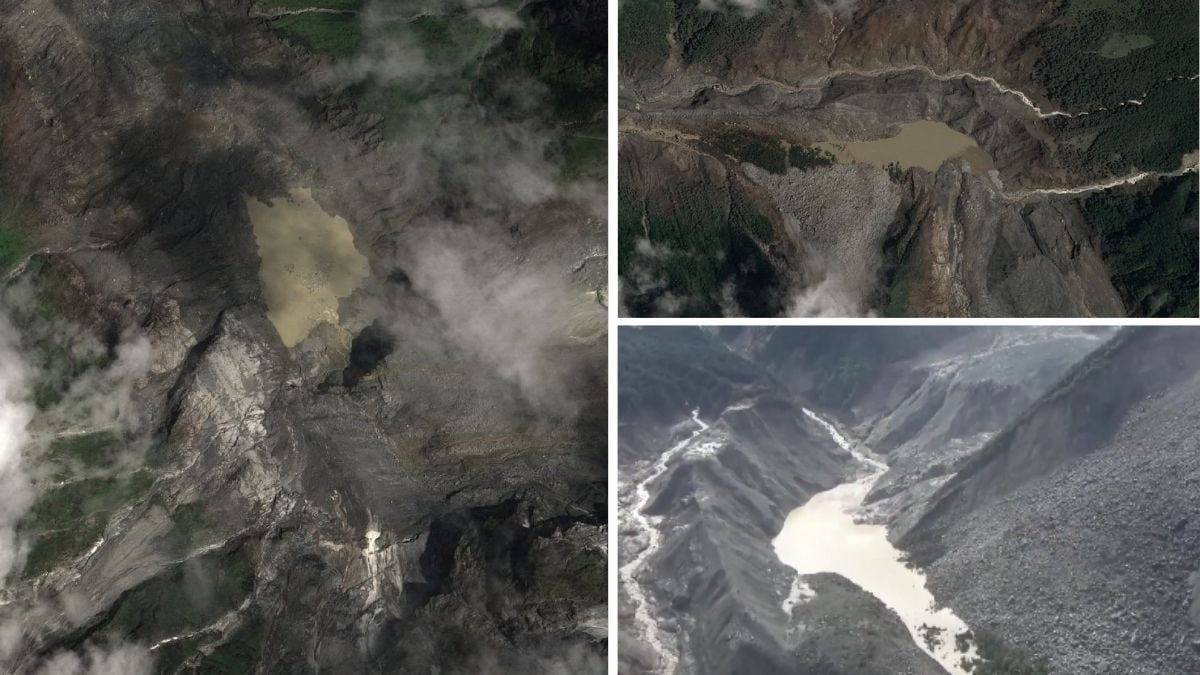
There are fresh concerns in Nepal’s Rusawa over a second newly formed lake in the mountains that has been swelling in size after the massive deluge on Wednesday. The new lake was observed via aerial footage of the flood zone after rescue efforts were briefly suspended on Friday over fears of a deluge from the first lake, CNN reported.
ALSO READ: Nepal: Panic after lake on China border bursts; rescue op halted
Authorities have been closely monitoring both lakes, relying on satellite imagery to track conditions, a Nepalese official said.
The second lake was formed higher upstream after water from the floods drained into a local basin. It also swelled in size compared to the first one and is expected to grow further with fresh rainfall expected. The body currently has no visible outlet, which means it could build immense water pressure.
Rajendra Sharma, a senior meteorologist from Nepal’s national disaster agency, also warned that more rain could be coming for the flood-affected areas in Nepal.
Nepal's Department of Hydrology and Meteorology said that light to moderate rain is falling in parts of Gandaki, Bagmati and Lumbini provinces, which lie close to the flood-affected areas.
According to Jeffrey Kargel, senior scientist at the Planetary Science Institute, if the second lake were to burst its banks, the water could flow into the landslide-dammed lake further downstream, and “together they could burst out very, very rapidly.”
“Alarm bells are ringing, and the rescue crews have to be ready to move to higher ground at every moment,” Kargel said.
Kargel said that the torrent of water and debris was “equivalent to at least 500,000 large dump truck loads of rock and ice. “The flood was previously described as liquid concrete.
Both lakes sit upstream of an area where hundreds were killed by the flood.
The Disaster Management Authority staffer said that officials plan on installing cameras and sensors downstream.
The death toll from Wednesday's devastating floods has now risen to 616 as of Saturday morning.
2,301 people are injured, and around 2,500 people are still missing on both sides of the border in Nepal and China.
