



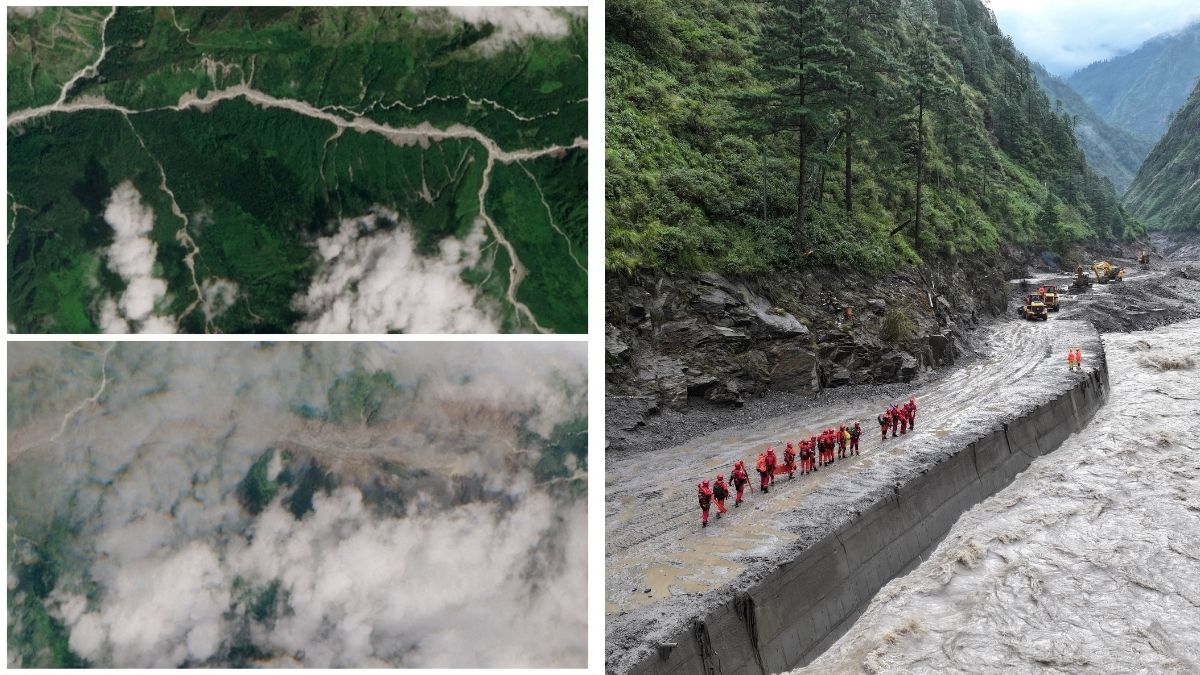
Raising fears of another flood, China has informed Nepal that a large lake formed after a landslide in the upper reaches of the Lhendi River in Tibet, China, has burst. Following this, helicopter rescue operations in the flood-hit Rasuwa district have been halted.
Rasuwa Chief District Officer Narendra Pariyar informed that the Chinese side has alerted that the lake formed near the confluence of Tibet's Chochen River and Nepal's Purepu Tsangpo River has burst. “We can see that the level of water in the river is rising,"
he said, adding that it is unclear how high the water level is at present.
The Chochen River and the Purepu Tsangpo River, which flow from Tibet, merge into the Trishuli via the Bhotekoshi.
Earlier, Global Times, citing China's Ministry of Water Resources, reported that about two million cubic meters of water had accumulated in the lake formed by the avalanche on Thursday.
A statement by the ministry said its water volume was estimated at 2 million cubic meters as of Thursday morning. Another 3 million cubic meters of water is expected to flow into the lake over the next three days, posing a high risk of a breach.
China mobilised an eight-member engineering team to conduct aerial surveys and 3D modeling of the lake on Thursday
Nepali experts have also predicted that the danger from the recent floods may not be over, as unstable canyon walls and a partially collapsed glacier could trigger fresh debris flows and secondary floods in the coming days.
Glaciologists and emergency response specialists from the International Centre for Integrated Mountain Development (ICIMOD) have identified the two hazards as the main risks. With the floods severely eroding the bases of steep rock and moraine slopes along the Lende Khola gorge, micro-landslides could occur, which could result in larger rockfalls and landslides blocking the river downstream.
Another risk is the potential collapse of the remaining mass of the Gangbhu glacier. Planet Labs satellite imagery shows a steep collapse wall and a large crack at the point where the glacier detached. Though the risk is moderate, any seismic activity or strong aftershocks could cause it to collapse into the gorge and trigger another wave, according to local media reports.
The confirmed death toll from the glacier collapse in the region on Wednesday rose to 469 in Nepal, with almost 1,000 more missing there and in Tibet.
