



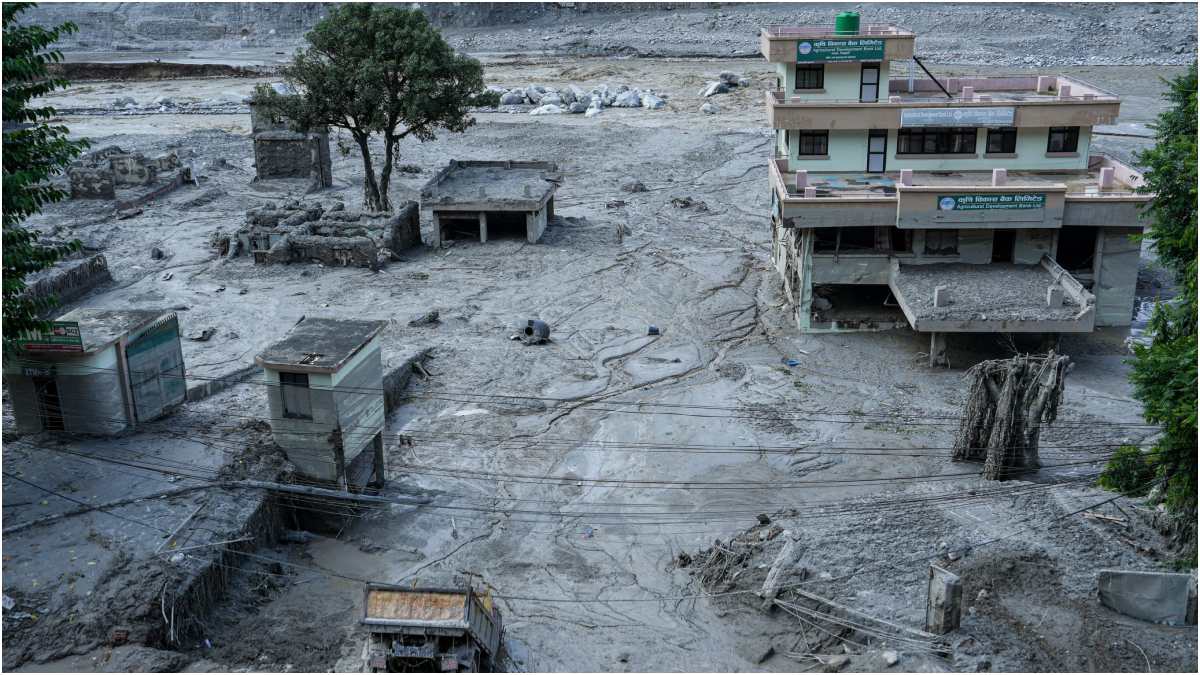
Even as the death toll from the flood disaster in Nepal has risen to at least 359 and around 900 people continue to be missing, experts have warned that the danger is far from over. Unstable canyon walls, a partially collapsed glacier and a rapidly filling lake could trigger fresh debris flows, landslides and secondary flooding in the coming days.
Experts from the International Centre for Integrated Mountain Development (ICIMOD) have identified two major hazards resulting from the flooding and earthquake in the region.
According to them, one of the most immediate concerns is the instability of the steep canyon walls along the Lende Khola gorge. The floods have eroded the bases of steep rock and moraine slopes, and micro-landslides have been detected in the aftermath. According to media reports, experts from ICIMOD observed that this has increased the possibility of larger rockfalls and landslides. Such events could once again block the river downstream, creating the risk of further flooding.
The second concern is the remaining mass of the Gangbhu glacier, which is a hanging glacier located high in the Himalayan mountains on the Nepal side of the Nepal-Tibet border.
According to a report by The Himalayan Times, only part of the hanging glacier has collapsed, leaving the remaining section as a potential hazard. Although experts have assessed the current risk as moderate, continued seismic activity or aftershocks from the earthquakes could cause another collapse and trigger a fresh wave.
Adding to the concerns is a lake that has formed at the site of the flooding in Nepal and continues to rise. Nepal's disaster authority said on Thursday that the lake was at risk of bursting and appealed to residents and rescue personnel to stay away from river banks, a report by Reuters said.
The lake was formed after a river was blocked on Wednesday, the authority said.
China's ministry of water resources has also warned about a major barrier lake near the confluence of the Chhochen Khola and Purepu Tsangpo rivers in Nepal. As of Thursday morning, the lake contained an estimated two million cubic metres of water and had already begun overflowing.
According to China Central Television, another three million cubic metres of water is expected to flow into the lake over the next three days, posing an additional risk.
