



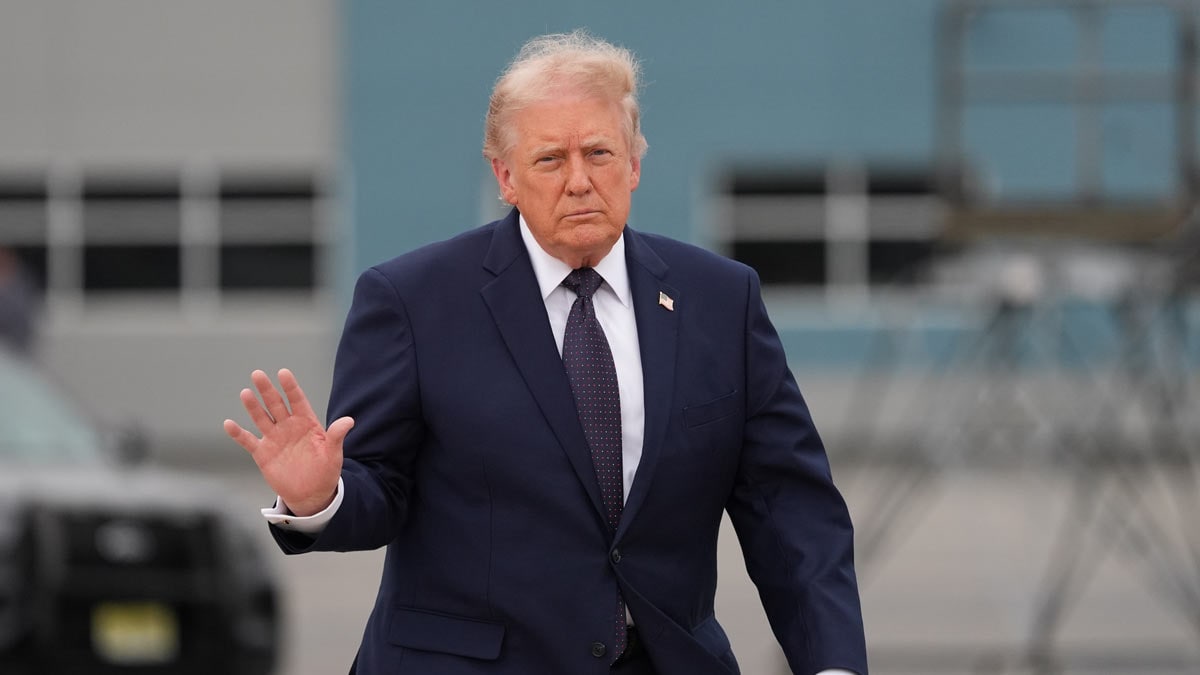
The US Supreme Court delivered one of its most consequential sets of rulings on Monday, the penultimate day of its current term. The court handed President Donald Trump a landmark constitutional victory while simultaneously frustrating three of his immediate political, economic and legal objectives.
In a remarkable day that revealed unusual alliances among the ideologically opposed justices, the court significantly expanded presidential authority over much of the federal government. Yet it also blocked Trump's attempt to exert greater control over the Federal Reserve, upheld a state law allowing certain mail-in ballots to be counted after Election Day and refused to rescue him from a multimillion-dollar defamation judgment. Taken together, it appears the court is willing to strengthen the powers of the presidency in principle, while placing limits on how those powers are exercised in specific cases.
Trump's biggest triumph came in a 6-3 ruling that could permanently reshape the relationship between the White House and independent federal agencies. The case arose after Trump dismissed Rebecca Kelly Slaughter, a Democratic member of the Federal Trade Commission (FTC), without citing any misconduct, despite a federal law stating that commissioners can only be removed for cause (a legally sufficient or valid reason). The court ruled that imposing such a restriction on the president “is contrary to the separation of powers enshrined in the Constitution.” The court's conservative majority decided that the president had the power to replace the heads of most independent executive agencies at will. Officials who exercise executive power on behalf of the president must ultimately remain accountable to him.
Writing for the court, Chief Justice John Roberts argued that the Constitution requires the president to retain effective control over executive branch officials. If they cannot be removed, he reasoned, meaningful democratic accountability is weakened. The judgment goes far beyond the immediate dispute. In one of its most significant constitutional moves in decades, the court overturned Humphrey's Executor v. United States, a unanimous 1935 ruling that had protected members of independent regulatory agencies from dismissal without cause for more than 90 years.
The decision is widely seen as a major endorsement of the so-called "unitary executive" theory, which holds that executive authority ultimately rests with the president. It gives Trump and future presidents far greater influence over agencies that have traditionally operated with substantial independence, including the Securities and Exchange Commission, the Federal Communications Commission and the National Labour Relations Board. Trump celebrated the ruling on social media, describing it as a "BIG WIN" and one of the most important judgments ever delivered on presidential powers.
The court's three liberal justices strongly disagreed. In a forceful dissent, Justice Sonia Sotomayor, joined by Justices Elena Kagan and Ketanji Brown Jackson, accused the majority of granting the president sweeping authority that the Constitution's framers never intended. She warned that the ruling embraces a system of "total executive control" that gives the president "unbridled authority" over institutions deliberately designed to remain politically independent.
While the court dramatically expanded presidential authority elsewhere, it stopped short of allowing Trump to exert similar control over the nation's central bank. In a narrow 5-4 decision, the justices blocked Trump's attempt to remove Federal Reserve Governor Lisa Cook. Trump had argued that Cook should be dismissed over allegations that she committed mortgage fraud before joining the Federal Reserve Board.
Cook denied all allegations against her, arguing that Trump was unhappy with her only because she refused to agree to the politically motivated interest rate cuts. Interestingly, Chief Justice Roberts and Justice Brett Kavanaugh crossed the ideological aisle and joined the court's three liberal justices to support Cook. They stressed upon the Federal Reserve's unique constitutional and economic role, which required independent leadership, and warned that granting unlimited powers to the president to dismiss the Fed leadership could result in chaos.
However, the decision may not end the dispute. Roberts noted that the administration could attempt to remove Cook again, provided proper legal procedures are followed, including giving her notice and an opportunity to respond to the allegations. Trump quickly signalled that his administration intended to pursue that option.
Trump suffered another setback in a closely watched election case involving mail-in ballots. By another 5-4 vote, the Supreme Court upheld a Mississippi law allowing election officials to count mail-in ballots that arrive up to five days after Election Day, provided they were postmarked by Election Day itself. The Trump administration had supported a Republican National Committee challenge arguing that an 1845 federal law requires all ballots to be physically received before polls close on Election Day.
Justice Amy Coney Barrett wrote the majority opinion, joined by Roberts and the court's three liberal justices. Barrett concluded that while federal law establishes the day on which elections must be held, it does not specify when properly cast mail-in ballots must arrive to be counted. The ruling preserves similar grace periods in more than a dozen states, including important electoral battlegrounds such as Nevada and Virginia. Trump, who has repeatedly alleged widespread fraud in mail-in voting despite a lack of evidence supporting those claims, criticised the judgment as damaging to election integrity and described it as a major defeat.
Trump's third defeat attracted less immediate attention but carried significant personal consequences. Among a series of routine orders, the Supreme Court declined to hear Trump's appeal against the $5 million civil judgment awarded to E. Jean Carroll. A jury had found in 2023 that Trump defamed Carroll after she publicly accused him of sexually assaulting her decades earlier. As is customary, the Supreme Court offered no explanation for refusing to hear the case. Trump, who exhausted all legal options in this case, responded angrily on social media, accusing the courts of engaging in political "lawfare" and insisting that the judgment represented a serious injustice.
Although overshadowed by the court's landmark ruling on presidential power, the refusal to intervene ensures that one of Trump's most prominent legal defeats will remain intact.
