



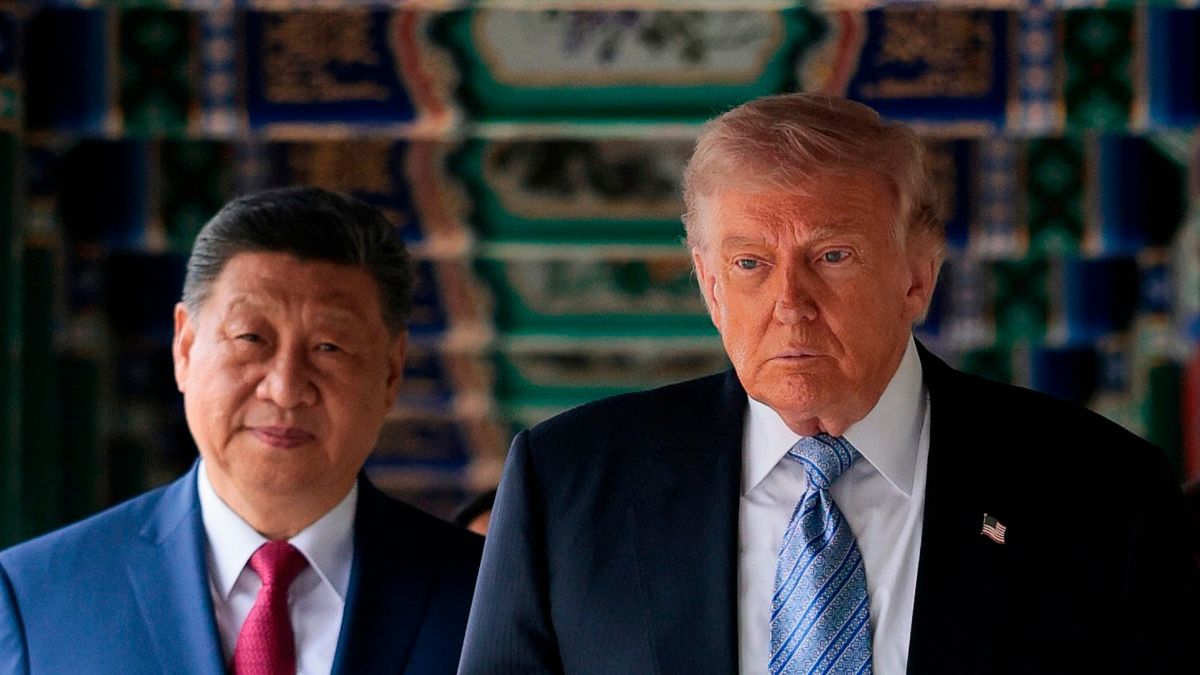
US President Donald Trump’s trip to China has laid bare not just differences in diplomatic style, but also the widening gap between Washington’s short-term transactional objectives and Beijing’s longer-term strategic ambitions. Throughout the two-day summit, Trump adopted an unusually deferential posture towards Chinese President Xi Jinping. In contrast to his often combative rhetoric on China during election campaigns and trade disputes, Trump repeatedly praised Xi as a “great leader” and appeared visibly captivated by the elaborate pageantry arranged by Beijing. Military parades, cheering schoolchildren and lavish receptions appeared designed to flatter Trump’s preference for spectacle and grandeur. His effusive body language reflected this warmth.
Xi, however, projected a far more restrained image. His demeanour remained measured, stoic and tightly scripted throughout the summit. Rather than appearing eager to accommodate Washington, Xi used the occasion to reinforce China’s self-image as a superpower capable of dealing with the United States on equal terms. Even the atmosphere in Beijing reflected this shift in confidence. Unlike during Trump’s 2017 visit, Chinese authorities made no effort to clear the city’s persistent smog or temporarily shut factories to create clear, blue skies for the American president.
The summit’s ceremonial highlights included a visit to the historic Temple of Heaven and an elaborate state banquet featuring fusion cuisine and cultural performances. Trump later invited Xi to visit the White House in September. Yet notable omissions underscored the narrowing scope of US-China engagement. Traditional American concerns such as human rights, democratic freedoms and climate cooperation were largely absent from public discussions, reflecting both Trump’s priorities and the increasingly difficult geopolitical climate.
Beneath the cordial atmosphere lay the summit’s central strategic fault line: Taiwan. Xi delivered a firm warning that Taiwan remains China’s ultimate “red line” and the most dangerous flashpoint in bilateral relations. Speaking at the Great Hall of the People, Xi cautioned that mishandling the Taiwan issue could push the two countries towards direct confrontation. His remarks reflected Beijing’s growing anxiety over deepening American support for Taiwan and rising military tensions in the Indo-Pacific.
While Trump focused heavily on personal rapport and economic deals, Xi repeatedly emphasised “strategic stability” and warned against the so-called “Thucydides Trap”, the historical pattern in which rivalry between a rising power and an established one leads to war. The contrasting official statements released after the summit highlighted these diverging priorities. The Chinese readout strongly emphasised Taiwan and long-term strategic stability, whereas the White House focused primarily on trade, agricultural purchases and cooperation on fentanyl trafficking, omitting Taiwan almost entirely.
Another major objective for Trump was securing China’s help in managing the escalating crisis involving Iran and the disruption of shipping through the Strait of Hormuz. China occupies a uniquely influential position in this context as Iran’s largest trading partner and the principal buyer of Iranian oil. Trump claimed Xi agreed not to provide military assistance to Iran and expressed willingness to help stabilise the situation.
China’s cooperation, however, appeared highly conditional and transactional. Beijing made clear it would continue purchasing Iranian oil and had no interest in helping Washington decisively weaken Tehran. China and Iran share a broader opposition to a US-dominated regional order, and Beijing sees strategic value in maintaining ties with Tehran. Analysts widely suspect China expects concessions elsewhere, particularly regarding Taiwan, in exchange for limited assistance in the Middle East. Speculation intensified after Washington delayed a proposed $13 billion military aid package for Taiwan shortly before the summit.
Economically, the summit produced modest agreements but fell well short of any transformative breakthrough in the trade war that has defined recent US-China relations. Both sides agreed to maintain the existing trade truce and establish a new “Board of Trade” mechanism intended to manage tariff disputes before they escalate further. Trump announced that China would purchase 200 Boeing aircraft. There would also be increased imports of American soybeans, oil and liquefied natural gas, though the aircraft order disappointed analysts who had expected a much larger deal.
Trump also arrived in Beijing accompanied by a high-profile delegation of American corporate leaders, including Elon Musk of Tesla, Tim Cook of Apple and Jensen Huang of Nvidia. Their presence highlighted how advanced technology has become the deepest and most sensitive battleground in the bilateral relationship. Artificial intelligence, semiconductor microchips and electric vehicles is now at the centre of strategic competition between the world’s two largest economies. Washington continues to impose strict export controls on advanced chips to slow China’s AI development, while Beijing accelerates efforts to reduce dependence on Western technology.
The summit also unfolded against the backdrop of escalating American punitive measures against China. In the weeks preceding the visit, the US Treasury sanctioned Chinese companies accused of purchasing Iranian oil and assisting Iran with satellite targeting data. Washington additionally accused Beijing of orchestrating large-scale theft of American artificial intelligence models and intellectual property.
Cybersecurity tensions have been simmering for some time now, brought to a head by claims that Chinese state-sponsored hackers have been systematically raiding American government databases. Washington has also moved to ban certain Chinese-made networking products from its markets — among them routers built by TP-Link—on the grounds that they pose an unacceptable risk to national security.
Things grew considerably more awkward when, just before the summit, a Californian mayor was arrested on charges of secretly working on Beijing's behalf. It was precisely the sort of episode that confirmed what many already suspected: that mistrust between the two countries has now seeped into virtually every corner of the relationship.
