



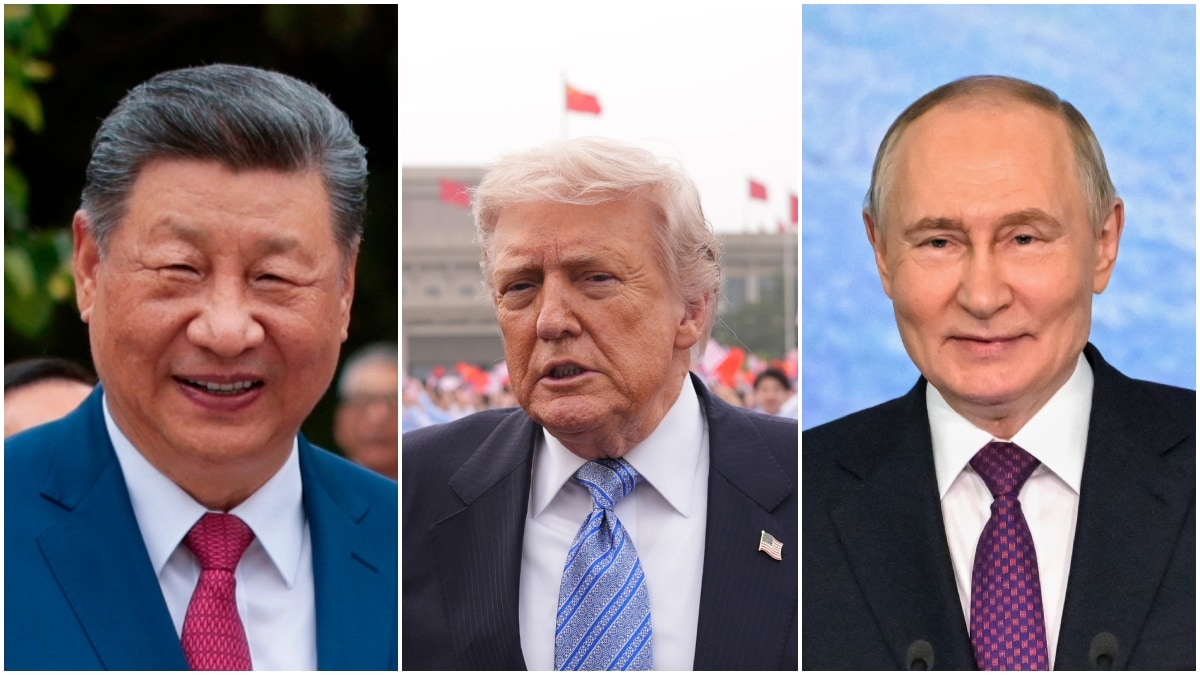
US President Donald Trump’s much-touted visit to Beijing from May 15–17, his second in nine years, together with his summit-level meeting with Chinese President Xi Jinping, has been described as a possible ‘G-2’ moment—darkly hinting at key US and China roles in deciding the destinies of nations as the world’s two most powerful countries.
But the ‘G-2’ moment wasn’t to be. It has a changed script now with the announcement that Russian President Vladimir Putin will visit Beijing, most likely on May 20. Of course, media reports attributed Putin’s visit as “part of Moscow’s routine dealings with Beijing”.
But facts indicate otherwise. It will be the first time Beijing hosts the US and Russian presidents in the same month outside of multilateral settings. Such high-profile visits are timed with a lot of thought and mean messaging and taking positions, rather than being a coincidence.
With the Iran conflict figuring as a core issue in talks between Xi and Trump, in all likelihood, the Chinese President and his Russian counterpart will take stock of what transpired in the Trump-Xi meeting. In February 2022, Xi and Putin signed a ‘no limits’ strategic partnership.
It is widely believed that the US has failed to meet its expectations of militarily pinning down Iran in a blitzkrieg-style attack jointly conducted with Israel from February 28 onwards. Iran has firmly stood its ground and actually scored a strategic victory by reinforcing its claims over the vital Strait of Hormuz, which remains blockaded. Faced with much-lowered domestic popularity, Trump, therefore, is on the lookout for a face-saving way out of the Iranian impasse.
En route to Beijing, US Secretary of State Marco Rubio told agencies: “We hope to convince them (China) to play a more active role in getting Iran to walk away from what they’re doing now in the Persian Gulf.”
Charting a U-turn on his earlier statement that he “did not believe he needed Xi’s help on Iran”, Trump later told reporters that he planned to have a “long talk” with Xi on Iran.
The implications are obvious. China and Russia’s stock and influence will go up in West Asia at the cost of the US. It also implies an increasingly multipolar world order. With the US on the back foot, China and Russia, both partners in BRICS, get a wider space to push for their de-dollarisation plan.
A multipolar world—something that India stands for and supports—will give more manoeuvring space to New Delhi, which vouches for strategic autonomy, a position where diplomacy and international relations are guided more by national interest than by anything else.
But a closer China-Russia relationship may also impact New Delhi’s military ties with Moscow if China persists in straining Russian deliveries of crucial items like components for the BrahMos missile and the S-400 air defence systems.
