



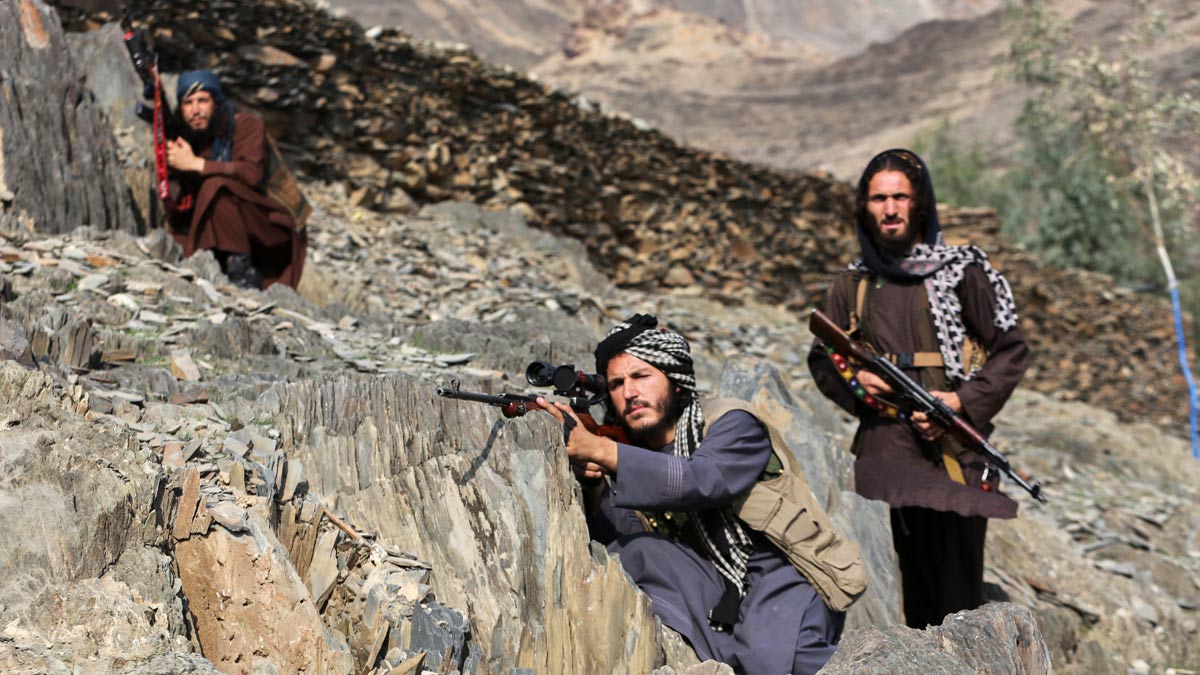
The Pakistan-Afghanistan tensions have flared up once again, this time as a full-blown war after Islamabad deployed its jets and heavy munitions onto the Afghan territory as a response to the Tehreek-e-Taliban Pakistan’s (TTP) incessant attacks inside Pakistan. The attacks, coined as Operation Ghazab lil-Haq, come with a loaded religious connotation to stake a higher moral ground vis-a-vis their Afghan co-religionists, similar to the term Fitna-al-Khawarij (named after the Khawarij, the fourth Caliph Ali’s supporters who later turned against him), a term used for the TTP.
From Former (and now court martialed) ISI chief Lieutenant General Faiz Hameed’s self-invite and tea sipping moment in Kabul to the present-day tensions, the clock has come full circle, and the entire Pakistani media is unanimous with the pressing question: ‘How dare the Taliban turn against us when we created and sheltered them’? On the contrary, Pashtun activists have been quick to point out the Pakistan Army’s dealings with the TTP in the Musharraf era, where the latter were empowered to fight the Americans, till they turned against the Pakistan Army.
Two key factors heavily weigh on the bilateral ties, namely the broader politics around Afghanistan’s historical rejection of the Durand Line, and the Afghan Taliban’s support for the TTP, which has led to the present fighting. If there are any lessons to be drawn from the war-scale fighting between Pakistan and Afghanistan, it is the relegation of history that resurfaces in myriad aspects of the Pak-Afghan ties. As an inheritor of the Durand Line, Pakistan, since its creation, has attempted to rewrite the Pak-Afghan frontier’s history by tying the Pashtuns to a larger cause of faith.
Let us return to late 1946, when Pandit Nehru, as the newly appointed head of the interim government and head of the External Affairs Department, undertook a visit to the NWFP. The Muslim League, which had gained ground across India after the Direct Action Day, was successful in turning the Pashtun tribesmen against him, despite the presence of the Congress-Khudai Khidmatgar coalition government in the province. In Malakand, Nehru, along with Khan Abdul Ghaffar Khan, came under attack from the locals and survived a brick attack on his head. He even travelled across the FATA region, including Waziristan’s Miranshah, Wana and Razmak. The overall attitude of tribes was hostile to Nehru, as the Muslim League convinced them that an imperialist Hindu was all set to rule them once the British left.
Later, in July 1947, the Muslim League won the referendum in the NWFP. Broadly, two factors consolidated the Muslim League’s position among the tribes: the first being the 1947-48 Indo-Pak war in Jammu and Kashmir, which was framed as a Holy War and was followed by the mobilisation of the Pashtuns to invade Kashmir. It is worth noting that besides Punjab and NWFP’s seminaries, prominent clerics of Kabul were also drawn into opposing Jammu and Kashmir’s accession to India. The second factor was Jinnah’s promise of autonomy to the FATA region, along with his personal assurance to the Afghan leadership, given the shared culture and familial ties. Jinnah’s concerns had a context; as its name suggests, the FATA region was administered separately from the NWFP, and till independence, the British faced waves of resistance from the FATA tribes, who resisted any attempts to be controlled. The jolt in Afghan-Pak ties came early in 1949, when Pakistan’s second Governor General, Khwaja Nazmuddin, gave a statement that the FATA was part of Pakistan.
The other problem pertained to Pakistan’s own anxieties on the Pashtunistan narrative, which it claimed was an Indian conspiracy with Bacha Khan and Afghan support. Pakistani newspapers carried accusations of India’s involvement in the NWFP through the Fakir of Ipi, a tribal mystic, who first fought the British, and later the Pakistani state. Both countries came to the verge of a war in 1949 after Pakistan Air Force carried out aerial bombardments in Afghan territory adjoining the FATA region to punish the Fakir and his followers. The Fakir is also said to have written to Nehru immediately after independence seeking India’s support, and his opposition to Pakistan in the FATA region also thwarted an effective mobilisation that could have potentially inflicted more damage in Kashmir during the tribal invasion of 1947.
The incorporation of both, NWFP (presently Khyber Pakhtunkhwa) and the Tribal Areas (former FATA region), into Pakistan was thus not without its set of complications, and naturally dragged Afghanistan into these problems.
In the Cold War years, as the Soviet Union came to interfere in Afghan politics, Pakistan found a natural alliance in the Islamist movements that challenged communism and cut across ethnic lines. The ISI worked with most of the influential warlords of the Afghan Jihad until it found the best bet in the Taliban in the 1990s. The Pakistani deep state’s confidence stemmed from its perceived influence on the Taliban through the Deobandi connections and its safe havens, but it could never get the Taliban to accept the Durand Line or support the Pakistan Army’s policies in KPK.
Since its creation, the two instances where Pakistan had unanimous support of the Pashtuns were first, when they were persuaded to unite and fight for Kashmir, and later during the Soviet invasion. These episodes, however, could not change the history of the Afghan frontier. The purpose of mentioning the specific towns where Nehru visited in 1946 is to recall that these very places emerged as home to much of TTP’s leadership, and to date continue to distract the Pakistan Army despite its mammoth operations for two decades.
This article does not intend to exonerate or question Nehru’s choices, but it certainly confirms a foreboding that the forces of history often manifest in silence.
Prateek Joshi has completed/defended his PhD from the University of Oxford, where his research looks into the early years of Indian foreign policy.
