



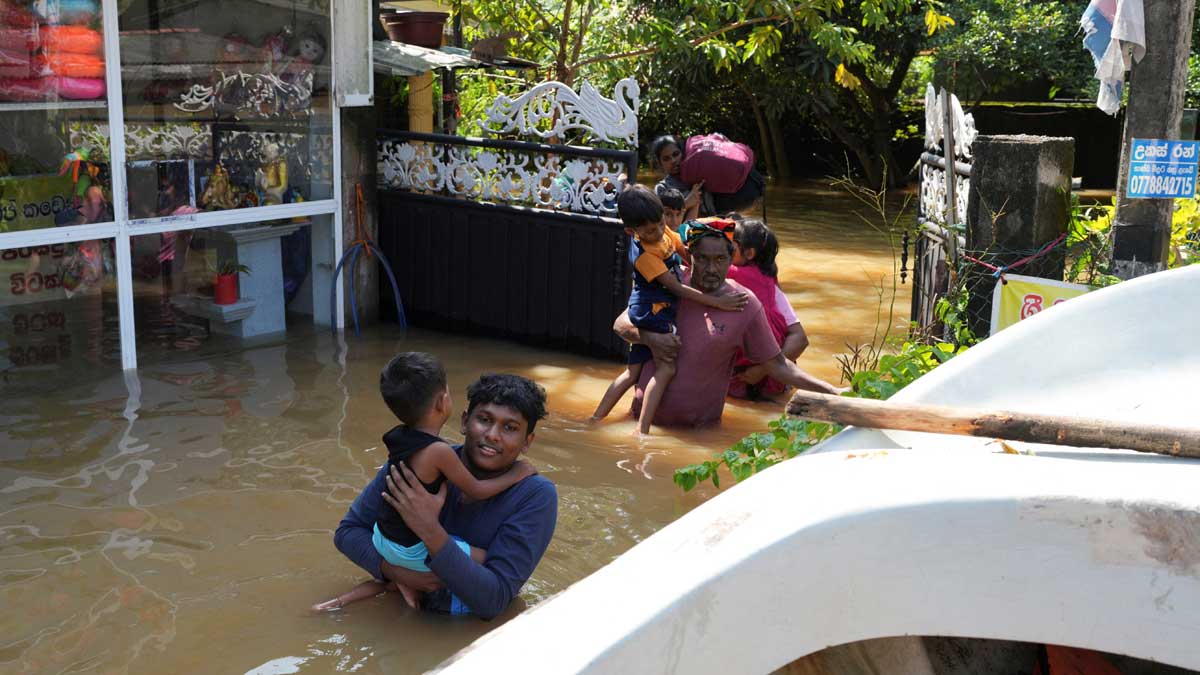
Cyclone Ditwah has devastated Sri Lanka, leaving at least 334 people dead and more than 400 people missing. Several neighbourhoods in 20 of the total 25 districts have been buried under mud as the country grapples with one of its worst natural disasters in the past one decade.
Over 20,000 homes in districts like Kandy, Badulla, Nuwara Eliya, Matale and Anuradhapura have been destroyed, sending around 1,08,000 people to temporary shelter homes run by the government. The hardest-hit districts include Gampaha, Colombo, Puttalam, Mannar, Trincomalee and Batticaloa, while deadly landslides in the central hill country have devastated Kandy, Badulla and Matale.
“20 out of the 25 districts in Sri Lanka have been severely affected by Ditwah. This is the first such devastation the country has faced in the past three decades. The administration is working in full swing,” a senior official in the disaster management department told THE WEEK over the phone from Colombo.
Several fatalities have been reported in the tea estates of Nuwara Eliya and Kandy, while Matale and Badulla are grappling to come out of the severe mudslides. Over 11 lakh people have been affected, and more than two lakh people have been displaced and shifted to temporary shelters.
“A third of the country is running without electricity and water. Rescue and relief measures have turned very difficult as the devastation is more than what we expected. The cyclone has brought multiple landslides in the hilly areas, making the rescue and relief operations very challenging,” the officer explained.
He said that the damage assessment turned difficult as most of the habitats, particularly the line rooms which housed several lakh people in Nuwara Eliya, working in the tea estates, collapsed or were buried under soil.
More than 24,000 army and police personnel have been deployed to carry out the rescue operations, who are still trying to reach families left stranded by floods and landslides.
While Nuwara Eliya is completely damaged, Kandy, which houses the most popular tooth relic temple and the headquarters of the Sinhala Buddhist chapters, is grappling with floodwater. The dark clouds have given way, but the water is yet to recede. “We will be able to reach certain places for rescue operations as the rains have stopped,” the official explained.
Over 200 roads remain impassable, while more than 10 bridges and a section of the rail network have been damaged. The national power grid is affected, plunging the country into darkness. Flooding along the Kelani River, which runs through Colombo and surrounding low-lying areas has led to major damage and complicated rescue and relief operations.
On Saturday, President Anura Kumara Dissanayake declared a state of emergency to deal with the aftermath of the cyclone. In a televised address, Dissanayake appealed for international help and said that “every life lost is not merely a number. Every life carried a name, a face, and a story,” he said.
While the international aid agencies are on the ground, India, Sri Lanka’s closest neighbour, was the first to respond through ‘Operation Sagar Bandhu.’ India sent its IAF aircraft with relief materials to the affected people.
Chetak helicopters from INS Vikrant airlifted several stranded people to secure locations, while MI-17 helicopters from IAD conducted search and rescue operations near the inaccessible Kotmale area, saving stranded persons, including pregnant women, infants, and those critically injured.
The IAF helicopters rescued stranded people from many nationalities, including Sri Lanka, India, Germany, Slovenia, the UK, South Africa, Poland, Belarus, Iran, Australia, Pakistan and Bangladesh and also airlifted Sri Lankan Army personnel to landslide-affected regions.
“National Disaster Response Force (NDRF) teams, India’s specialised Disaster Response Agency for Search and Rescue and HADR activities, who arrived in Colombo, carried out rescue operations in Kochikade, Colombo, working closely with Sri Lanka authorities. Further, NDRF teams are now working in the Puttalam and Badulla areas, which are severely impacted and cut off. NDRF assisted families affected by severe flooding and helped ensure their immediate safety,” a press statement from the Indian High Commission in Colombo said. About 750 Indian passengers have been evacuated from Sri Lanka to Thiruvananthapuram and later to various cities in India.
“It will take several years for us to come out of the damage caused by Cyclone Ditwah. The administration was not prepared to handle such devastation. The government did not anticipate this,” the official pointed out.
