



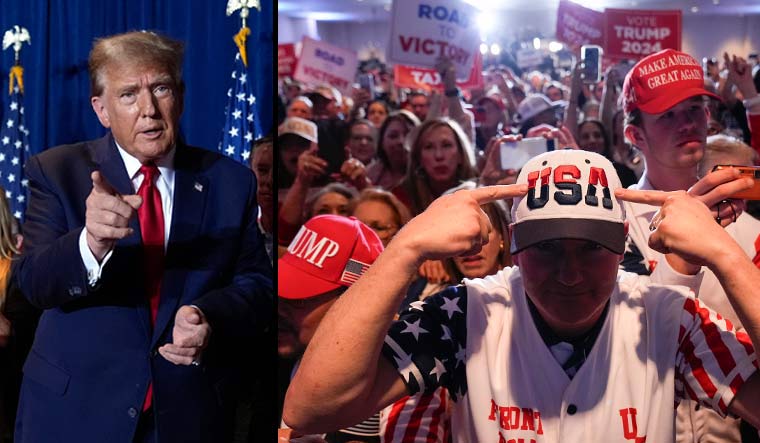
The decision by the US Supreme Court to accept the Trump v. United States case for review and delay its resolution until after the 2024 presidential election has plunged the United States into an existential crisis with far-reaching implications for the future of democracy, both in America and around the world.
In a move that has left democracy advocates worldwide stunned and outraged, the US Supreme Court has effectively enabled Trump’s election delay gambit, denied the American people their right to make an informed decision in the upcoming 2024 presidential election.
Scheduling to hear Donald Trump’s audacious claims of immunity from prosecution for his efforts to overturn the 2020 election postpones the start of his criminal trial in Washington D.C. The Court has handed the former president a significant strategic victory.
Trump’s naked aim has been to stall each of the criminal cases against him until after the 2024 election. The calculation is that recapturing the White House would allow him to install an attorney general to make the federal investigations disappear. While legal experts dismiss Trump’s immunity assertions as fanciful, the gambit has now succeeded in bogging down prosecutions to run out the clock.
Even with Supreme Court arguments slated for late April, Trump’s cases remain frozen. If the Court deliberates until June or July before issuing an opinion rejecting his immunity claims, any subsequent trial would be pushed into the height of election season.
There is outrage at the prospect that Trump will exploit his unprecedented delay tactics to evade judgment from voters before they head to the polls.
Make no mistake, the Supreme Court’s accommodation of Trump’s transparent stalling strategy effectively enables his assault on accountability. Although the justices are within procedural norms, the consequence is granting cover for a criminally accused former leader to escape public scrutiny as he seeks a return to power.
At the very least, the move leaves the feeling of a surrender of judicial duty to political interests that ill serves justice and democracy.
The Court had an opportunity to nip Trump’s delay gambit in the bud. Instead of allowing his legally outrageous immunity bid to linger, the justices could have swiftly dismissed it as an affront to constitutional order and the rule of law.
By failing to do so, the Court is passively abetting Trump’s quest for impunity and subversion of the integrity of elections by denying the public’s right to know about the legality of his previous actions. This jeopardizes bedrock principles America claims to champion worldwide.
This choice of delay, made through a discretionary decision by the court's conservative majority, raises fundamental questions about the judiciary's commitment to upholding the rule of law and providing clarity to the American people during a crucial election year.
Without prosecution on the criminality of the former president, voters face a distorted choice at the ballot box. The lack of resolution effectively shields Trump from public judgment regarding his conduct in office. This denial of transparency and accountability contradicts the foundations of an open democracy. It degrades civic discourse and breeds ever more brazen abuses of executive power.
Even more alarming is the prospect of Trump successfully winning reelection in 2024 before any immunity arguments are rejected.
By its action the court makes it likely that voters will head to the polls without crucial information about the legal consequences of electing a candidate who may have committed disqualifying crimes in the minds of many voters and who claims absolute immunity from criminal prosecution. This would consolidate lawlessness and further erode checks on his actions.
With democratic institutions already battered by Trump’s turbulent past presidency, many fear a point of no return where election outcomes cease to matter as constitutional norms collapse. By delaying any verdict, the Supreme Court is exacerbating this looming threat.
In the cauldron of a hot political contest, this calls into question America’s commitment to the rule of law by providing cover for an authoritarian-minded leader seeking to return to power in order to stop his own prosecution on the 91 criminal indictments he faces.
The delay gambit abuses the justice system itself as a shield against consequences for illegal action. While most criminal defendants seek swift resolution of charges, Trump wants to drag proceedings out indefinitely. This brazen attempt to avoid a reckoning corrupts judicial process into a weapon for delaying and denying justice.
Trump is able to maneuver the courts in ways unavailable to ordinary citizens because of his wealth and connections and a lifetime of out-moneying and out-timing legal issues. He can afford extensive legal motions and appeals to bottleneck lawsuits and run down the clock.
The backstory: Trump’s bid for absolute power
To appreciate the gravity of the current situation, some background is helpful. The case of Trump v. United States originated from legal actions taken against Donald Trump stemming from his conduct as president and his role in the January 6, 2021 insurrection.
As investigators began building cases against Trump, his legal team floated the theory that a former president cannot be charged with crimes committed while in office, a claim so extreme that legal experts give it no chance in law, characterizing its argument that since it is not specifically banned in the Constitution a president should have unlimited immunity as a pragmatic manner.
Trump’s aim, however, is not to win but to tie up the courts in order to delay the time of his trial because as a presidential candidate and potential winner of the elections, under the American system, he would have the ability to stop all criminal investigations and court actions against himself and even pardon himself, effectively ending any accountability.
This claim of lifelong immunity was robustly denied by a lower court and widely panned by legal experts as an absurd overreach and an attempt to place the president above the law. In a bid to shield Trump from accountability, however, his lawyers appealed to the Supreme Court to enshrine this radical theory as settled constitutional law. Many observers expected the Supreme Court to swiftly reject such an obviously anti-democratic assertion.
The vision of an unaccountable president operating with impunity flies in the face of the Constitution and the rule of law. The fact that the Supreme Court is taking this argument seriously enough to grant certiorari –and a strategic delay to Trump– rather than to affirm a decision that the court itself is expected to mirror, speaks volumes about the precarious state of US democracy and has chilling implications.
By postponing decisive action, the Supreme Court denies American people the timely understanding of whether Trump as president and afterward operated beyond the law. Voters are now deprived of essential facts as they consider candidates for their nation’s highest office.
In effect, the likely outcome is that Trump and the lawlessness for which he stands indicted will escape court scrutiny on his way to reclaiming the White House.
By granting Trump extraordinary deference, the Court signals that Trump’s raw power and audacious defiance of norms now reign supreme over bedrock democratic principles and institutional constraints on authority. This is an exceedingly dangerous development at this point in American history.
A threat to democratic values
At the very least, the Court appears swayed by Trump’s powerful demagoguery instead of dismissing it outright. This calls into question the judiciary’s ability to be an impartial check on authoritarian power grabs. And it leaves America’s global standing as a champion of rule of law, open democracy, and human rights severely damaged.
Many see the Court’s certiorari delay as a baldly partisan maneuver by Republican- and Trump-appointed justices aimed at protecting Trump and his allies from accountability. This perceived politicization of the judiciary undermines the legitimacy of not just the Supreme Court but the American Court system in general.
America at an existential crossroads
With this, the Supreme Court has placed the United States at an existential crossroads with its commitment to democracy in question.
Will the nation live up to its ideals of equality under law, or will America go down the dark road of charismatic strongmen operating with impunity? The implications of Supreme Court action could not be more consequential.
By postponing any ruling on Trump’s legally shaky immunity claim, the very US Supreme Court has made this doomsday scenario more likely.
The critical importance of judicial independence
America prides itself on leading the free world. But this lofty role rests on the nation’s commitment to justice, transparency and reasoned deliberation. By enabling the delay in the criminal prosecutions against Trump, the Court reflects a dangerous erosion of principles in a nation long considered the gold standard for liberty. The Court has all but guaranteed a clouded if not compromised electoral process and a continuing threat to American democracy.
Global consequences of America’s retreat from justice
The stakes of the Supreme Court’s decision are not limited to America alone. This resolution of charges against Trump are closely watched around the world as judgment on the resilience of US democracy. The Court’s apparent capitulation in the face of Trump’s strongman tactics is an ominous signal heard worldwide.
America has long declared itself a shining city on a hill and reprimanded tyrannical regimes abroad. But this moral authority now rings hollow as Trump tramples legal restraints and the Supreme Court fails to rein him in. US global leadership and influence cannot be separated from its domestic commitment to justice and democratic principles.
For the world, there are also profound geopolitical implications. A United States untethered from the rule of law risks destabilizing alliances, emboldening adversaries, and creating a power vacuum quickly filled by dangerous actors. It forfeits soft power and legitimacy on the global stage. The world grows more hazardous as America abandons its long-stabilizing role as anchor of the liberal democratic order.
In democracies and authoritarian states alike, politicians are carefully monitoring Trump’s delay, delay, delay tactic against accountability as surging blueprint.
Even the perception that the US’s most powerful court appeasing a defiant strongman signals that the law will bend to accommodate the powerful who trample it, not restrain them. This contagion endangers democracies worldwide already backsliding toward populist nationalism and minority rule.
Determining democracy’s future course
Looking ahead, much remains uncertain as America reaches a dangerous political crossroads. Will the nation reaffirm its commitment to justice, human rights and the rule of law at this crucial hour? Or will expediency and cynicism prevail to drive a final stake through the heart of America’s democratic experiment?
The world is watching and waiting to see whether the United States steps back from this constitutional cliff or slides further toward uncharted autocratic terrain. Other nations face their own daunting democratic tests in the years ahead. But America remains the indispensable nation, whose example is followed globally for good and ill.
As the eyes of the world focus on the unfolding constitutional drama, the question in the air is whether the great nation can steer the ship of state through stormy waters back to democracy's safe harbor. How this will affect global democracy is in the balance.
The views expressed in this article are those of the author and do not purport to reflect the opinions or views of THE WEEK.
