


A New York Times article, while critiquing the 2024 edition of the Venice Biennale for being too preachy, made an important observation—that we are all quick to point out the problem without being willing to do the heavy lifting necessary to solve it. “In the domain of rhetoric, everyone has grown gifted at pulling back the curtain,” it said. “An elegant museum gallery is actually a record of imperial violence; a symphony orchestra is a site of elitism and exploitation…. But when it comes to making anything new, we are gripped by near-total inertia.” In our case, the country’s largest and South Asia’s longest-running contemporary art biennale—the Kochi-Muziris Biennale (KMB)—was beset by financial and organisational woes, and detractors were quick to write it off.
After its first edition in 2012, the Kochi Biennale Foundation that hosts the event was in a debt of 6.5 crore. Things came to a head with the 5th edition in 2022, curated by Singapore-based artist Shubigi Rao. It seemed like Murphy’s Law—that everything that can go wrong will go wrong—seemed to be playing out right in front of the organisers’ eyes: shipments delayed in transit and at customs past the opening day; confusion regarding the sale of one of the main exhibition sites, Aspinwall House, to the government; delay in opening due to the pandemic; rain harming many of the exhibition spaces; lack of funds to pay the workforce; a lack of steady electrical power; and an open letter from the artists asking the biennale management to move away “from a system of accepted dysfunction, structural helplessness and fear of failure….”

“I was a jury member at the Singapore Biennale just before KMB started,” says Bose Krishnamachari, one of the co-founders of KMB and president of the Kochi Biennale Foundation. “Some of the artists’ works were in transit and had not yet been installed, but no one made any fuss about it, unlike here, where most of the problems were caused by maybe four artists.” He contrasts it with the first edition of KMB, when contributing artists like Vivan Sundaram, Subodh Gupta and Anish Kapoor paid out of their pockets to ensure that the event was a success.
Before the politics behind the art, like a rising tide, could submerge it, something had to be done. And that, in a way, is what the ongoing edition of the KMB is about: placing art at the centre once again. It has been an attempt at healing, a quest for redemption. For that, the organisers seem to have decided to go on the offensive instead of being on the defensive. The sixth edition, curated by Nikhil Chopra and HH Art Spaces, Goa, returns bigger than ever, with the work of 66 artists/collectives displayed across 22 venues, apart from parallel shows like the Students’ Biennale, Edam (a show by Malayali artists) and Art By Children. Of the Rs30crore budget, Rs7.5 crore was promised by the Kerala government.
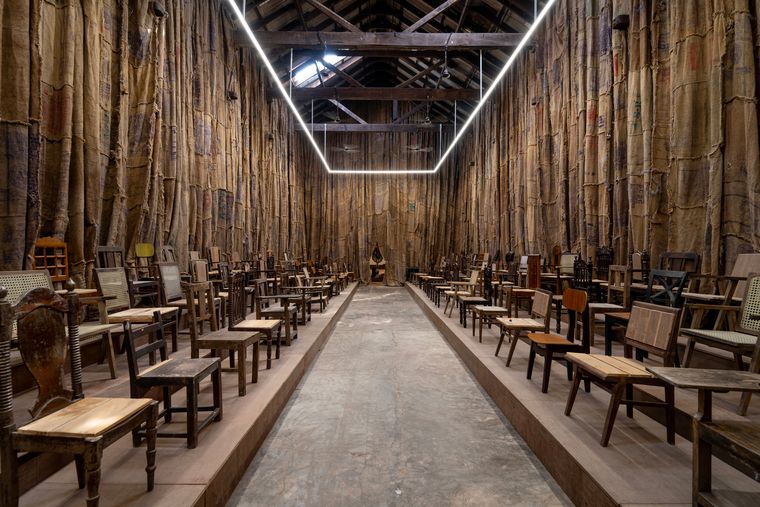 Overturning hierarchies: Ibrahim Mahama’s Parliament of Ghosts | Kochi Biennale Foundation
Exploring the biennale is like visiting another world—one where hierarchies are overturned and the view is bottom-up, rather than top-down. The voiceless are given a voice, and the world is turned off-kilter just for the time it takes you to see it from its underside.
“A biennale is an opportunity to bring to the forefront practices that have existed outside the mainstream and hegemonic powers,” says Chopra. “It is a moment to recognise the subaltern and the marginalised, what sits on the borders and the boundaries. If we have been asked to invite 33 artists from the subcontinent, I’m going to go as far to the border, because there is a politics embedded in that as well, which is why there are artists from Kashmir, Assam, Nagaland and, of course, Kerala at this biennale.”
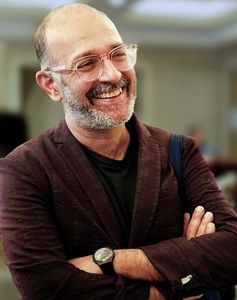 Nikhil Chopra | Kochi Biennale Foundation
Take, for example, Assamese artist Dhiraj Rabha’s exhibit, The Quiet Work of Shadows. Part documentary, part installation, Rabha creates a garden of flowers, with eight watchtowers overlooking it modelled on the surveillance structure found in every United Liberation Front of Asom (ULFA) camp. The watchtowers hold video displays of conversations with former ULFA members, each sharing their stories of loss and violence. The work is a commentary on the impact of decades of insurgency on Assam and its people.
“Because of me, my mother and my wife had to suffer torture, so I had to return,” says one of them. “We took an oath with a bullet in our mouth that we will give our lives for the movement, but we failed. Now we are like the antlers of a dead deer.”
Some distance away, at the Anand Warehouse in Fort Kochi, is another striking work—Ghanian artist Ibrahim Mahama’s Parliament of Ghosts. Mahama furnishes a room with rows of discarded chairs from public institutions. Unlike the parliaments of the world—neoclassical spaces of supremacy—his parliament is built with materials from the second-hand markets of Kochi. It is a striking subversion of power to give voice to labourers who are usually left out of political decision-making. The project originally stemmed from an exploration of the promises of Kwame Nkrumah’s government in Ghana right after independence, which remain unfulfilled following several political and military coups.
But for Chopra and his team to be able to do their work, there was an army of players—from sponsors and trustees to legal advisers and auditors—working silently behind the scenes. First, the organisational structure had to be overhauled so that they could pay off old debts and start this edition on a clean slate. The benefactor and patron programmes were instituted, where each platinum benefactor would contribute Rs1 crore every year for five years, and each platinum patron would contribute Rs1 crore for this edition of the biennale. There are gold, silver and bronze benefactors and patrons as well.
“We are surrounded by so much divisiveness, disinformation and hate, and are hurtling from a vibrant, colourful and multicultural past to an increasingly monocultural future,” says Mariam Ram, trustee, Kochi Biennale Foundation. “It is more important than ever to seek spaces that promote and showcase the multiple cultures of India and the world as seen through the beauty and thoughtfulness of the arts. I think this is the reason to support the KMB, with its respectful irreverence and creative disruption, and to ensure its future.”
The organisers also brought in new auditors and consultants. Dr Venu V., former chief secretary of the Kerala government, came in as chairperson of the Kochi Biennale Foundation and Thomas Varghese, who had previously worked with the United Nations Economic and Social Commission for Asia-Pacific in Bangkok, as its CEO. “One of the weaknesses of the biennale over the years was that we did not build a strong institutional framework,” says Venu. “We were not a good professional organisation. We did not invest in a robust structure. We always had a fund crunch so it was difficult for the foundation to find the money for a full-time workforce.”
The organisational restructuring has proved effective in enabling the biennale to restore its original vision—of celebrating contemporary art from around the world by invoking the historic, cosmopolitan legacy of Kochi. As Riyas Komu, one of the co-founders of the biennale and co-curator of the first edition, said earlier, it is easy to quantify the economic benefits of the biennale, but not so much its wider socio-cultural aspect. “There is no cultural audit, and nobody has actually looked into its effects,” he said. “But there is a great energy coming in; it is like an acupuncture that is happening in Kochi….” He could not have put it better. It is something in the air which must be felt to be understood, like the smell of sea salt on the shores of Kochi. It is something more than the 1.6 lakh visitors who came this December to view the biennale. Something more than the increase in tourism or the locals of Kochi who have made it the ‘people’s biennale’. Something more than the ‘Guggenheim Effect’ of what a landmark cultural building or event can do to revitalise a city.
Perhaps it is about the shift in perspective that art always brings, a new way of picturing the world. As Shabana Faizal, vice chairperson of KEF Holdings and one of the platinum benefactors of KMB, put it, “Art helps us understand what is happening around us, question it and reflect on who we are.” It helps us see what’s near by taking us afar. It shows us the new by unveiling the old. It alienates in order to explain, binds in order to set free.