



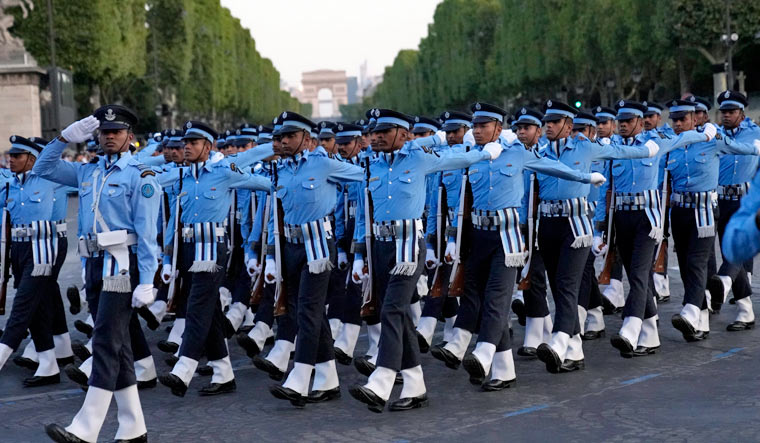
India’s bilateral ties with France are much more deeper and profound than the expected deal to buy the about 30 Rafale M fighters for the Indian Navy or the likely order for three more Scorpene Class submarines—pacts likely to be inked during Prime Minister Narendra Modi’s three-day-long France visit beginning Friday.
Of course, the icing on the cake would definitely be aero-engines to power India’s still-in-the-works fifth-generation Advanced Medium Combat Aircraft (AMCA) if France is found willing to supply a 100 per cent technology transfer.
One of India’s earliest strategic partners—more so in the military, aerospace and civilian nuclear domains—France has maintained consistency in its India ties throughout the past decades.
The India PM’s July 14-16 visit to France will mark the 25th anniversary of the India-France Strategic Partnership and would be, as an official source put it, an “opportunity to chart the way for the next 25 years, coinciding with the 100th anniversary of India’s independence in 2047”.
The source added that “ambitious outcomes” are expected on defence, space, geostrategy, infrastructure, energy, climate action, museology, student mobility, people to people, sports, culture, and other verticals.
No doubt, the framework of the upcoming India-France agreements would have already been cleared during the July 6 India visit of Emmanuel Bonne, the diplomatic adviser to French President Emmanuel Macron, during his meetings with India’s National Security Adviser Ajit Doval.
PM Modi will grace the Bastille Day celebrations as the Guest of Honour even as a tri-services contingent from India will participate in the French National Day or Bastille Day parade.
Interestingly, the Indian contingent will also include a fly-past by four IAF Rafale fighters and two C-17 ‘Globemasters’. The Rafale fighters were fuelled by IAF’s IL-78 mid-air refuellers en route to the Evreux-Fauville air base in France.
A most important day in the French consciousness, the French National Day commemorates the Storming of the Bastille Prison in 1789 during the French Revolution.
Considered a massive market with more than 17 per cent of the world’s population, India has a huge 15-lakh-strong military that is being modernized at a dizzying pace while focusing on indigenisation.
In 2021, after the US ($800 bn) and China ($293 bn), India ($77 bn) was the world’s third largest military spender.
According to the SIPRI fact sheet of March 2022, in the five years from 2017-21, India was the biggest weapons importer in the world accounting for 11 per cent of the total global arms import.
Between 2012–16 and 2017–21, Russia’s share of total Indian arms imports fell from 69 per cent to 46 per cent, according to SIPRI data, while that of France increased about eleven-fold.
In effect, for 2017–21, France became India’s second-largest arms exporter after Russia. Notwithstanding the disclaimer that India’s total imports also fell because of its indigenisation plan.
The SIPRI report says: “France’s arms exports to India in 2017–21 were almost 11 times higher than in 2012–16 and reached their highest level for any five years since 1950.”
What helps is that French military hardware in India has a legacy factor. Not just the Mirage 2000 multi-role fighter aircraft from the Dassault stable, there have been the ubiquitous ‘Chetak’, ‘Cheetah’ and ‘Cheetal’ helicopters in Indian military service that had their origins in the French ‘Alouette’ and ‘Lama’ helicopters.
And before the big-ticket six Scorpene submarine deal of 2006 and the Rafale aircraft deal of 2016 for 36 platforms, there were French diesel engines for submarines and ships, anti-submarine warfare sonars, radars, the ‘Milan’ anti-tank missiles, the list is a long one.
At a time when global strategic equations are being re-drawn in the backdrop of the ongoing conflict in Ukraine, in a silent but significant way, France is positioning itself as the most important supplier of military equipment to India.
Therein lies the importance and significance of the Indian prime ministerial visit to Paris.
