



There was a time when Al Capone could commit serious crimes in Chicago and cross state lines into the neighboring state of Wisconsin and away from the arms of the law because law enforcement agencies had limited jurisdiction outside of their respective states. This made it easy for criminals like Al Capone to evade arrest by simply staying across state lines. Capone’s house still stands on 55th Street of the Wisconsin border town of Kenosha.
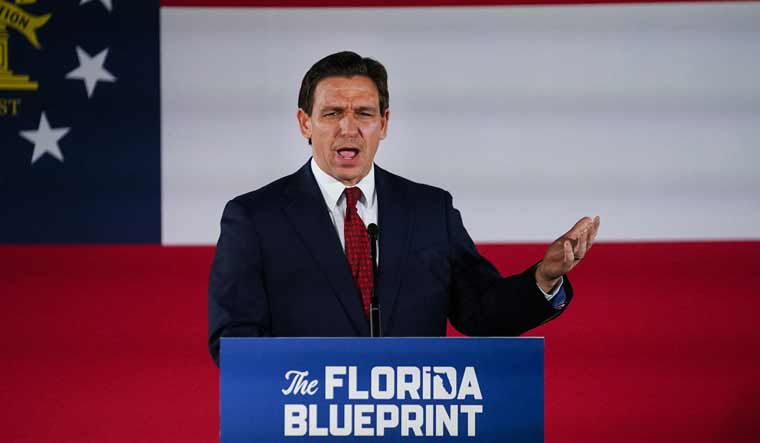
In the wake of the New York state indictment of Donald Trump, Florida governor Ron DeSantis moved to turn the clock to the days of Capone’s interstate bootlegging and racketeering by declaring that his state, where Trump keeps his Mar-a-Lago home “will not assist in an extradition request given the questionable circumstances at issue” with Manhattan District Attorney Alvin Bragg and his “political agenda.”
Theoretically, that would allow Trump to refuse to turn himself in on Tuesday in Manhattan and, try to avoid prosecution, Al Capone-style, across state lines. Even that remote—and quite unlikely— possibility is a stunning turn for the two men, Trump and DeSantis, who have made a political career of claiming to be the candidates of “law and order” as much as has their Republican Party, to be part of this fantastical speculation.
DeSantis's justification that the decision was made due to "questionable circumstances at issue" and "political agenda" by Manhattan District Attorney Alvin Bragg is a naked display of political farce and cynicism.
“How stupid do you think we are,” is the question by news anchor Erin Burnett that CNN replays on its promos, channeling its audience’s skepticism and disbelief when politicians attempt to bamboozle their constituents.
Well, people gathered along the streets leading to Mar-a-Lago waving flags and expressing support for the former president, shouting cries of “Political persecution!’’ days before anyone finds out the actual charges and evidence against Trump.
It is indeed a shocking move by the Florida governor, making a law enforcement declaration that should raise fundamental questions about his own integrity, placing political positioning above the law for his political benefit.
In a volatile post-Trump political climate, DeSantis drew the line outside the law and the Constitution of the United States to further his standing with Trump supporters: He wins the Republican political hyperbole steeplechase; the lines are drawn, and the stakes are high.
It should be noted, however, that extradition from one US state to another is governed by the United States Constitution's Extradition Clause, which requires states to honour valid requests for extradition from other states, in fact defining the “united” part of the United States name. One state cannot go against another in the enforcement of the law. If a state fails to honour a valid request for extradition, the state seeking extradition may take legal action to enforce compliance.
In fact, American law is tired of antics of the likes of Capone back in 1919 when Congress passed the Dyer Act—a federal statute that began by making it a crime to transport a stolen vehicle across state lines and then expanded its scope to include a wide array of criminal activities, making it possible for federal authorities to pursue and prosecute across state lines. It is a hallmark of federal law enforcement across the US.
Another hallmark of US justice has been the impartiality of the justice system and the ability of prosecutors to carry out their duties without political interference. By claiming that prosecutions against Trump are politically partial De Santis and other Republicans give the world a glimpse of the kind of world they envision, a world where justice is decided by political power that quite literally places their kind above others.
Functionally, however, Trump, who is entitled to Secret Service protection as a former president who had access to some of America’s most sensitive secrets, is unlikely to be able to do anything other than to follow the law and to present himself for his arraignment in New York. The Secret Service is there to protect his safety, but it is a law enforcement agency, and its ultimate charge would be to cooperate with other US law enforcement bodies.
In a country that has for nearly 250 years paraded itself and its values as examples to the rest of the world, it is nonetheless astounding to see the political cynicism of Republican partisans so prominently at the centre of the American discourse around the indictment of its former president on criminal charges.
Newly minted Speaker of the US House of Representatives and third in line for the presidency Kevin McCarthy, called for an investigation of the prosecutor.
Trump’s vice president, targeted by the January 6 mob who wanted to “hang him” spurred by Trump’s words and tweets, shook his head in righteous outrage while speaking with CNN’s Wolf Blitzer; he attacked the prosecutor and said the “unprecedented indictment of a former president of the United States on a campaign finance issue is an outrage,” going on to say, without a hint of cynicism, that “the American people have had enough of that kind of ‘two-tiered justice system.” It is one more example of the criminalisation of politics, said Pence.
South Carolina Senator Lindsey Graham who as an impeachment manager against Bill Clinton famously called on the House floor for the conviction of Clinton arguing that “impeachment is about the cleansing of the office,” was this time sporting a different kind of outrage on FOX News as he called the indictment “legal voodoo,” and “bullshit” before going on to fundraise for the billionaire, “Give the man some money so he can fight!”
The fight that Trump may have in mind can be deducted from his words in anticipation of the indictment when he warned of “death and destruction.” Authorities, conscious of the effect of his words on January 6, have reinforced protection around New York.
Still, more Republicans at all levels —with very few exceptions— are rushing to microphones to attack the indictment and the prosecutor, even before the full facts are known, all seemingly unaware that even Capone's criminal activities eventually caught up with him.
In 1931, Capone was convicted of tax evasion and sentenced to 11 years in prison. So was the end of his reign as a powerful crime boss.
