



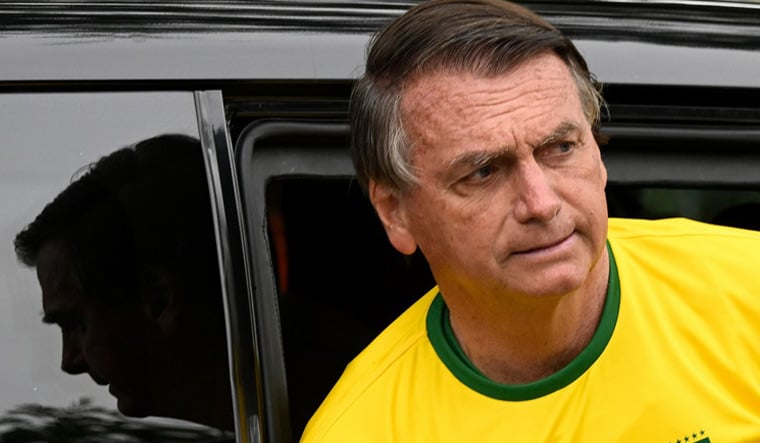
Brazilian president Jair Bolsonaro disappeared from public view and online comments for 20 days after the election loss. Now, he has signed on to challenges to the election results and is suddenly resuming a public presence with a scheduled appearance at a military installation surrounded by his supporters. His son had a meeting with Trump in Florida. What is he up to?
What are his options?
Bolsonaro rode into power in Brazil in 2019 on wave of resentment and embarrassment and a theoretical vision to redirect society according to a set of espoused ideologies such as family, religion, values, ethics, and civility. To get there, he drove a rather uncivil, confrontational tack on the opposition, indigenous peoples, environmentalists, gays, women, and others not to his liking.
This year, instead of the projected wholesale rejection of his policies and his government which presided over record deforestation levels in the Amazon, the first round of the presidential elections showed the creation of a new Bolsonarist movement that will live on in policy and in elected offices.
Even as he lost to Lula in the first round, his supporters and sympathisers gained a record number of seats in congress, ensuring the survival of his brand of policies.
The election, held in two rounds due to a failure of either candidate to garner over 50 per cent of the first vote, also showed him as the twice loser of the presidential election. Despite a last-minute surge of support, the people of Brazil chose Lula over him once and again within the period of a month. The final result, however, was much closer than expected and showed a nearly evenly divided electorate.
Bolsonaro never acknowledged his defeat and this in the context of having spent months seeding doubt in the integrity of the country’s election system, claiming without evidence that the government he presides over would rig the election against him.
In fact, many elements similar to the set up of the failed post-election insurrection in the United States were in place to replay the Trump move in Brazil.
On election night after the results of the election were announced, he retired without saying a word, leaving up in the air a whole mechanism of mobilisation of forces designed to allow him the reason to call for either a federal or military intervention due to the rejection of the results by a large portion of the people.
Since about 2020 Bolsonaro supporters have been claiming an interpretation of Article 142 that gives the military the power to mediate conflicts between the country’s executive, legislative, and judicial powers in times of political chaos.Bolsonaro himself has pushed the theory. He has spoken about enforcing Article 142, saying that in times of need, any of the three powers can ask the armed forces to re-establish order in Brazil.
Large, planned demonstrations struggling to present themselves as uncoordinated grassroots efforts sprung up around the country, with strategies ranging from blocking the nation’s highways by truckers, to sit-ins outside military installations begging the military for a coup to stop Lula from taking power.
Their reasons range from a fervent belief in the lies that set the ground for precisely this type of thing alleging fraud in the voting machines to plain refusal to accept Lula as president because he was convicted of corruption and sent to prison, to fear that the ex-president would turn Brazil into another Venezuela. “Our flag will never be red,” say recurrent chants among the demonstrators.
Lula was able to run for president because his conviction was overturned by the Supreme Court on technical grounds, and he has not been re-tried because of Constitutional protections.
In this atmosphere, Bolsonaro neither voiced acceptance of the election results nor congratulated his opponent.
The president remained at Alvorada Palace, the official residence of the president of Brazil, nearly all of the time since his election loss, leaving only for a 30-minute statement at the Planalto Palace, the president’s official office a handful of kilometres away. In the time since, he has been missing in action, even failing to preside over events such as the presentation of credentials by ambassadors beginning their post in Brazil.
On the 30-minute visit on November 3, Bolsonaro made a statement which only said that he would “stay within the four margins of the Constitution”, and let one his ministers confirm that his government would cooperate with the transition to a Lula administration.
That only fuelled more excitement among the avid supporters who have been camping outside military installations for weeks now. To them, it meant he would attempt to activate Article 142 of the Constitution, despite legal opinions that said their interpretation was misguided.
Even as a leg infection with erysipelas was put forth as the reason for the void in the exercise of the presidency by Bolsonaro, online forums still maintained that the absence is strategic and that he is consolidating power with the military to call on them to “restore order in the country"— the language of Article 142— supposedly then invalidating the elections and re-running them under their auspices.
Bolsonaro, a former army captain, has been a fan of military power and has openly praised the country’s former military dictatorship.
There was an audit of the voting machines by the military commissioned by Bolsonaro that failed to turn the claimed smoking gun of election fraud that would invalidate the elections. That, on the heels of another audit conducted in Argentina and announced from Buenos Aires that also showed underwhelming findings of potential fraud but no evidence of actual fraud.
Save for a short video in which Bolsonaro told truckers to unblock the roads while saying they had the right to protest, there had been no other public statements and the president remained at Alvorada every day for the last 20 days, leaving the country apparently adrift without presidential leadership.
That all changed this week. The Washington Post reported that the president’s son Eduardo Bolsonaro, a congressman from São Paulo state, travelled to meet Trump in Mar-a-Lago where Trump reportedly gave advice to challenge the results of the election.
In the same article former Trump adviser Steve Bannon told WaPo that he had advised the Bolsonaro son on the power of the protests and challenges to the election.
“What's happening in Brazil is a world event. I can say there is no legal way for him to return to power,” said noted historian Jose Theodoro Mascarenhas Menck, general secretary of Brasilia’s Historic and Geographic Institute, speaking to THE WEEK about the options available to Bolsonaro.
“People are saying they were totally disenfranchised. [The movement] went beyond the Bolsonaros in the same way that in the US it went beyond Trump,” WaPo reported Bannon saying.
Then it was announced that Bolsonaro and his political party, had filed a petition with Brazil Supreme Electoral Tribunal formally contesting the results, alleging that some older voting machines malfunctioned and that thus their results should be voided.
The petition received a quick response from Alexandre de Moraes, Supreme Court justice and president of the electoral court, noting that the same machines were used in the first round of elections, many of which were won by Bolsonarists, and requested information on how the malfunctions altered results in both rounds of the elections.
"Thus, under penalty of dismissal of the complaint, the plaintiff must add to the complaint so that the request covers both rounds of elections, within 24 hours. It should be published urgently," wrote Moraes in the decision.
Failing to receive the requested information, Moraes rejected the petition and fined Bolsonaro and his party R$22.9 million, about USD 4.3 million, writing in his ruling, “The complete bad faith of the plaintiff’s bizarre and illicit request…was proven, both by the refusal to add to the initial petition and the total absence of any evidence of irregularities and the existence of a totally fraudulent narrative of the facts.”
For this and other rulings which Bolsonarists see as helping Lula, Moraes has become the right’s new bogey man and he is often accused of being Brazil’s tyrannical dictator, a line of attack bolstered by former Trump adviser and GETTR CEO Jason Miller, who is also reported by the Washington Post to have met with Eduardo Bolsonaro.
The stew of lies, doubt, and fear of a stolen election prepared for months before the polls opened has continued to cook.
Dating back to the declaration of the republic, Brazil’s military has used untruths and set-ups to gain power. With republicans failing to gain popular support to replace the monarchy, a scheme based on rumours spurred military mutinies, then with that manufactured support they fired a minister of the monarchy, proclaimed the republic, and expelled the imperial family.
In 1964, in the context of the Cold War, a military coup installed its generals as presidents and ran a brutal authoritarian regime that severely repressed left-wing groups and lasted until 1985.
After breaking his reclusion, Bolsonaro got back into a series of public acts, and summoned the commanders of the Army, Navy and Air Force for an emergency meeting about Moraes’s decision to dismiss his petition for voiding votes and affecting the election.
To be sure, Bolsonaro has met with military commandants to discuss election-related Electoral Commission actions in the past.
But then, shortly after the meeting with the generals, Planalto Palace announced that Bolsonaro would be at a military ceremony this Saturday at a military academy in Rio de Janeiro, accompanied by Navy, Air Force and Army officials.
The Military Academy of Agulhas Negras, in the Rio de Janeiro town of Resende is near the border of Sao Paulo and Minas Gerais states, is one of the military headquarters around the country that has been under siege by pro-Bolsonaro protesters asking for a military coup that, they hope, would put Bolsonaro in the presidency.
