



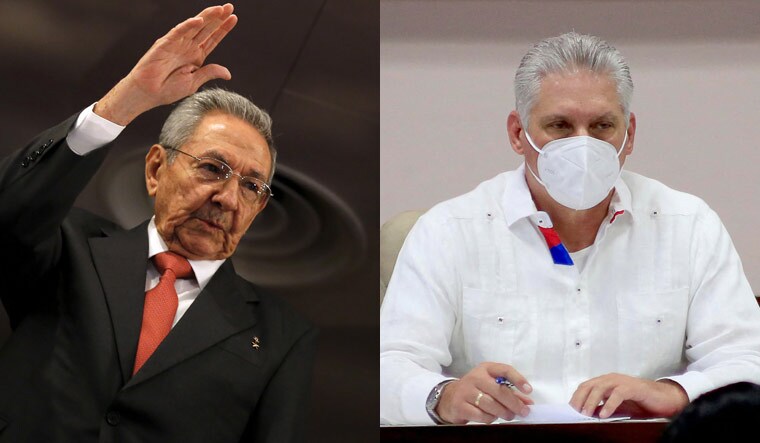
Raul Castro, Fidel Castro's brother has stepped down as Communist party's chief. Raul Castro had taken over as chief of the Communist party in 2011 after his brother Fidel Castro stepped down in 2011.
Raul is expected to be succeeded by Miguel Diaz-Canel.
R Viswanathan, Latin American Expert and former ambassador to Latin American countries say, “This transition has been planned very carefully-- it isn't happening suddenly. So, no drastic changes would be expected. Raul Castro would keep a watch and therefore, Miguel Diaz-Canel isn't expected to make any sweeping changes.” A handful of revolutionaries still hold seats in the Politburo and would closely watch the actions of the new secretary.
Small changes, are in the offing in the fringes, with artists being fed up with government censorship and activists pushing for legislation protecting animal rights have used increased internet access to organize and publicise small protests.
Diaz-Canel, who is the first Cuban to be born after the 1959 revolution to become president, ran local governments in two provinces before becoming minister of higher education and then vice president. Diaz-Canel became president of Cuba in 2018. Diaz-Canel has been more active on Twitter. The responsibility of renewing Cuba's stagnant economy now lies with Diaz-Canel.
Viswanathan adds, “Cuban leaders are quite confident about the system they have established. It has been established that non-democracies can flourish. Venezuela has replicated the Cuban system. Cuba has, in a way taught Venezuela to survive American sanctions, be self-reliant.”
While there have been speculations, none of Raul Castro's children, are likely to take up leadership roles. Castro's son, Alejandro is a colonel in Cuba's interior Ministry and his daughter Mariela runs a government centre promoting LGBTQ rights. A son-in-law, General Luis Alberto, Rodriguez Lopez-Callejas, who maintains a low profile, heads a sprawling military company that controls state-owned hotels, marinas and infrastructure projects.
The country does face problems like food shortages, shortage of medicine and other necessities. As per a CNN report the economy shrunk by at least 11 per cent in 2020 due to the pandemic. “Cubans have learnt to live in misery. They believe that 100 years after the revolution, they will have paradise,” Viswanathan says.
“The shortages they currently face is the result of mismanagement and quick progress as a result of the revolution. The revolution, however, has outlived its cause,” he adds.
The country, keen on being self-reliant is making its COVID-19 vaccine. The country is developing five vaccine candidates, two of which are in the final phase three trials.
The Biden administration, as of now is not in a hurry to engage with Cuba. “Had America opened up trade with Cuba, Fidel Castro probably wouldn't have had a strong-hold over Cuba for such a long time. America instead, blockaded trade, which increased their mental resolve to survive. The only way ahead for the US is to learn from past mistakes.”
in 2014, Raul Castro reached accords with the then Us President Barack Obama in which led to the most extensive US opening to Cuba since the early 1960s. The surge in contacts with the US created a result that was largely reversed under Obama’s successor, Donald Trump.
