


 Add as a preferred source on Google

Ever thought of crossing over a country via foot? The India to Bhutan crossing is an iconic experience and surprisingly easy to do.
On one side is Jaigaon, a border town in West Bengal, with throngs of sweet shops, chai stalls and blaring Bollywood soundtracks. And on the other side of the iconic Bhutan Gate was Phuentsholing.
As my best friend and I walked through the gate, I saw prayer flags replace advertising banners. Dzongkha appeared on signboards alongside English. We saw men in gho and women in kira hurrying to work. As we looked around, we marvelled at the landscape and culture that transformed right before our eyes.

Red rice replaced basmati for lunch. Butter tea appeared instead of milk tea, and local ingredients – from buckwheat to yak products replaced milk sweets.
Yet, the more time I spent in Bhutan, the more I realised how much these neighbouring countries shared.
Our first stop was Phuentsholing, where I checked into Lhaki Hotel, a convenient introduction to Bhutanese hospitality just across the border. Around the hotel, I was stunned to find of all things – Karaoke bars! If there is one thing you must do is to sing a Bhutanese song with the locals. Our recommendation is ‘Ausa Ausa’ – the vibe of humming a song with the locals is unparalleled.
But when I spent more time in the mountains and experienced the ancient healing practices of Amankora I realised the beautiful way in which the cultures of the two countries overlapped. Heat, for example is central to healing. The Grounding Massage at Amankora used a Hot-Stone Massage using heated basalt stones. In ayurveda too, swedana or the sweating therapy loosens toxins in a similar way.
One of the most iconic experiences was dining in a secluded pine forest in a traditional Bhutanese claypot dinner, with simmering homegrown potatoes, chillies and of course, fermented cheese.
From Thimphu, the journey continued towards Punakha, with a stop at Dochula Pass. Its 108 memorial chortens stand against a dramatic mountain backdrop, making it one of the most memorable stretches of the drive.
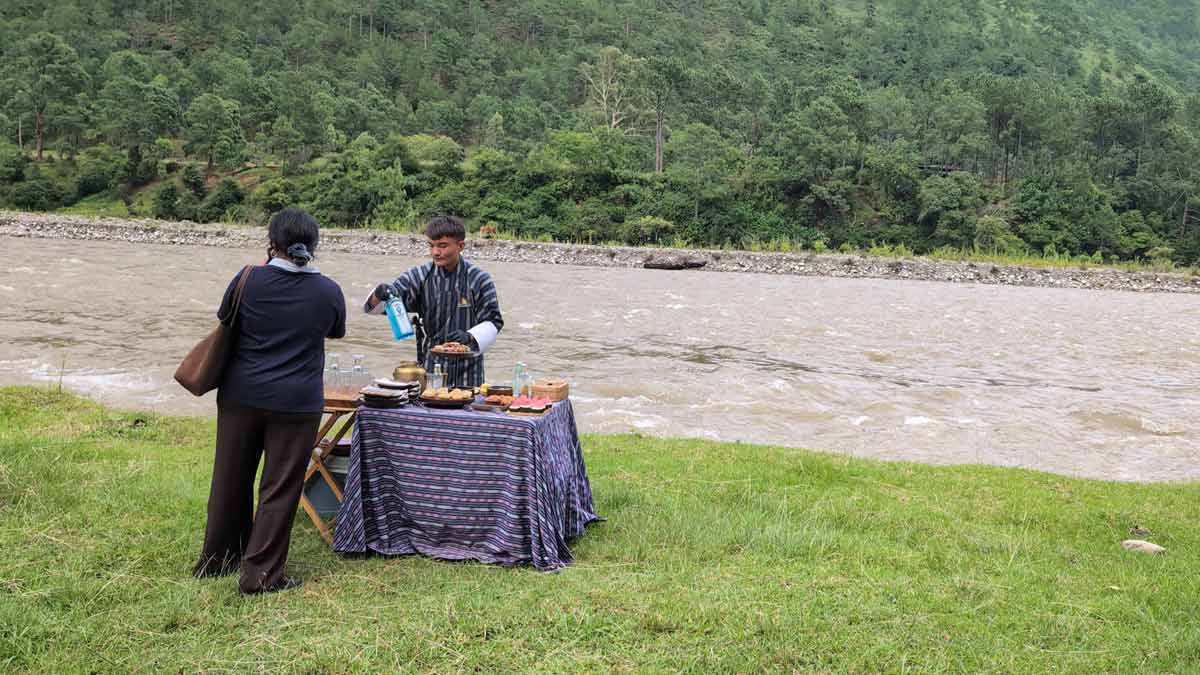
Soon after, we landed at our lodge, set beside the Mo Chu amid rice fields and a gushing river. A hotbed for birding, I was mesmerised by the flapping wings all around me. I was sure I spotted the endangered white-bellied heron, known to frequent the rivers close by. You can also spot the white-capped redstart, the white-throated kingfisher and the River Lapwing.
From Punakha, I continued to Paro. As I dipped my feet in the infinity pool of my hotel, I looked up at the moon, which is central to the Bhutanese way of life – especially, astrology. India’s very own ‘Chandamama’. I realised that I came to Bhutan looking for differences. I had heard it was a world away from everything we know. But all I found were similarities. India's idea of Atithi Devo Bhava – treating a guest as God – has a meaningful parallel in Bhutan's Buddhist understanding of jinpa, or generosity and giving.
Perhaps, that is what makes walking across this particular border so memorable. A few steps separate two countries dramatically, but the warmth of their people, their relationship with food and their love for hospitality goes far beyond borders.
