



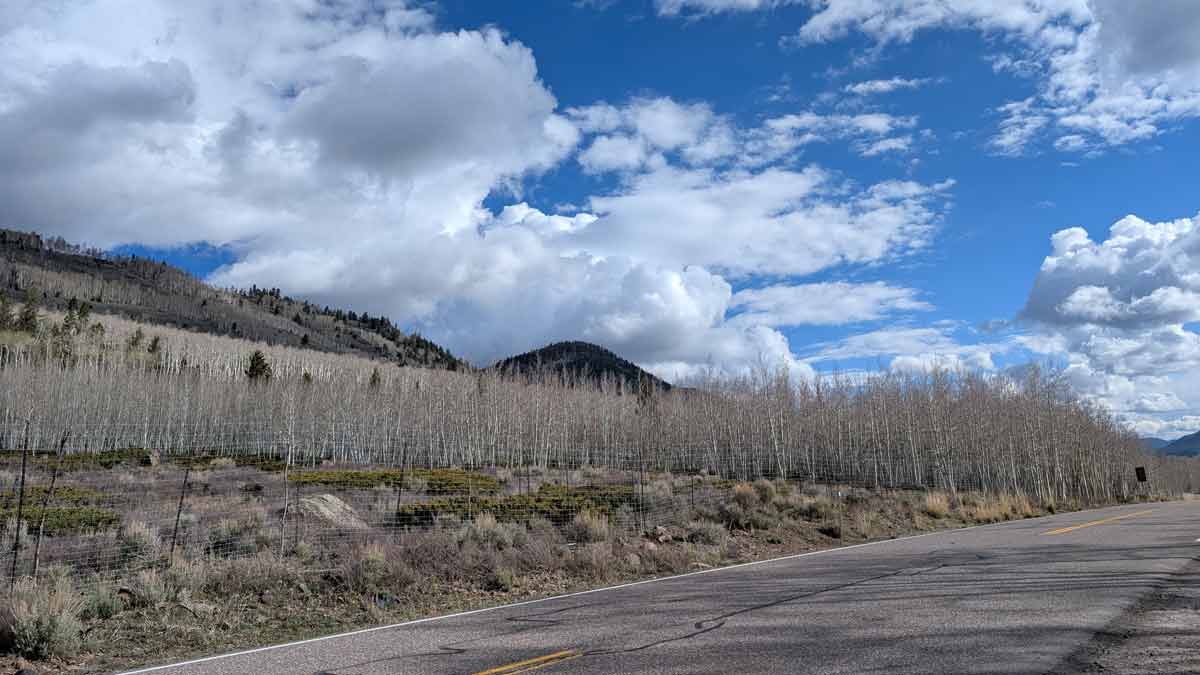
At first it felt like an ordinary hike at the Fishlake National Forest in the Colorado Plateau of Utah. But my guide pointed out that I was walking right into the largest living thing on earth.
Meet Pando. It looks like a cluster of thousands of trees in a forest, but it is in fact one single organism.
Every trunk I touched, every leaf above, belonged to the same individual. If you picked leaves from opposite ends of Pando – over 100 acres apart – their DNA would match almost perfectly. Every part was connected through a single underground root system.
Instead of growing from seeds, Pando has spent millennia cloning itself. It is no wonder that the name Pando itself is Latin for "I spread".
As older trunks die, new shoots emerge from the ancient roots, ensuring that while individual stems come and go, the organism itself continues to live. It feels like the entire organism has a very accurate ‘never-say-die’ attitude – something I would love to borrow!
Standing within Pando, I couldn't help but think of the Tree of Souls from Avatar – the sacred place where the Na'vi gather to pray and remember their ancestors. There are no glowing tendrils or mystical spirits here, but I had goosebumps.
On cue, I hear a strange shriek ringing through the forest. All around I see thousands of pale leaves shimmering in the daylight, creating the sound that gave this remarkable forest its nickname – The Trembling Giant.

Scientists estimate that Pando is older than civilisation itself. That means it was already ancient when humans first began farming. So, Pando has witnessed the ice age, outlived empires and even watched the last woolly mammoth disappear!
Paul Rogers, an ecologist at Utah State University talks about how difficult it is to accurately predict the age of Pando. You will often read "around 14,000 years old", or "up to 80,000 years old", but the truth is that nobody knows.
There's no obvious boundary marking where Pando begins or ends. To most visitors, it simply appears to be an ordinary aspen grove – but watch for the sign that says ‘Fishlake National Forest’. The forest is a great hiking spot in the summers. But, it is towards mid-September that you will begin noticing a transformation – the entire foliage turns shimmering golden yellow, giving it an other-worldly feel.
But like they say, even giants have a weak spot.
Today, Pando faces challenges unlike those it has encountered for most of its existence. Climate change is bringing hotter temperatures and longer periods of drought, placing stress on the forest. At the same time, heavy grazing by deer and elk prevents many young shoots from reaching maturity. New stems are often eaten before they can replace ageing ones, threatening the natural cycle that has sustained Pando for millennia. Conservationists have fenced parts of the grove to protect the trees, but urgent measures need to be taken. I learn that if one part of Pando dies, everything dies – almost like a hive mind!
I looked up and saw a Great blue heron, perhaps diving for fish in the nearby Fish Lake of Utah – its largest natural mountain lake. It was fascinating to assume that Pando, an organism by itself, held so many others deep within its belly – from songbirds to wild turkeys and red foxes.
As I left the forest, the trembling leaves continued their chorus behind me – a soft goodbye, a reminder to never give up? I guess Pando says what you needed to hear the most.
