



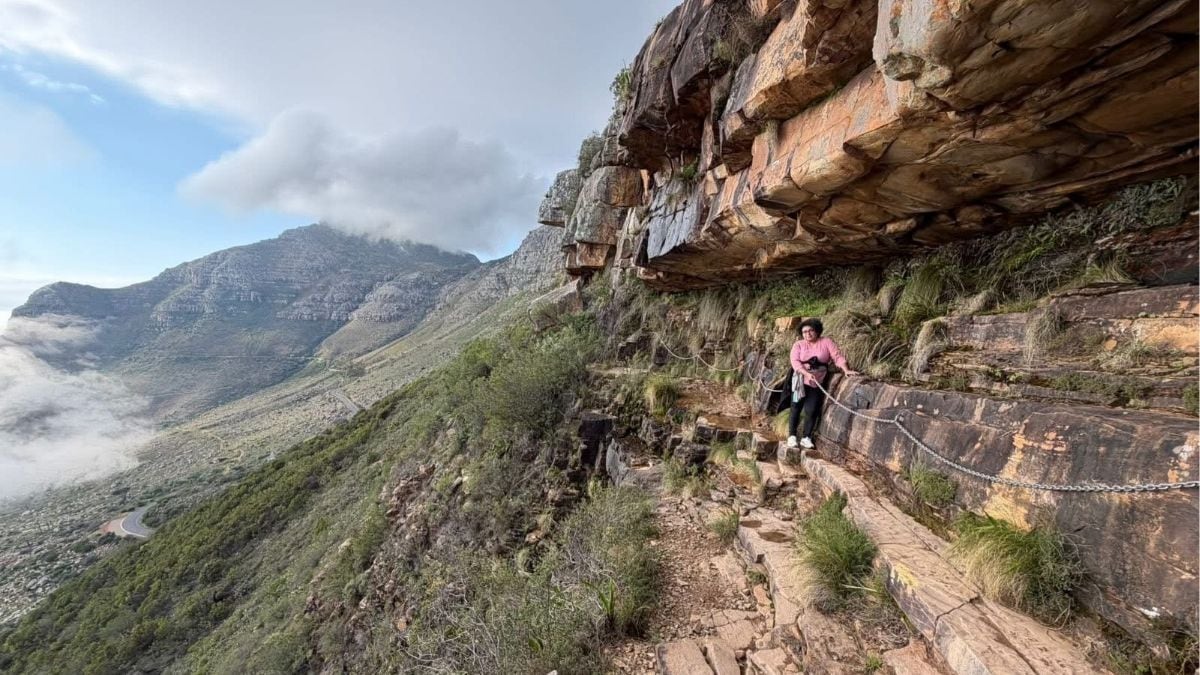
Table Mountain came to me late. At 53, an Indian economist and mother, with only one previous hike—Mill Creek Canyon in Utah in 2003—to my name, the decision carried the flavour of impulsive joy. My son, who had some incredible climbing experience, would serve as my guide, coach and lifeline. What followed was less a recreational outing than an experience in endurance, judgement and risk.
Table Mountain dominates Cape Town like a vast, flat-topped fortress, rising sharply above the city and the sea. Its plateau offers sweeping views of the Atlantic, the City Bowl, Lion’s Head and Robben Island. Tourists glide to the summit by cable car; the more determined tackle routes such as Platteklip Gorge or the exposed traverses of India Venster.
The mountain’s moods are famous. Sudden cloud cover, known locally as the “tablecloth”; and rapid weather shifts are part of its character. On our chosen day, cool mist and light winds offered merciful conditions, though the terrain still demanded respect.
We began on the classic Platteklip Gorge route, the most direct and popular path to the summit plateau. For a novice of my profile, this was not hiking but a sustained vertical climb. The trail rose steeply and relentlessly, offering few opportunities for distraction.
I held my son’s hand for long stretches. Inside the gorge, the enclosing rock walls provided a sense of containment that reduced psychological risk. There was no terrifying exposure, only the monotonous grind.
The rumbling of Silver Stream offered momentary relief as I negotiated wet rocks with care. At my pace, the full ascent would have required another five hours.
My son’s rational assessment led us to plan a cable-car descent. Descending Platteklip as a beginner would have imposed unnecessary risk. For beginners, descending is way tougher than ascending.
Transition to India Venster route

Things changed when we deviated onto the India Venster route, expecting an easier return to the cable station. This proved to be the day’s crucial adjustment. Initially, the change brought welcome relief. After the enclosed verticality of Platteklip, the trail allowed actual walking. My eyes could finally lift from the immediate footfalls. Mist drifted across the slopes. The wind moved through the fynbos. The broken sunlight created pockets of genuine beauty. For the first time that day, joy entered the experience function. I enjoyed.
Yet mountains punish complacency. The path narrowed rapidly, and exposure intensified. The safe containment of the gorge vanished, replaced by airy traverses (moving vertically on the mountain cliffs, no ascent or descent either) and steep drops. Hiking transitioned into “scrambling”. I pressed close to the rock face, both hands searching for holds, my eyes fixed firmly on the rock in deliberate refusal to acknowledge the steep drops. Here, my fear of heights announced itself with visceral clarity. The only viable strategy was absolute concentration on the next movement: one hand, then the other; one foot, then the next.
My son’s performance was exemplary. Calm, precise and instinctively technical, he reiterated the core principles: maintain three points of contact, keep one hand free and move deliberately. At one particularly committing section, he instructed me to tie my scarf around my waist, freeing both hands. That small optimisation captured the shift in regime. We were no longer casual hikers, but two individuals carefully negotiating the mountain’s exposed terrain and changing weather. The instruction reflected the practical wisdom of someone who understood both the terrain and his mumma’s constraints.
India Venster route offered higher aesthetic returns than monotonous Platteklip, but at a much greater psychological cost. Its narrow ledges, sudden exposure and sustained scrambling demanded continuous attention. Between moments of tension came intervals of transcendence with cool mist and wind across the face and the peculiar exhilaration born of managed fear.
We passed through a damp, cave-like hollow where water seeped gently from the rock. Chains fixed to the ridges provided reassuring handholds. The weather remained kind, no shrieking winds or rain.
Our practical Decathlon clothing performed well enough. As my body warmed, I shed my jacket.
This was not polished mountaineering. It was an economist confronting physical and psychological constraints in real time. As we made our way towards the lower cable station, broader reflections emerged - the discovery of latent courage and the satisfaction of attempting something far outside my usual domain.
Table Mountain reveals different truths depending on how one encounters it. From the cable car, it is scenic grandeur. From within Platteklip Gorge, it is an unrelenting monotonous ascent. Along the exposed traverses of India Venster, it is risk, respect and humility.
I finished the day not as a conquering mountaineer but as a novice who had trusted the person beside me. My son was more than a companion or guide; he was the steady hand that kept me moving when fear wanted to stop me. On that mountain, I understood that courage is not the absence of fear but the willingness to place your trust in companion, in love, in judgement and in the next careful step.
Safety advice for beginners
Watch the weather forecast carefully before ascending; as you climb up, it can really get windy at the mountain top—Table Mountain’s conditions can change rapidly.
Carry at least two litres of water per person and avoid dehydration.
Do not attempt descent even via steep and popular routes like Platteklip; use the cable car instead.
Hike in groups with an experienced guide.
Never go alone. If you get injured, there should be someone to take care of you and bring you down.
Avoid sleeping on the mountain or lighting campfires.
Wear sturdy hiking shoes, layered jackets, and a hat for protection against sun or rain.
Daily walk two hours steadily prior to experiencing mountaineering, but knee strengthening is crucial for Platteklip-type rocky vertical climbing.
Do only the Platteklip route if you are a beginner. India Venster route is immensely risky. If you have a fear of heights (acrophobia), just don't do it.
Lend me your ears: Maintaining “pace” matters a lot in hiking, not only to keep up time, but to negotiate safety from the rapidly changing weather.
Never start climbing in the afternoon, as it can get windy and wet and dark. Start climbing in the morning hours, and return by noon.
Respect the mountain and climb responsibly.
The author is Professor, NIPFP and Research Affiliate of Levy Economics Institute of Bard College, New York and Member, Governing Board of International Institute of Public Finance (IIPF) Munich.
