



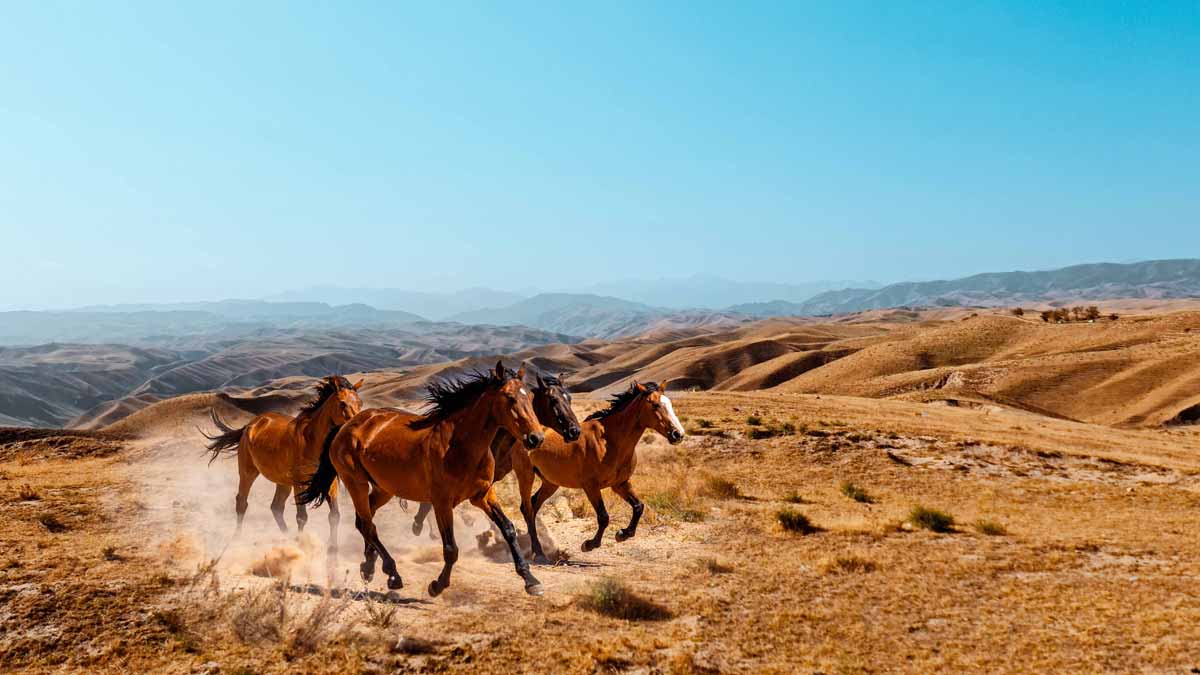
Everyone visits Samarkand, Bukhara, and Khiva when in Uzbekistan. The turquoise domes, ancient mosques and madrasas, the grand bazaars inside them already arrive framed, legendary. But the landlocked country keeps another story, that doesn't announce itself on postcards right away. It lives in the high places, in the creak of juniper underfoot, in the silence between desert dunes, and this is the Uzbekistan I went looking for.
My first glimpse of it came in Zaamin, tucked into the mountains of Jizzakh, where the landscape climbs from parched foothills into miraculous pine-scented ridges, rushing streams shaded by centuries old almond trees, wildflowers pressing on your foot. Locals call it the "Switzerland of Uzbekistan," and the comparison, however cliché, earns its keep. The air alone feels curative, sharp with conifer and cold mineral water, the kind of air your lungs don't forget easily. The old Soviet sanatorium at the foot of the highest peaks still draws families seeking relief from allergies and breathing troubles for its atmospheric wellness.
Across desert roads
From Zaamin, the road winds west into the Nuratau mountains, where time seems to move differently, measured by the ripening of apricots, in the migration of flocks of sheep. Enormous, shaggy guardian dogs of orchards—their fur the colour of dust, their eyes ancient and kind, wagging their tails in friendship. The orchards smell of warm fruit and dry earth, and the fruit, eaten straight from the branch, tasted like something that shouldn't be possible.
The sheep, on the other hand, were less diplomatic. I spent one breathless afternoon chasing a flock across a hillside outside Nuratau—nominally helping a shepherd, mostly just delighting in the chaos. The sheep had opinions. The hillside was steep. The shepherd watched with the quiet amusement of a man who has seen many foreigners discover their own inadequacy at speed. I arrived at the top flushed and laughing, and he poured ‘choy’ from a battered thermos without a word, which felt like the highest compliment, as we sat down to see the sun set in the far away horizon.
The Kyzyl Kum dessert spreads across a vast emptiness south of the Aral Sea basin, a landscape so elemental it seems to predate human vocabulary. We drove through it in the long light of noon with Bigzo, my driver, who despite being a local, felt tired of the endless road— a thin civilisational argument against the scale of the land, saxaul trees and the occasional salt flat shimmering at the horizon.
We came upon Aydarkul Lake like a rumour made true. In the middle of all that sand and desiccation, a vast inland sea stretches to the horizon—formed by Soviet-era irrigation overflow, now an ecosystem unto itself, impossibly blue, impossibly calm. Marsh harriers hunted over water, bright blooms of salt cedar made the landscape seem rich and nourishing. We fished at dawn from the bank, sitting in silence with an old man who spoke no English and needed none, our lines cutting the glass-flat water through to the visible kelp underneath. By mid-morning I waded water up to my chest, watching birds cruise overhead with the indifference of creatures who have always known this as a place they belong in.

Nights of discovery
But it is the night that I keep returning to, for I have never seen anything like it. A short drive from Zaamin carried you up to the Suffa Plateau, perched 2,500 metres above sea level on the Turkestan ridge, where an unfinished radio observatory stands among the rocks like a question addressed to the universe. Up here, the sky doesn’t wear a veil of pollution and light leaks. The Milky Way arrives unceremoniously above your head. No telescope needed. Just eyes, and the willingness to look up. The wind carried nothing but cold and silence. Bigzo and I lay on our backs in the grass for a long time.
I'd carried a Sony Alpha 7rv up the ridge precisely for this, and the moment everyone else reclined into stargazing, I was already on my knees setting up the tripod on a patch of flat rock. The plan was star trails—those long, arcing streaks that accumulate when you hold a shutter open long enough for the Earth's rotation to write itself in light. I mounted the newly acquired Zeiss Batis 18mm, set it wide open, locked the focus on infinity, and began.
What followed was three hours of the most patient, the most freezing, and the most rewarding shooting I have ever done. Every 30 seconds, the shutter would close and open again; stacked in post, those frames would eventually resolve into concentric rings of light spinning around Polaris, the plateau's dark ridgeline anchoring the bottom of the frame. But that was later. At that moment, I was simply a person alone in the cold, watching a screen flicker, fingers too numb to feel the cable release, completely, absurdly happy. The Batis rendered the stars with an almost cruel sharpness — individual points of colour, blue-white and amber, not the soft blur most lenses produce at the edge of their ability. The 61-megapixel sensor pulled detail from the darkness I hadn't expected to find. By the time I packed up, the others were asleep in the car and the sky had shifted a full quarter-turn overhead. The mountain had given me two gifts that night: the version you see with bare eyes, and the version only a long exposure can reveal.
There are places that heal through beauty, and places that heal through scale — by making you briefly, gratefully small. The mountains of Uzbekistan do both at once. I came looking for the country behind the landmarks, and I found it in the orchards of Nuratau, in the red silence of the Kyzyl Kum, in the impossible lake, in the sky above. I found it in the dogs who trusted me, the sheep who didn't, the old fisherman who knew that words were beside the point. Uzbekistan keeps its quietest wonders for those willing to drive a little further, climb a little higher, and wait for the stars to come out.
