



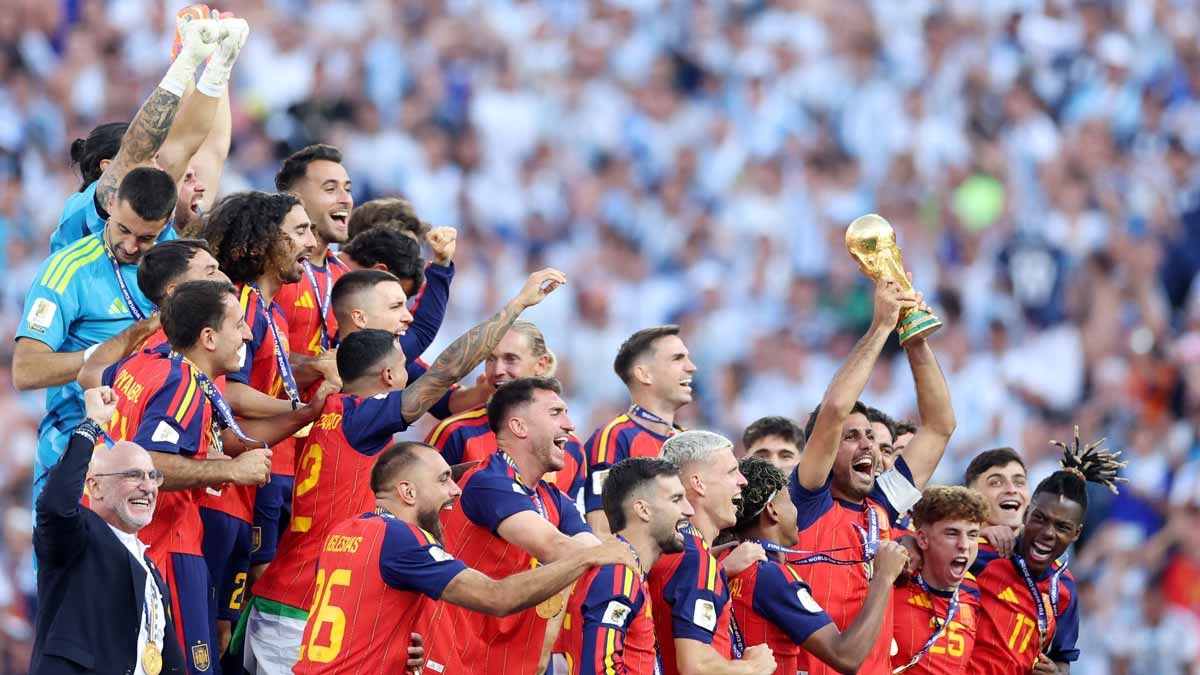
Sixteen years and eight days after Andres Iniesta scored in extra time to give Spain their first World Cup title with a 1-0 win over the Netherlands, substitute Ferran Torres did an encore by scoring another dramatic extra-time goal to clinch a similar 1-0 victory over defending champions Argentina in the FIFA World Cup 2026 final.
Spain were the overwhelmingly dominant force throughout the match, controlling possession and peppering Argentina's goal with 12 shots on target. Yet, a resilient Argentina managed to hang on and push the nail-biting contest into extra time.
The decisive moment arrived in the 106th minute, at the start of the second period of extra time. Torres found himself in the right place at the right time, pouncing on a bouncing ball headed into the box by substitute Nico Williams. He used his left foot to fire a powerful shot just under the crossbar and into the back of the net, finally breaking the deadlock.

Argentina's challenge was made even tougher when they were reduced to 10 men. In second-half stoppage time, Enzo Fernandez received his second yellow card for a reckless play that sent Spanish defender Pau Cubarsi cartwheeling into the air, resulting in an immediate sending-off.
The late drama didn't end there. Just minutes after play resumed, a foul set up a promising free kick for Spain’s Lamine Yamal from about 22 yards out. His curling strike was headed for the right post, but a diving Emiliano Martinez made a spectacular save—his 10th of the afternoon, the most ever in a World Cup final.
The statistics from normal time told the story of Spain’s control: 15 shots to Argentina’s zero, and nine corner kicks to their one. And somehow, for 90-plus minutes, that dominance wasn't enough.
With the win, Spain became the first nation to simultaneously hold both the men's and women's World Cup titles.
This final was the 104th and concluding match of the largest World Cup in history. The expanded 48-team tournament, hosted across the United States, Canada, and Mexico, featured more matches than ever before and, fittingly, a record-breaking 308 goals.
The event was as much a cultural spectacle as it was a football match, drawing A-list celebrities from every corner of the entertainment world.
In a first for FIFA, the match featured a 27-minute halftime show with performances by Justin Bieber, Madonna, Shakira, and BTS.
President Donald Trump was also present at the final.
