



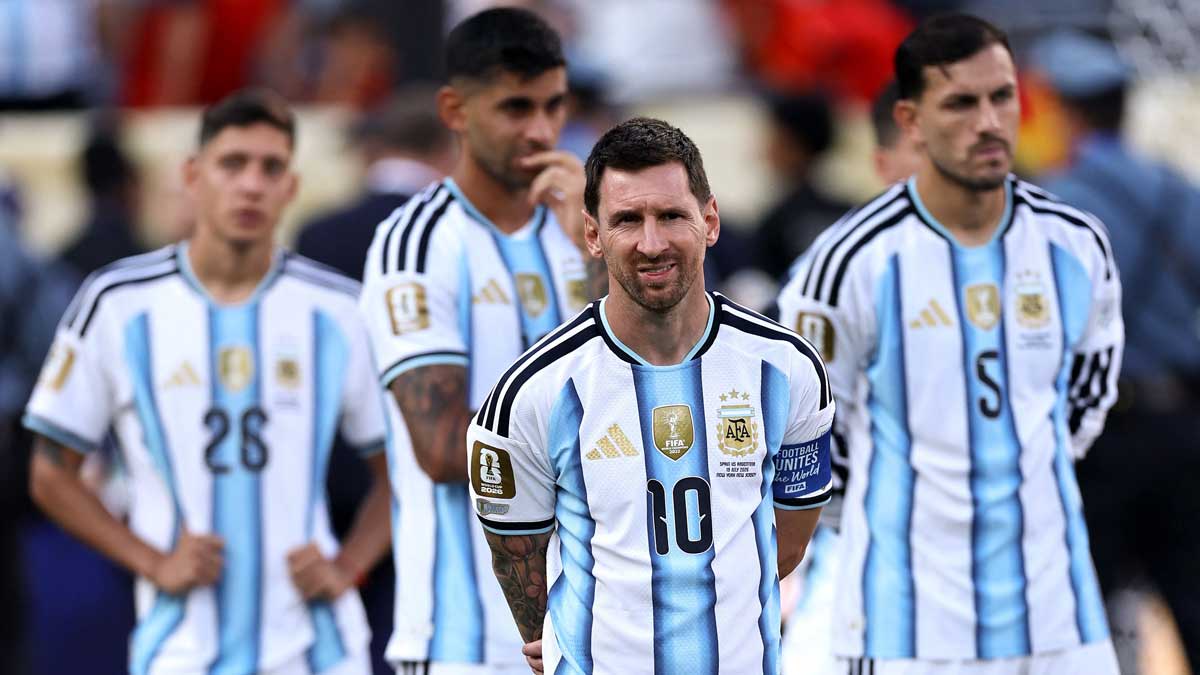
For most of this FIFA World Cup, defending champions Argentina had not played well. But they had shown great character to claw themselves back into games after conceding goals. Be it against Cabo Verde (3-2), Egypt (3-2), Switzerland (3-1) or England (2-1).
In the final against a rampaging Spain, too, they showed that character to keep the Spanish attackers at bay and even after being a goal down in extra time. This time though there was no fairytale ending as it came too late to make a difference, especially as they were already down to 10 men.
On the face of it, there were no obvious tactical errors by manager Lionel Scaloni. There was just a structural issue—the team is built to get the best out of Lionel Messi. In most cases, that is not a problem, as, more often than not, Messi delivers. But, against the newly crowned world champions, there was always a risk that the Argentine legend was going to get isolated. La Roja are simply that good at suffocating the opposition when they don’t have the possession. This, combined with their traditional dominance when on the ball, meant that Argentina needed a new approach: move the ball faster and let Messi be just a highly skilled attacker in a team playing fluid football.
But, the movement and patterns of passing seemed to indicate that the aim remained finding Messi in a dangerous position. As a result, Spain were able to prevent exactly that from happening and Argentina simply had no plan B. Spain effectively had a man advantage long before the red card. All 11 players, including goalkeeper Unai Simon, commanded their zones impressively. Argentina, meanwhile, had to contend with nine outfield players. Messi’s role in this team is to roam in search of space and keeper Emiliano Martinez never really offered himself as a passing option when the midfield was getting choked.
The midfield quartet was probably the most discernible tactical mistake by Scaloni. Leandro Paredes had done well since being brought into the starting 11 midway through the tournament. But, he was inexplicably dropped to start wide man Nico Gonzalez. With golden ball winner Rodri running the midfield for Spain, ably supported by the energetic Dani Olmo and substitute Pedri in the second half, this was the game in which Paredes was most crucial for Argentina. Instead, the lack of that extra body in midfield for Argentina allowed Spain to seize the initiative early.
Lisandro Martinez’s injury was a stroke of bad luck for a team that has enjoyed the rub of the green in this tournament. It was particularly significant because the centre-back has been the team’s best progressive passer, apart from Messi, during the tournament. His composure on the ball and range of passing were sorely missed in the second half.
At right-back, starting Gonzalo Montiel ahead of Nahuel Molina seemed like a good choice, given that the former has looked much better than the latter. He prevented Marc Cucurella from scoring, but had to be withdrawn early in the second half. So, in effect, it was another substitution lost. If the right-back had been able to play at least 90 minutes, an attacker, like Lautaro Martinez, could have been brought on. Yellow-carded Cristian Romero’s substitution had a similar effect.
Two unnecessary yellow cards earned by Enzo Fernandez summed up the day for Argentina. There was too much focus on the so-called dark arts rather than just playing the kind of football this talented team is capable of. There was also an inability to think beyond Messi, both in the dugout and on the pitch. That Spain were not in the least bit affected by Lamine Yamal’s underwhelming performance, shows how stark the contrast was.
Spain answered the Messi question, but Argentina looked clueless as to how to deal with a cohesive team driven from the centre by a magnificent Rodri.
