



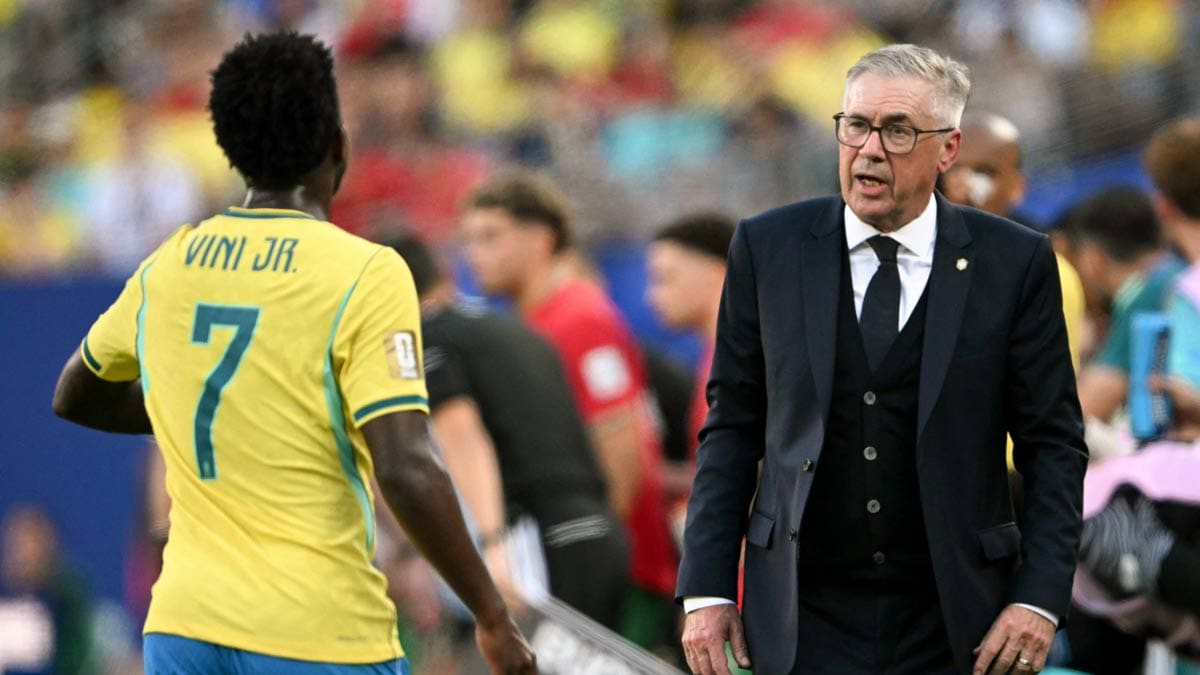
A 1-1 draw between the sixth -and seventh-ranked teams in the world would seem like a fair result. But, when one of those teams is Brazil, the expectation, and the resulting disappointment with the result, is perhaps expected.
The five-time champions were held to a stalemate by the African champions in their Group C opener of the FIFA World Cup 2026. It won’t come as a surprise for those who have been following the form of these two teams of late. Brazil are a team in transition under veteran Italian coach Carlo Ancelotti, who took over in May last year, and are missing key players including Neymar because of injuries. Morocco have been going from strength to strength since their historic semifinal run in the 2022 FIFA World Cup in Qatar, which included a record 19 consecutive wins across all competitions in 2025.
The difference was there to see as the two teams met in the first high-profile clash of this World Cup. Morocco were quick to get off the blocks and were tactically disciplined and physically superior. Their transitions were rapid and free-flowing, often catching the Brazilians off-guard. The Selecao, on the other hand, were sluggish in the first half, especially in the midfield, and were playing catch-up against the superior Moroccans for much of the first half.
A draw would be enough for both teams to progress to the Round of 32 as their next two games in the group – against Scotland and Haiti – would be relatively easier.
But Brazil will be the more worried side. Here is why:
1
Right-back conundrum
It was Brazil’s biggest headache coming into the World Cup. Lack of quality in both the right- and left-back positions was expected to hurt them at the World Cup. Regular right-back Wesley’s injury just before the World Cup only accentuated it. Despite having experienced but ageing Danilo, Ancelotti opted to start with Roger Ibanez, who is a natural centre-back, in that position. The result? The Al-Ahli defender was often caught out of position, with Morocco exploiting the space behind him whenever he advanced and Brazil lost possession. Brazil’s inability to deal with Morocco’s movement behind the lines led to the defensive midfielders being forced wide and the centre-backs being exposed. It was one of the reasons for the Atlas Lions’ goal in the 20th minute, with Brahim Diaz delivering a ball down the middle and Ismael Saibari chipping it over an onrushing Alisson Becker in the 21st minute.
Danilo replaced Ibanez in the second half, bringing more stability to that right channel, but the 34-year-old will be tested against higher-ranked teams that counter-attack with more pace and creativity. Also, whether he can sustain the intensity for 90 minutes remains to be seen.
2
Midfield puzzle
Playing in a 4-2-3-1 formation against a fast and dynamic side like Morocco was always going to be the challenge. Ancelotti went with the experienced pair of Bruno Guimaraes and Casemiro, and the creative Lucas Pacqueta in the midfield. But, call it nerves or sheer inability to match up to Morocco’s midfield led by Ayyoub Bouaddi, the trio struggled to maintain possession and control the rhythm of the game. As a result, Brazil’s attempts to press were frequently disrupted, with their central unit looking vulnerable against the high-energy opponents. The two wingers Raphinha Vinicius Junior and forward Igor Thiago too were starved of enough passes from the midfield. Neymar’s creative playmaking was sorely missed. It was only after the introduction of Fabinho and Danilo Santos in the second half that Brazil improved their midfield play.
3
Overdependence on Vinicius Junior
With Morocco a goal up and dictating terms for most of the first half, Brazil, at one time, looked to be in danger of losing their first ever World Cup opener in 92 years. It took a moment of brilliance from Vinicius in the 32nd minute of the game to ensure a point for his team. In fact, he was the only player who threatened to unlock the low-block employed by Morocco. Thiago missed a golden opportunity to head home in the 14thminute, and messed up at least a couple of other goal-scoring opportunities. Raphinha was a shade of his Barcelona self. Ancelotti would be hoping that his forwards get over the opening-match jitters soon. Else, Matheus Cunha and Luiz Henrique will get an earlier look-in unlike today when they were brought on in the second half. Trying out teenage star Endrick in the centre-forward position, too, would not be a bad idea.
The coach would know that Brazil cannot afford to let their attack depend solely on Vinicius and risk themselves becoming predictable. And that the forward line must move in sync and occupy spaces in the final third consistently.
The next two games would allow Ancelotti to zero in on the right combination and be ready for the knockout stages when the big guns come calling.
