


 Add as a preferred source on Google

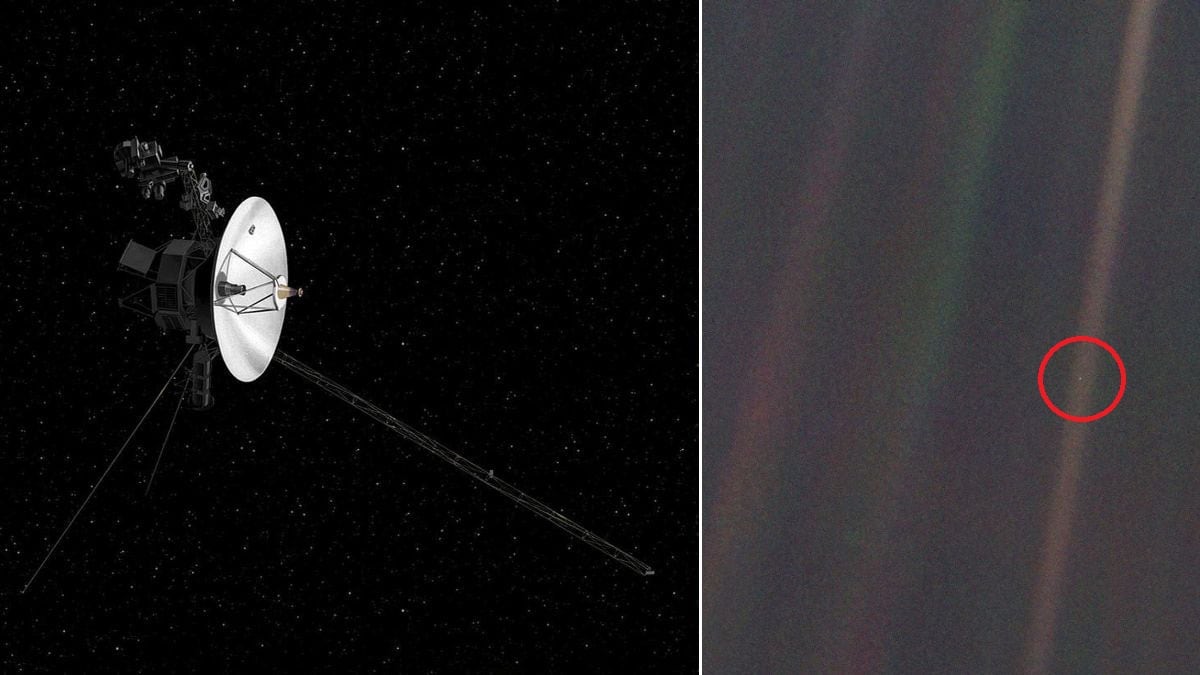
It is one of the most famous photographs of all time. And it wasn’t even clicked by a human being.
In 1990, when Voyager space probe’s camera was all set to be powered off after more than 12 years in space, cosmologist Carl Sagan suggested to NASA that they turn the camera back and click one final pic. That blurry photo of Earth clicked by a dying device triggered by a radio command from 600 crore kilometres away (Voyager was by then travelling beyond Neptune) became perhaps the most poignant photograph in the history of mankind.
Why? At one glance, it seems blurry and insignificant, until you realise what it stands for. Titled ‘The Pale Blue Dot’, it has our planet seemingly suspended in a ray of sunlight in the vast loneliness of space.
If that alone wasn’t enough to bill it iconic, Sagan’s note about it in his 1994 book ‘Pale Blue Dot: A Vision of the Human Future in Space’ entrenched it in our collective psyche. In a moving reflection on the fragility of our existence, that of our home planet and the human condition, he wrote:
"Look again at that dot. That's here. That's home. That's us. On it everyone you love, everyone you know, everyone you ever heard of, every human being who ever was, lived out their lives. The aggregate of our joy and suffering, thousands of confident religions, ideologies, and economic doctrines, every hunter and forager, every hero and coward, every creator and destroyer of civilisation, every king and peasant, every young couple in love, every mother and father, hopeful child, inventor and explorer, every teacher of morals, every corrupt politician, every 'superstar,' every 'supreme leader,' every saint and sinner in the history of our species lived there—on a mote of dust suspended in a sunbeam.”
Sagan’s musings continue to retain its significance over the decades as all kinds of religious, political and geo-strategic posturings and conflicts threaten our future, highlighting how we are not only one and have all the more reasons to stick together and not only live in harmony, but also to protect the only planet where life is possible, for our own sake.
“Our posturings, our imagined self-importance, the delusion that we have some privileged position in the Universe, are challenged by this point of pale light,” Sagan wrote.
"The Earth is the only world known so far to harbour life. There is nowhere else, at least in the near future, to which our species could migrate. Visit, yes. Settle, not yet. Like it or not, for the moment the Earth is where we make our stand.
“There is perhaps no better demonstration of the folly of human conceits than this distant image of our tiny world. To me, it underscores our responsibility to deal more kindly with one another, and to preserve and cherish the pale blue dot, the only home we've ever known.”
