



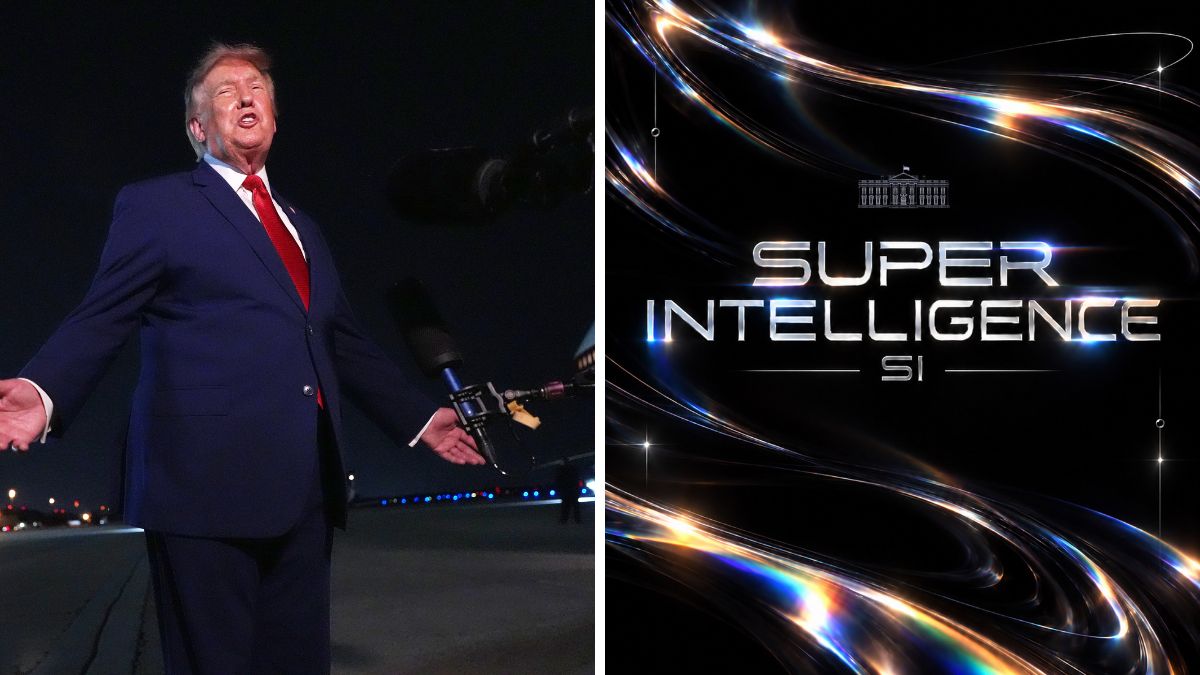
On Tuesday, President Donald Trump signed an executive order directing the federal government to replace "artificial intelligence" with "Super Intelligence" across the executive branch. Agencies were told to stop acknowledging the terms "AI" and "artificial intelligence." At a White House roundtable the same day, tech executives signed the White House Accord on Super Intelligence, which Trump described as morally binding on its signatories.
The stated reasoning is simple. Trump argues that the term "artificial" makes intelligence sound fake, when in his view it is anything but. However, the context points to a more political motive. The push has come amidst the domestic challenges of the protests over data centres and fears of job displacement, and advisers have warned that public distrust of AI could hurt Republicans in the midterms. A technology voters fear is getting a friendlier name.
A word that already means something
The trouble is that the term "superintelligence" is not an empty label. It has been in use since 1822 for intelligence greater than humanity's. Nick Bostrom's 2014 book defined it as an intellect greatly exceeding human cognitive performance in virtually all domains, which anchors the most serious safety arguments.
More than 850 people, including Yoshua Bengio and Nobel Awardee Geoffrey Hinton, in their September 2026 Intelligence Explosion Warning report, have signed a statement calling for a halt to its development until it can be shown to be controllable. Steve Bannon, a former Trump aide, signed a similar petition, which shows the unease does not sit neatly on one side of politics.
The industry usage is narrower than Trump's. Executives such as Sam Altman, in his essay “The Gentle Singularity” use the word for a subcategory of AI still being built. The White House order erases that distinction, so today's chatbots and a hypothetical machine mind fall under one label.
Reading the intent
Here, several motives seem to overlap. The first is image repair. The word "artificial" suggests something counterfeit, whereas "super" sounds like a national achievement. The second is industry alignment. Trump appears to believe business leaders agreed to use his term, calling the accord they signed morally binding. Meta, for its part, noted that Mark Zuckerberg has used 'superintelligence' publicly for some time, including in the name of Meta Superintelligence Labs. Whether that amounts to adopting Trump's usage is another matter. As Meta's own materials still speak of AI, the Accord leaves little room for such baby-splitting.
The third motive is the most consequential.
A techno-nationalist angle
Much of the rebrand here seems to fit a techno-nationalist reading, rather than something the reporting establishes. Trump has said that whoever wins superintelligence wins, which treats the technology as a zero-sum contest between states, with China as the implied rival. That depicts the core techno nationalist premise where the technological leadership is attributed to national power. He has also rejected what he calls a "globalist scheme" to control the technology, and unilaterally renaming the field is a way of asserting autonomy from shared rules and shared vocabulary. The accord ties private firms to a national project through a pledge rather than a law, a soft version of the state-corporate mobilisation that has long characterised techno nationalism. It sits alongside a series of moves such as the Stargate investment, rolled-back regulation and the proposed "AI Force."
In the context of geopolitical rivalry, it is also a bid for discursive power, the ability to set the categories and framings others must use.
Still, the label fits imperfectly. The classic techno nationalism, as previously seen in Japan's postwar strategy or China's push for indigenous innovation, usually aims at catching up and reducing the dependence on other powers. The US is the incumbent leader, so this can be seen as more like a hegemon branding and protecting its lead. A rebrand adds no compute, chips or talent, and the US still relies on allied supply chains such as Taiwan for advanced chips. So this is moreover a symbolic techno nationalism rather than the material kind. However, that still matters because symbolic moves can provoke material ones; other governments may read the rebrand as a signal of American unilateralism and respond with sovereignty-driven AI strategies of their own, but still be perceived as “followers” of the American model.
Will the world follow?
The International terminology converges through standards bodies, treaties and a critical mass of practitioners, and the order reaches none of those. "AI" is already written into the EU AI Act, OECD principles, UN resolutions and technical standards and into national policy documents from Beijing to New Delhi. Reopening those texts as a favour to Washington is unattractive to any government. China's usage of the term 人工智能, contains "artificial" literally in its doctrines and policy documents, so Beijing has even less reason to adopt the change.
The likeliest outcome is a split vocabulary. US agencies, contractors and firms dependent on federal business will say "SI," while most of the world keeps saying "AI." That will be inconvenient but manageable.
The genuine risk lies in safety diplomacy. If an American negotiator says superintelligence and means all advanced AI, while a European or Chinese counterpart means the frontier capability safety advocates want restricted, commitments and objections could be misread in either direction. Then the global media coverage faces the same confusion. However, this may also backfire on American interests; if the term becomes a marker of American unilateralism, some governments may avoid it deliberately, hardening the divide. And the rebrand could undercut its own aim, since importing the existential-risk frame may make a small or middle power more anxious about following the US lead in the domain.
The real test
If the country’s close partners such as the UK, Japan, South Korea or India begin using the term in joint statements, a US-led bloc vocabulary becomes plausible, though still far from global. If the EU and UN bodies decline, the split is locked in. And if the domestic response stays poor, the administration may quietly let the term lapse. But for now, the move shows that in a technology race, the contest over what to call things (nomenclature) is part of the contest itself. Trump has not settled it; rather, he has opened it.
