



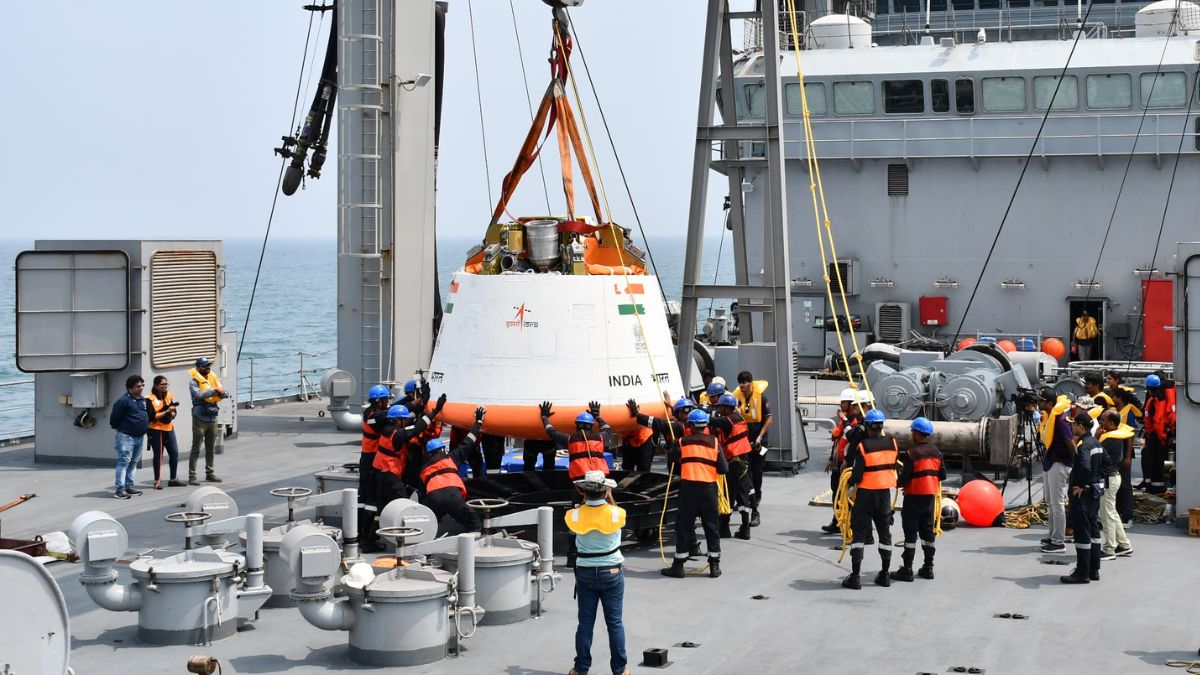
ISRO plans six more launches before the calendar year ends; two of them carry significance that the others do not. One is the navigation satellite NVS-03. The other is the opening uncrewed test of Gaganyaan, the programme meant to carry Indians into orbit aboard an Indian rocket. ISRO Chairman V. Narayanan laid out the roadmap soon after GSLV-F17 placed the Earth-observation satellite EOS-05 exactly where it was meant to be — in geostationary orbit, a high-altitude path where the spacecraft appears to hover over the same patch of Earth, quietly watching the land and sea for signs of changing weather, crop conditions and security threats.
Speaking after that success, Narayanan drew a line that explains everything about Gaganyaan's pace. Protecting a living person in space is simply not the same as despatching a machine. A satellite that fails can be rebuilt and flown again; a human being cannot. That single sentence sits underneath a number that startles most people who hear it: roughly 8,000 tests have already been conducted for a mission that will fly with nobody on board.
Those tests are neither glamorous nor visible. Vibration tables shake the hardware as violently as an actual liftoff would, until anything loose in the design rattles itself into the open. Heat chambers roast components the way atmospheric friction will scorch them on the climb, and the way re-entry will scorch them again on the way back down. Computers work through thousands of imagined failure combinations, one after another, so that when the real countdown begins there is no surprise left waiting anywhere in the system.
“The reason for such exhausting caution is plain. Every valve, every weld and every line of flight-critical code that must keep the air moving, hold the temperature steady and keep the capsule sealed has to earn its place while still on the ground. Reaching orbit was never the true objective. Bringing the crew home breathing is,” remarked space analyst Girish Linganna.
ISRO will fly three empty missions before any Indian is strapped into the capsule. The first of these is now in final preparation, and its results will be studied in detail, line by line. Two more rehearsals will follow. Only after all three have shown that every system behaves precisely as designed will the crewed voyage be cleared. Each of these is a complete dress rehearsal with nobody at risk, yet every sensor, every parachute and every abort command must still perform exactly as though a life depended on it.
The rocket itself has been rebuilt from within for this responsibility. “The LVM3, India's heavy-lift workhorse, has been human-rated, layered with backups so that if one element falters another quietly takes over an obligation no ordinary cargo launcher ever carries. Above the capsule sits the crew escape system, already developed and proven in flight abort trials: a tower of solid motors that ignites within milliseconds if the booster misbehaves in those first critical minutes, hauling the capsule clear like a lifeboat that casts off without waiting for permission. The environmental control and life-support equipment, which supplies breathable air, scrubs away exhaled carbon dioxide and holds the cabin temperature within the narrow band a human body accepts, has reached an advanced stage. Special products required by astronauts alone have been designed and manufactured. Work on the orbital module continues at the U R Rao Satellite Centre, while the tasks assigned to the Vikram Sarabhai Space Centre stand completed,” added Linganna.
