



Recently, officials from India and the United States sat down at ISRO headquarters in Bengaluru for the ninth meeting of their Civil Space Joint Working Group. Such meetings usually pass without much notice. This one did not. Before the talks ended, NASA had formally invited ISRO to join its Moon Base programme.
The US Ambassador to India, Sergio Gor, shared the news publicly, describing it as a deepening of the India-US partnership in deep space.
ISRO Chairman V. Narayanan had opened the session alongside him, and the invitation came bundled with an agreement to share scientific data openly under the Artemis Accords.
What has India been invited into?
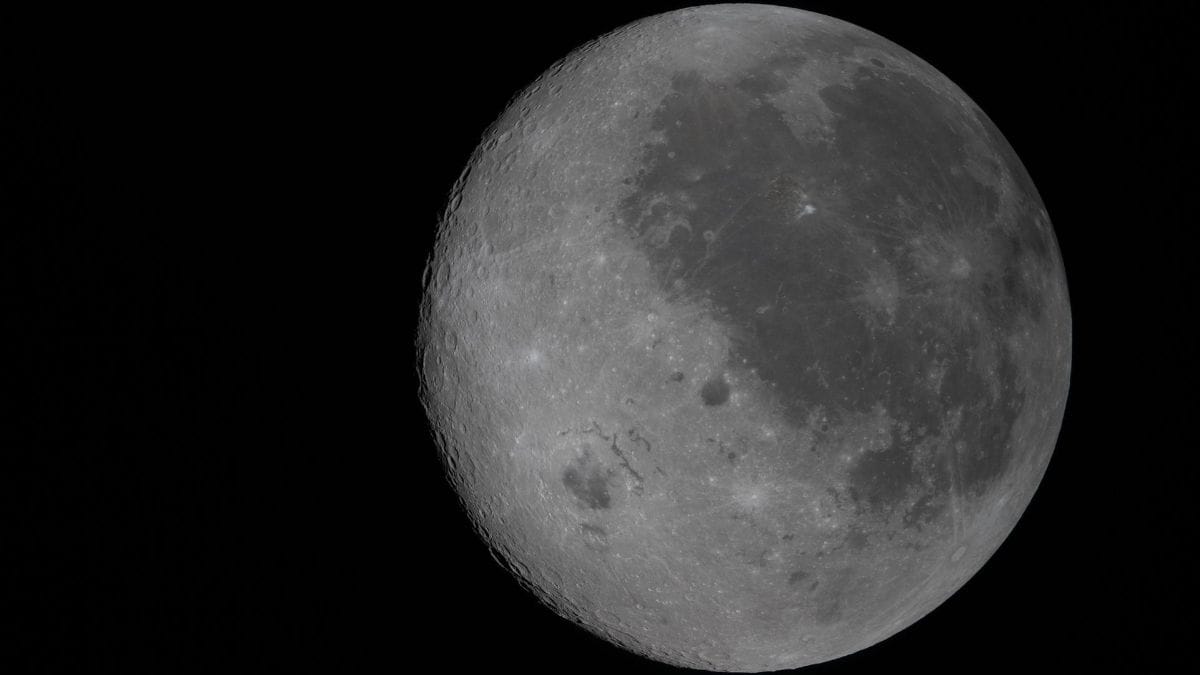
The Moon Base programme is NASA's plan to stop merely visiting the Moon and to start living there. The Apollo missions of the 1960s and 70s were remarkable, but they were essentially camping trips. Astronauts landed, gathered rocks, planted a flag and returned home within days.
“The Moon Base idea is completely different. The goal is a permanent outpost near the lunar South Pole where crews can stay for weeks or months at a stretch, carry out experiments, and slowly turn the Moon into a practice ground for the far harder journey to Mars. NASA has already announced its first three Moon Base missions, with the earliest expected no sooner than late 2026,” explained space analyst Girish Linganna.
Why the Moon’s south pole?
Certain craters near the lunar poles have floors that sunlight has never once touched. Inside these permanently shadowed regions, ice has been sitting undisturbed for billions of years.
Ice means drinking water. Break it apart, and one can get oxygen to breathe and hydrogen for rocket fuel. Carrying every single litre of water up from Earth is punishingly expensive, so a base that can dig up its own supply is the difference between a short experiment and a place where people can genuinely stay.
Why India?
Because India has already been there. In August 2023, Chandrayaan-3 landed gently near the lunar South Pole, making India the first country ever to touch down in that difficult region.
India had also signed the Artemis Accords in June 2023, the agreement that lays down shared rules for peaceful activity on the Moon. The two agencies have a proven working relationship. NISAR, the NASA-ISRO Synthetic Aperture Radar satellite launched in July 2025, is the first spacecraft the two built together, and it is already sending back detailed pictures of Earth.
Add India's Gaganyaan human spaceflight programme and the ongoing talks on training Indian astronauts at NASA's Johnson Space Center, and this invitation begins to look less like a diplomatic gesture and more like a natural next step.
Which Moon bases are being built?
“Two rival efforts are now underway, and both are aiming at the same small patch of lunar ground near the South Pole, because that is where the ice lies. The first is NASA's Artemis Base Camp, built with Canada, Japan, the European Space Agency and now, possibly, India, alongside more than forty Artemis Accords nations.
It is being assembled in stages. Between now and roughly 2029, over twenty robotic cargo landings, many flown by private companies such as Intuitive Machines and Blue Origin, will drop off instruments, hopping drones and basic survival equipment.
The Artemis III crewed landing is targeted for around 2027. From about 2029, the heavier machinery arrives: a Foundational Surface Habitat, a pressurised rover that doubles as a mobile home for long drives across the surface, a small nuclear power plant, and equipment to mine water ice automatically,” added Linganna.
The second attempt is the International Lunar Research Station, led by China's CNSA with Russia's Roscosmos and joined by around seventeen partner nations, including Pakistan, Venezuela, Belarus, Egypt, Thailand and South Africa. China's robotic Chang'e-8 mission, planned for around 2028 or 2029, will test ways of building with lunar soil and scout the landing site.
A Chinese crewed landing is targeted for about 2030, followed by up to five heavy rocket launches between 2030 and 2035 carrying habitat modules, power systems and rovers. A jointly built nuclear reactor is meant to arrive between 2033 and 2035, keeping the lights on through the freezing fourteen-day lunar night.
Chinese researchers have also spoken of leaning heavily on machines, including robotic dogs, to patrol, mine and handle daily chores while humans make the decisions.
These are plans, not finished machines. Space timelines slip all the time, and much of this hardware is still on paper. Yet the direction is unmistakable. For the first time since Apollo, humanity is preparing to stay, and India has just been asked to help shape what that future looks like.
