



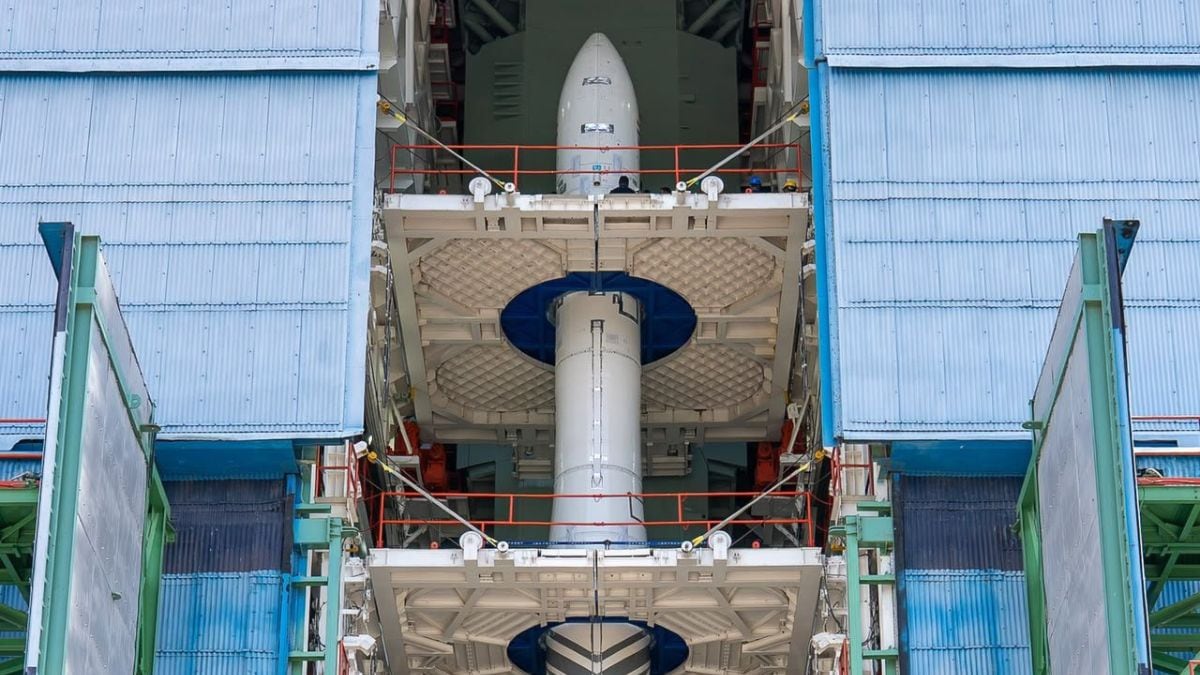
Post the success of Skyroot’s Vikram-1 rocket, many other private space companies are gearing up for their future missions. India's private space companies have grown up. Once, they only made small parts for rockets and satellites. Today they are building complete, world-first machines that even bigger countries have not yet tried. With the support of IN-SPACe, the government body that opened the space door for private players, these young firms are dreaming very big.
Take the case of Agnikul Cosmos from Chennai, which is chasing something clever. Rockets are costly because we burn them once and throw them away. Agnikul wants to reuse them. They have already fired four 3D-printed semi-cryogenic engines together, which is a proud engineering feat. “Now they are preparing Mission-02, where they will try to catch a returning rocket booster on an ocean barge, a first for India. Even more exciting, they have joined hands with NeevCloud to turn old upper-stage rocket parts into an "AI data centre" floating in space. Instead of becoming junk, these parts will store and process data in orbit,” remarked space analyst Girish Linganna.
Pixxel from Bengaluru began by taking very sharp pictures of the Earth using hyperspectral cameras. These cameras see hundreds of colours our eyes cannot, helping spot crop diseases or hidden gas leaks. Now Pixxel is aiming higher. “Along with Sarvam AI, they are building Pathfinder, a 200-kilogram satellite planned for launch in the last months of 2026. The surprising part is that it will carry powerful, ground-level computer chips into space. Normally, satellites send raw data back to Earth for slow processing. Pathfinder will do the heavy thinking in space itself and send back only ready answers within seconds,” added Linganna.
GalaxEye, also from Bengaluru, is solving an old headache. During monsoon, storms, or at night, ordinary camera satellites go blind because clouds and darkness block their view. In May 2026, GalaxEye launched Mission Drishti on a SpaceX Falcon 9 rocket. At 190 kilograms, it is India's largest privately built Earth-watching satellite. It is the world's first commercial satellite to combine radar and optical cameras in one machine, so it can see clearly in any weather, day or night. An onboard Nvidia AI chip turns raw signals into useful information while the satellite is still flying.
Bellatrix Aerospace, the space start-up from Bengaluru, works on clean and smart movement in space. They build Orbital Transfer Vehicles, which act like taxis, dropping satellites into their exact orbits after the rocket leaves them. They have already tested an Indian-made green propulsion system under DRDO projects. Now, with South Korea's TelePIX, Bellatrix is developing a special satellite that will fly very low, only 150 to 250 kilometres above us, by 2028. At such a low height, air drag usually pulls satellites down fast. Bellatrix's Air-Breathing Electric Propulsion will scoop up thin air molecules and use them as fuel, allowing sharp, close-up images of the ground.
Now, what about other private rocket makers?
Skyroot Aerospace, from Hyderabad, is now working towards bigger orbital launches to place satellites into space at low cost. “Such companies are important because they give our startups a home-grown ride to orbit, instead of depending on foreign rockets. When launch, satellites and in-space services all come from India, the full chain becomes truly ours,” said Linganna.
Why does this whole shift matter so much? First, it keeps our data safe. When companies like Pixxel let Indian AI models run on machines in space, our sensitive information stays away from foreign clouds and foreign control. Second, it makes business sense.
Experts point out that adding a data centre or many sensors to one satellite means a single launch does many jobs, earning far more money than an old single-purpose satellite. Third, it cuts costs dramatically. If Agnikul succeeds in recovering boosters from the ocean, they believe small-satellite launch prices could fall by almost eighty per cent.
Another space start-up, EtherealX, represents India's long-term vision for fully reusable launch systems. The company is developing reusable rocket architectures intended to recover and refurbish major launch vehicle components, thereby reducing operational costs and increasing launch frequency. Unlike conventional expendable launch vehicles, reusable systems aim to maximise hardware utilisation while minimising manufacturing requirements and environmental impact. The company's research focuses on sustainable launch technologies, reusable propulsion systems, advanced structural engineering, and high-frequency launch operations that align with the future direction of commercial space transportation.
Another company, Abyom SpaceTech and Defence, is emerging as an important contributor to India's reusable launch vehicle ecosystem through the development of indigenous reusable propulsion technologies. The company has successfully demonstrated a fully indigenous reusable liquid rocket engine and is developing reusable sounding rockets, reusable small launch vehicles, and future medium-lift launch systems. Its research includes reusable propulsion, cryogenic engine technologies, vertical take-off and vertical landing concepts, advanced engine control systems, and integrated testing infrastructure. These developments represent important milestones toward establishing indigenous reusable launch capabilities and strengthening India's commercial launch vehicle programme.
OMSPACE Rocket & Exploration (OSRE) is another emerging Indian aerospace company dedicated to the development of reusable launch vehicles for nano- and small-satellite deployment. The company is developing the Infinity One launch vehicle with a focus on reusable first-stage recovery, lightweight composite structures, indigenous propulsion technologies, modern guidance, navigation and control systems, and rapid launch turnaround. Through sounding rocket campaigns and technology demonstration missions, OMSPACE is validating propulsion performance, flight stability, structural integrity, telemetry, and recovery systems that will support the future evolution of its orbital launch vehicle programme.
“The global launch industry is rapidly transitioning from expendable rockets to reusable, modular, and highly efficient launch systems that significantly reduce the cost of reaching orbit. Advances in lightweight composite materials, additive manufacturing, artificial intelligence, autonomous flight control, precision avionics, digital mission planning, and advanced propulsion technologies are reshaping the economics of space transportation. Indian private space companies are embracing these innovations to develop launch vehicles that are reliable, scalable, economically sustainable, and internationally competitive,” said Srimathy Kesan, the CEO and founder of SpaceKidz India.
Kesan’s company Space Kidz India is working on electric propulsion technologies and has successfully undertaken two experimental rocket launches, reaching an altitude of approximately 3 kilometres.
Collectively, these organisations illustrate the rapid evolution of India's private launch vehicle ecosystem. Their combined expertise spans launch vehicle design, reusable rocket technologies, advanced propulsion engineering, additive manufacturing, autonomous flight systems, composite materials, mission integration, and sustainable launch operations. “Rather than functioning independently, these companies are creating an interconnected commercial aerospace ecosystem capable of supporting scientific research, commercial satellite deployment, defence applications, planetary exploration, and future space transportation services,” added Kesan.
Collectively, these organisations illustrate the rapid evolution of India's private launch vehicle ecosystem. Their combined expertise spans launch vehicle design, reusable rocket technologies, advanced propulsion engineering, additive manufacturing, autonomous flight systems, composite materials, mission integration, and sustainable launch operations. Rather than functioning independently, these companies are creating an interconnected commercial aerospace ecosystem capable of supporting scientific research, commercial satellite deployment, defence applications, planetary exploration, and future space transportation services.
