



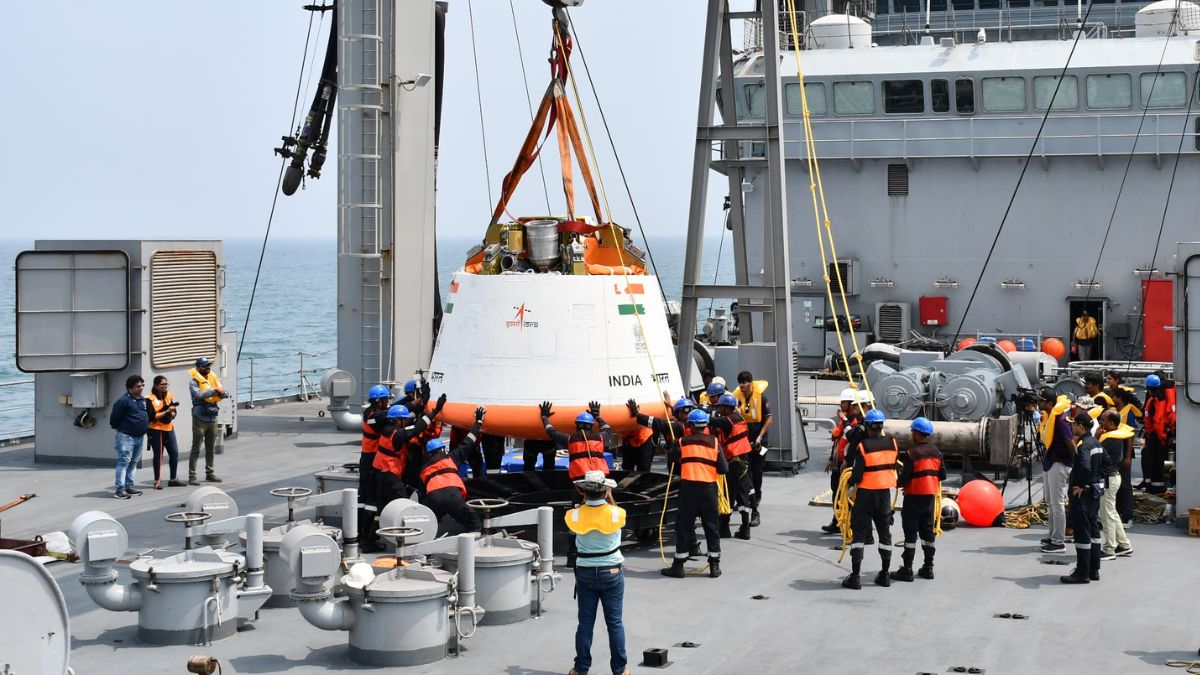
India's first human space journey has come one big step closer. The Indian Space Research Organisation (ISRO) has announced that it had successfully completed three important qualification tests for the Gaganyaan crew module. Gaganyaan is India's first mission to send astronauts into space and bring them back safely. If it succeeds, India will become only the fourth country in the world after the United States, Russia, and China to send humans into space using its own rocket and spacecraft. The astronauts, called Gaganyatris, will travel to Low-Earth Orbit, about 400 kilometres above the Earth, and stay there for up to a week.
Why the three tests are crucial for the mission?
The three tests are crucial as each one protects the astronauts at a different risky moment.
The first test was for the Crew Module Uprighting System (CMUS). When the crew module finally returns from space, it lands in the sea with a big splash. Sometimes, a capsule can turn upside down in the water, which is dangerous for the people inside. To stop this, ISRO built a special system that uses stored cold gas. High-pressure gas is released through control valves, which inflates floating bags around the capsule. These bags turn the module back into the correct upright position, so the astronauts stay safe until rescue teams reach them. In the test, ISRO checked that the bags inflate properly and in the right time, across different gas pressures. It worked perfectly.
The second test was for the Crew Module-Service Module Connect and Disconnect System (CS-CDS). “The crew module is where the astronauts sit. The service module supplies power, propulsion, and life support. These two parts are joined by connectors called umbilicals, think of them like cables and pipes carrying electricity and fluids. There are two such connectors, named CSU-1 and CSU-2. When the spacecraft comes back to Earth, these two parts must separate cleanly at the right moment. CSU-1 detaches when the service module leaves, and CSU-2 disconnects just before the crew module enters the atmosphere. ISRO tested the separation of CSU-2 using a model crew module and confirmed it separated cleanly, with the structure staying strong and stable,” explained space analyst Girish Linganna.
The third test was the Apex Cover structural qualification. “The apex cover is a protective cap that shields the parachutes during launch and the fiery return through the atmosphere. Without parachutes, the capsule cannot slow down for a soft landing. So the apex cover must stay firmly in place, and then jettison at exactly the right time to let the parachutes open. In this test, ISRO pushed the crew module with loads nearly 1.75 times stronger than what it will actually face during flight. Even under this extra pressure, the module stayed strong. The bending and stress remained well within safe limits,” added Linganna.
The success proves the reliability of the systems that will protect Indian astronauts during the most dangerous stages separation, re-entry, and splashdown.
Is the launch happening soon?
May not be as these tests are a big milestone, but they are only part of a long, careful process. In a human space mission, there is no room for even a small mistake. So every part is tested again and again until engineers are fully confident. Alongside these tests, ISRO's parachute qualification campaign (IMAT series) continues in phases, with a major air-drop test done earlier in 2026 to check parachutes for safe landing.
Here is what still lies ahead. Before any human flies, ISRO will send uncrewed test missions. The first, called G1, is expected around late 2026. It will carry Vyommitra, a half-humanoid robot that will sit in the astronaut's seat and check the life-support and safety systems. Two more uncrewed flights, G2 and G3, will follow. Only after these successful trials will the first crewed mission, called H1, take flight currently planned for 2027. Four astronauts have already been selected and are training hard.
Why is ISRO going so slowly and carefully?
Human lives are at stake. Testing step by step allows engineers to find and fix problems on the ground, long before anyone climbs aboard. Over 8,000 ground tests have already been done for the Gaganyaan mission.
