



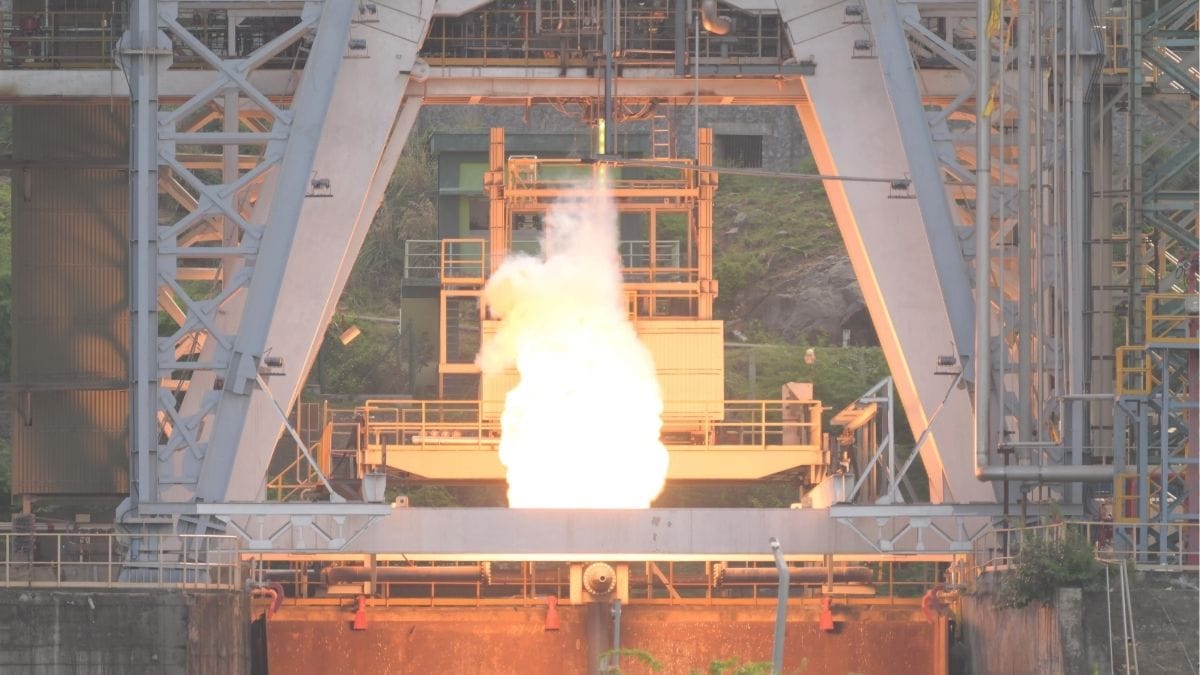
India has taken a proud step forward in its space journey. Very recently the Indian Space Research Organisation (ISRO) successfully carried out a hot test of the powerhead of its semi-cryogenic engine at the ISRO Propulsion Complex in Mahendragiri, Tamil Nadu.
The powerhead ran steadily at 88 per cent of its target thrust level, reaching 175 tonnes. This was the latest and most powerful test in the series, following earlier trials at 47 per cent and 60 per cent of target thrust.
With this success, ISRO now has enough confidence to go for the full-thrust demonstration of the engine at 200 tonnes (2,000 kN).
What is a powerhead?
Think of a rocket engine like the human body. The powerhead is its beating heart and pumping system. It is the assembly of turbo pumps, the pre-burner and the control systems that suck in the fuel and oxidiser and push them, at tremendous force and speed, into the engine to be burnt. Just as the heart decides how strongly blood flows through the body, the powerhead decides how powerfully the propellants flow into the rocket. If this part works well, the whole engine works well.
That is why ISRO tested the powerhead first, on its own, before firing the complete engine a wise and safe way to build confidence step by step.
Experts point out that every rocket needs two things to burn and produce thrust: a fuel and an oxidiser.
The oxidiser is what helps the fuel burn, because there is no oxygen in space. In a normal cryogenic engine, the fuel is liquid hydrogen, and the oxidiser is liquid oxygen. Both have to be kept extremely cold, which makes the whole system costly and difficult to handle. A semi-cryogenic engine works on a slightly different idea. Here, the fuel is refined kerosene, while the oxidiser stays the same — liquid oxygen.
So only one part needs to be kept super cold, and the other part, kerosene, can be stored at normal conditions. That is why it is called "semi" cryogenic — only half of it is cryogenic.
This small change brings big benefits. Liquid hydrogen forms a large and expensive part of the propellant in a rocket. By replacing it with kerosene, the cost comes down sharply. Kerosene also does not need to be cooled to those harsh, very low temperatures that hydrogen demands, since hydrogen turns into gas and takes up huge space unless it is chilled deeply.
This means the difficult problems of insulation and storage become much simpler. The engine also produces more thrust, so the rocket can carry heavier loads into space. This technology is available with only a few nations in the world, and India is now set to join that small group.
“The new engine, named SE-2000, delivers that 200-tonne (2,000 kN) thrust, and is built to burn its fuel at very high pressure for powerful performance. This engine will power a stage called SC120. It will replace the older L110 core stage in our powerful LVM3 rocket. Once this happens, the rocket's strength will grow noticeably. Its payload capacity in geostationary transfer orbit will rise from four tonnes to five tonnes, and its low Earth orbit capacity will go up from eight tonnes to ten tonnes. In short, the same rocket will be able to lift bigger and heavier satellites. For example, it can now launch bigger communication satellites, or more small satellites together in one go,” explained space analyst Girish Linganna.
The development of this engine has been led by the Liquid Propulsion Systems Centre, with the test conducted at a special facility built to handle engines up to 2,600 kN. The non-toxic propellant combination not only improves performance but is also safer and easier to handle than older systems.
With this easier handling, India can also launch more rockets every year. “Right now, for big rockets like LVM3 and not counting the smaller PSLV launches, we manage only about six flights a year. India also launches many foreign satellites, and this earns good revenue, because there is a huge worldwide market for satellite launching services. At present, India holds only about 2 per cent of this global market. The aim is to raise this share to around 10 per cent by 2030 or 2032. This is where the semi-cryogenic engine becomes truly important, as the whole process becomes simpler, faster and cheaper,” added Linganna.
This success has brought ISRO one step closer to qualifying the engine for full-scale testing and, finally, fitting it into India's next-generation launch vehicles. With self-reliant technology like this, India strengthens its own hands in satellite launches and deep-space exploration.
