



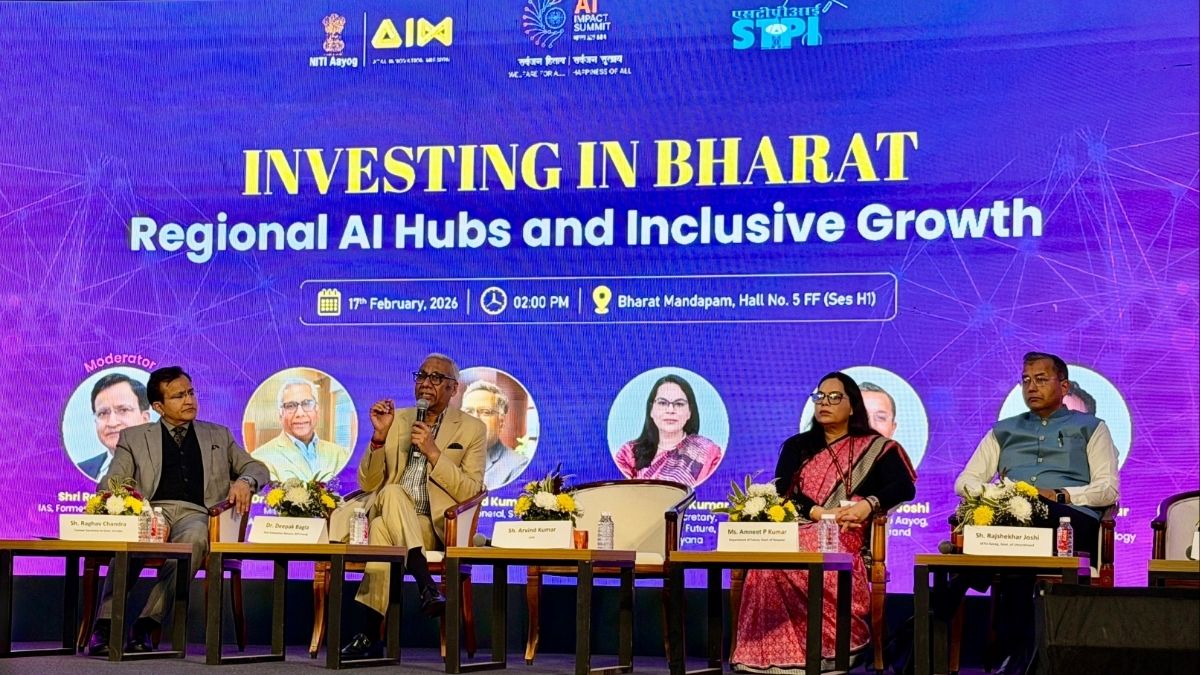
If you were in Delhi in February, you couldn't avoid the hubbub of the AI Impact Summit—it didn’t matter whether you were a tech aficionado or not. And if you did happen to be among the five-lakh-plus AI enthusiasts who attended the six-day-long summit at the Bharat Mandapam, odds are that you attended at least one talk that hammered home the urgent need for ‘data localisation’ or ‘data sovereignty’.
But this fervour around data localisation isn’t new. India’s emphasis on regulating and storing the data of its citizens within its borders has been making waves in the world of global data governance for years now, especially since 2023, when the Ministry of Electronics and Information Technology introduced its landmark Digital Personal Data Protection (DPDP) Act.
India’s rationale is compelling even for globalists—if Indians are generating terabytes upon terabytes of data daily (and data is the new oil), it is only fair that Indians should reap benefits from something they themselves are producing.
After all, training any AI model requires feeding it ample data. One thing is clear as we strike new ground to harvest and harness this ‘new oil’ - India is serious about its position in the AI revolution.
What does this exciting frontier technology space have to do with seemingly stuffy government reform? In order for the government to understand and thereby regulate private data collection effectively, it must thoroughly understand what data can do and what its dangers are.
The entire government machinery generates a massive amount of data that could offer new insights into solving India’s development challenges. However, this data can often be stored in ways that are inaccessible—not only to the outside world but often to many within the government system itself.
Scheme-level progress data that is inputted at the block-level, often under the supervision of a single Block Development Officer for hundreds of schemes, has to travel up the hierarchy to the district, the state and then the centre, and even at the centre, data sharing between ministries is an astoundingly arduous task.
The e-office system introduced years ago has only just expanded to include inter-ministerial files, and data sharing protocols are tedious. The system currently operates on hierarchical permission granting, so for a rank-and-file employee trying to conduct a cross-ministerial data analysis (as and when they might find the time and motivation to innovate or dig deeper beyond their daily duties), the request would go up the chain in their ministry, across to the other, down the chain in there and then back. We can think of these as transaction costs—when they become too high, the transaction does not occur. But for policymakers, these transaction costs actually represent a transformative opportunity. By easing this accessibility bottleneck, grassroots data could become a powerful feeder for India's AI infrastructure.
A question may arise: why should one ministry’s employee be interested in another’s data at all? And how does that help them do their own job? The answer can be illustrated by a peculiarity of India’s malnutrition system.
If a child aged 0-6 years suffers from Moderate Acute Malnutrition (MAM), they fall under the purview of the Anganwadi system, under the Ministry of Women and Child Development.
If they suffer Severe Acute Malnutrition (SAM) with complications, such as pitting oedema, they are supposed to be admitted to a Nutrition Rehabilitation Clinic, under the Ministry of Health and Family Welfare. But if they suffer from SAM without complications, they fall through the system—there is no official place for them to be.
In practice, Anganwadi workers and clinic workers often bend the rules to support them, but that, too, depends on how they are resourced, whether they have the time and budget to take one extra child to a clinic or pay for their F75 or F100 feed.
A similar challenge emerges in the early childhood education domain. A child born with low birth weight would need not only strong nutrition, but also greater emphasis on gross and fine motor skills development.
The circumstances of birth are relevant to the primary physician, community health worker, daycare worker and preschool teacher. Similarly, colocation of Anganwadi Centres with schools requires tracking the same child from birth to three years in infancy, three to six years for playschool, then six to eight years, completing the foundational stage, and beyond.
With Anganwadi centres falling under the purview of the Ministry of Women and Child Development, health centres and hospitals under the Ministry of Health and Family Welfare, and primary schools under the Ministry of Education, effective coordination depends on accessible, shared data for officials at every level working across both Ministries. These are just two examples illustrating a simple point: both India’s challenges and its government institutions are spread out in a vast map that requires an extraordinary amount of coordination to function effectively. They have to be able to talk to each other as seamlessly as possible.
The Digital Personal Data Protection (DPDP) Act, 2023, provides an opportunity to change this. While the Act attempts in admirable ways to protect citizens’ privacy from bad actors or systemic negligence in the private sector, making anonymised public sector data available for legitimate use is equally crucial for innovation and knowledge production. Privacy considerations can help strengthen public trust, while successful data utilisation can improve the effectiveness and efficiency of government functioning.
There are two more points that are worth exploring here: the first is about what shape such a reform can take, and the second is about why this reform is crucial to improving India’s global competitiveness. First, calls have been made for every ministry or department to hire in-house data scientists—this is a significant first step. But in order for human resources to actually do what they’re hired for, they have to be managed properly.
Data scientists hired by the government must be given access to data and empowered with the ability to influence how it is generated, utilised, anonymised, and shared. Bureaucratic reform towards stronger state capacity, including hiring and managing high-capacity and specialised lateral entrants and consultants, is critical for effectively mobilising manpower to orchestrate India’s AI revolution.
How does this connect to India’s global AI ambitions?
International competitiveness, in AI but also in more traditional industries, requires harnessing all of the vast capacities inherent in the Indian population. Providing open access to decentralised administrative data about the performance of central and state government schemes is fodder for both impact evaluation of specific schemes and broader innovation.
In order for India’s public investments in health and education to bear fruit, we must have a way to determine how well our schemes are functioning and where they are failing. Econometric statistical analysis and methodologies are advancing at a remarkable pace globally, and those techniques can be applied even further in the Indian context, to improve scheme functioning, public service delivery and thereby future human capital.
At the same time, innovation is becoming more and more data-driven, and it is in India’s best interest to make its data easily available to researchers, while also strengthening its internal public servants’ capacities. Capacity augmentation in terms of additional staffing as well as training and capacity-building must happen not only at the level of management, i.e. IAS officers, but also at the Group B and Group C officers who actually do much of the grunt work, all the way down to block development officers and frontline workers who generate and input data.
In order for data localisation, and through it the AI revolution, to benefit the average Indian, reliable data must be utilised not only by public institutions but also by students, researchers, private sector companies and civil society organisations seeking to contribute to India’s development. This convergence can only be facilitated if transaction costs are reduced, and the ecosystem opens up to data-driven innovation.
Through the AI Impact Summit, India has clearly staked its claim in an AI-forward future. With the right infrastructural backing, the next Parag Agarwal or Sundar Pichai might not have to look outside India to build their legacy. Our ambitions towards a 5 trillion-dollar economy driven by indigenous innovation can be met—but our public institutions need committed support so that we’re not just watching the AI revolution from the sidelines, but actually leading it.
The writer is national initiatives and policy lead at Rocket Learning.
The opinions expressed in this article are those of the author and do not purport to reflect the opinions or views of THE WEEK.
