



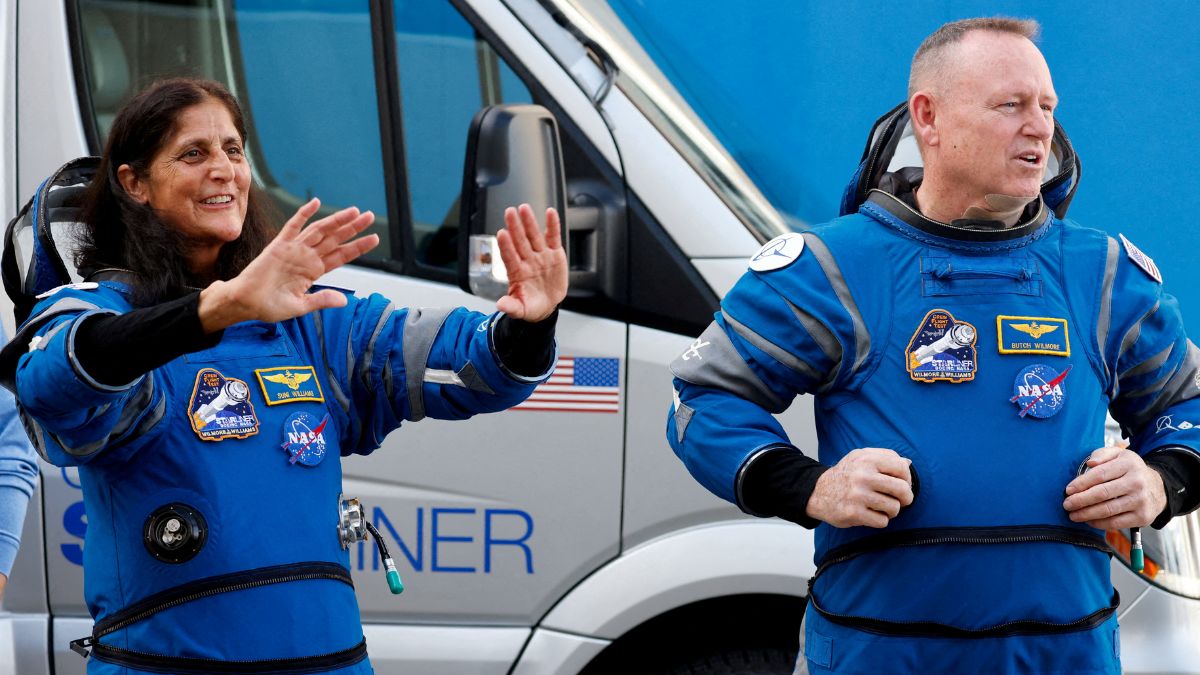
Space travel is a remarkable achievement, but it also comes with challenges that make it unpredictable. Sunita Williams and Barry Wilmore, who were supposed to return from the International Space Station (ISS) quickly, now face an extended stay due to a mix of technical issues and bad weather. What should have been a routine return mission has turned into a complex situation, highlighting the difficulties of human spaceflight.
Williams and Wilmore launched on June 5, 2024, aboard the Boeing Starliner, marking a key milestone for Boeing in commercial space transportation. Their original plan was to stay on the ISS for about a week to ten days, conducting important tests and collecting data before returning to Earth. However, after docking, engineers discovered helium leaks and thruster issues in the Starliner’s propulsion system. These problems required careful assessment and repairs, leading to delays in their return.
Since the Starliner could not be used for their journey back, NASA decided to bring them home using a SpaceX Crew Dragon capsule instead. This decision caused a ripple effect, impacting multiple missions, including Crew-9 and Crew-10. Initially, Williams and Wilmore were expected to return in early February 2025, but various challenges have repeatedly pushed their return date further.

The Crew-9 mission, launched in late September 2024 under NASA’s Commercial Crew Program, had a different setup compared to usual missions. Instead of carrying four astronauts, it had only two—NASA’s Nick Hague and Roscosmos’ Aleksandr Gorbunov. This was done to keep two seats available for Williams and Wilmore’s return.
With the Starliner unable to complete its mission, the Crew-9 Dragon capsule was modified to bring them back safely. However, before they could leave, a replacement crew had to arrive at the ISS to take over their responsibilities.
That replacement crew was assigned to SpaceX Crew-10, which was supposed to carry four astronauts to the ISS. Unfortunately, this mission has faced multiple delays due to technical issues and bad weather.
One major problem was a malfunction in the ground support system at the launch site. A hydraulic failure in a clamp arm, which secures the Falcon 9 rocket before liftoff, created a safety risk. Engineers have been working to fix and test the system, but this has further delayed the launch.
Additionally, strong winds and heavy rain at the planned splashdown locations for the returning Dragon capsule have made it unsafe to proceed. Since astronaut safety is the top priority, NASA and SpaceX must carefully monitor the weather before approving any launch or return.
Just an hour before liftoff, SpaceX postponed the launch of the Falcon 9 rocket from Florida. This mission was meant to transport four astronauts to the ISS to replace Williams and Wilmore, who have been waiting for their return.
NASA and SpaceX stated that the Crew-10 mission was postponed due to a hydraulic system issue with the ground support clamp arm at Launch Complex 39A at NASA’s Kennedy Space Center. For safety reasons, the launch was delayed.
NASA has now set a new target for liftoff, planning to launch no earlier than 7:03 PM EDT (4:33 AM IST) on Friday, March 14.
After reviewing weather conditions, officials decided to cancel the previous launch attempt scheduled for Thursday, March 13, due to forecasts predicting strong winds and heavy rainfall along the Dragon spacecraft’s flight path.
These conditions could pose serious risks during launch, so mission managers opted to wait until the weather improves.
NASA astronauts Anne McClain and Nichole Ayers, along with JAXA astronaut Takuya Onishi and Roscosmos cosmonaut Kirill Peskov, have safely exited the Dragon spacecraft. The rocket remains in good condition and will be ready for launch once all technical and weather-related challenges are resolved.
Experts point out that even after Crew-10 reaches the ISS, Williams and Wilmore’s return won’t be immediate.
''A handover period is required, during which the new crew gets familiar with ISS operations, ongoing experiments, and daily tasks. This transition usually takes a few days to ensure a smooth exchange before Crew-9 and Williams’ team can leave," explained space expert Girish Linganna.
It is expected that with ongoing technical repairs and weather monitoring, the tentative window for Williams and Wilmore’s return is now projected for late March or early April 2025. However, this timeline remains subject to change, depending on real-time assessments and mission developments.
"This situation highlights the complexities of space travel. Even with the most advanced technology, unexpected challenges can arise. It serves as a reminder of the risks involved in human spaceflight and the importance of patience, problem-solving, and backup plans to ensure astronaut safety." added Linganna.
