



At an average temperature of 17.01°C globally, Monday – July 3 – was the world’s hottest day on record. The previous highest was 16.92°C in August 2016.
At about 0.8°C higher than the average for the time of year during the late 20th century, this rise is the culmination of the burning of fossil fuels, human activities and emerging weather conditions due to El Niño (a phase of unusually warm weather).
A 2021 report by the Intergovernmental Panel on Climate Change (Summary for Policymakers), has concluded that global temperatures have not been as high as they are now for 125,000 years.
Reasons? As per IPCC, ‘unequivocal human influence’ that has warmed the atmosphere, ocean and land; increased greenhouse gas emissions; changed precipitation; altered near-surface ocean salinity; caused the global retreat of glaciers.
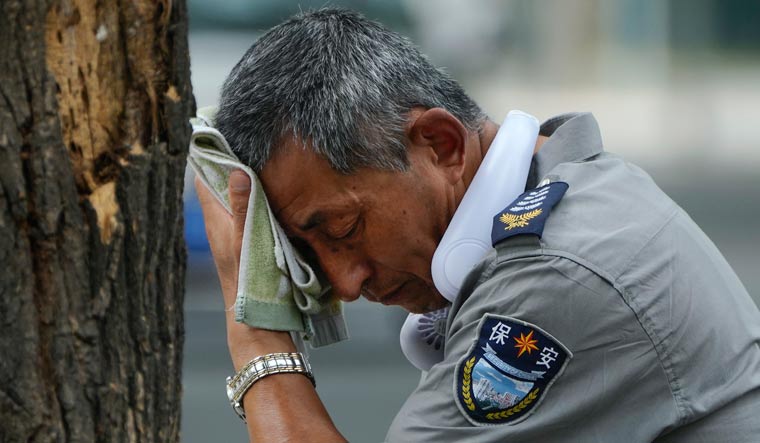
Here are some examples of what happened around the world on July 3. Texas and large parts of the southern USA were being hit by very high temperatures linked with a heat dome. The worst ever wildfires in Canadian history continued to burn, with an area more than the United Arab Emirates already charred. China continued to reel under a heatwave with temperatures above 35°C, and major floods hitting parts of the country. North Africa saw temperatures of 50°C. The British Isles and Nordic countries reeled under extreme marine heat waves, and even the Antarctic region broke records of previous high temperatures.
As per the Indian Metrological Department, minimum temperatures were above normal at isolated places over Odisha; at many places over Gangetic West Bengal, Jharkhand, Jammu-Kashmir-Ladakh-Gilgit-Baltistan-Muzaffarabad, Punjab and Chhattisgarh and also in Himachal Pradesh among other places.
Dr Robert Rohde, lead scientist at Berkeley Earth, a US non-profit climate research organisation, has predicted that this record is likely to be broken again in July itself.
Friederike Otto, senior lecturer in Climate Science at the Grantham Institute for Climate Change and the Environment, London, said, “This is not a milestone we should be celebrating, it's a death sentence for people and ecosystems. And worryingly, it won't be the hottest day for a long time. With El Niño developing, the world will likely break this record again in the coming months. We absolutely need to stop burning fossil fuels.”
Saleemul Huq, director, International Centre for Climate Change and Development (ICCCAD), Independent University, Bangladesh, said, “Loss and damage from human induced climate change has arrived throughout the world…. Expect many more hottest days in (the) future."
