


 Add as a preferred source on Google

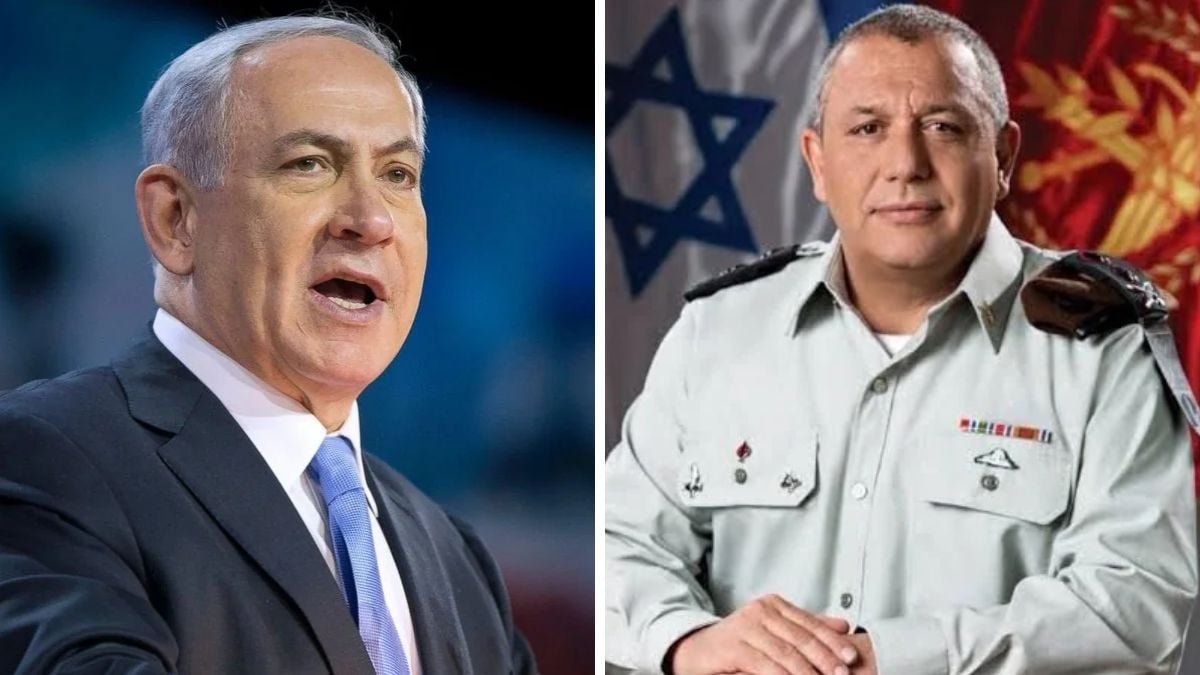
The crucial meeting between Benjamin Netanyahu and Gadi Eisenkot in Herzliya this morning could shape Israel’s next government. By offering his political rival the first turn as prime minister in a proposed national unity government, Netanyahu has made a dramatic concession. But the offer is also a high-stakes political gamble, aimed at disrupting an emerging opposition coalition, buying time, and preserving his influence over the country’s political future. For Eisenkot, who is nearing the end of his mandate to form a government, accepting the offer could bring him to power but leave him vulnerable to Netanyahu’s manoeuvring. The negotiations will test the credibility of Netanyahu’s offer and Eisenkot’s ability to secure a government without compromising his political commitments.
Netanyahu announced the proposal in a video statement last night, calling it a patriotic response to the scale of the security challenges facing Israel. Although his Likud party secured 27 seats in the October 27 election, compared with 21 for Eisenkot’s Yashar party, Netanyahu said he was prepared to set aside the principle that the leader of the largest party should become prime minister, allowing Eisenkot to serve first while he assumed the position of alternate prime minister. He called for immediate negotiations to establish a broad-based government capable of addressing the country’s security and political challenges.
However, the apparent generosity of the offer has been tempered by reports of conditions that could fundamentally alter the arrangement. According to Hebrew media reports, Netanyahu wants to remain prime minister for an initial period of three to four months before transferring power to Eisenkot. He has reportedly justified the proposed delay by citing heightened regional tensions and the possibility of a confrontation with Iran. Eisenkot opposes any arrangement that postpones the transfer of executive authority, viewing it as an attempt to undermine the central promise of the proposal. The inclusion of Netanyahu’s traditional ultra-Orthodox allies, United Torah Judaism and Shas, adds another complication, particularly over the contentious question of military conscription.
The timing of Netanyahu’s overture is significant. The election produced no clear parliamentary majority, with his right-wing bloc securing 53 seats against 48 for the anti-Netanyahu change bloc. President Isaac Herzog subsequently entrusted Eisenkot with a 28-day mandate to form a government after 67 lawmakers recommended him for the task. Eisenkot had made considerable progress towards assembling an alternative coalition without Likud. He reached agreements with Avigdor Liberman’s Yisrael Beytenu and Yair Golan’s Democrats while holding advanced discussions with ultra-Orthodox parties.
The possibility of securing support from Arab lawmakers further strengthened his position. Ra’am leader Mansour Abbas indicated that his party could facilitate an Eisenkot-led government, acknowledging in a television interview that Hamas was a terrorist organisation—a condition Eisenkot had set for cooperation. Reports that Eisenkot was close to putting together a viable parliamentary arrangement involving ultra-Orthodox and Arab factions intensified concerns within Likud. The pressure increased when Naftali Bennett, leader of B’Yachad, gave Netanyahu an ultimatum: offer Eisenkot the first turn as prime minister or risk Bennett formally joining an alternative coalition. Netanyahu’s sudden change of position was therefore as much a response to an immediate political threat as an appeal for national unity.
His strategy appears to have two objectives. The first is to prevent the formation of a government that would remove Likud from power. The second is to exploit the ideological differences within the opposition. By offering Eisenkot the premiership, Netanyahu has placed Bennett in a difficult position and exposed disagreements among the parties seeking to dislodge him. While Bennett welcomed the proposal, Yair Lapid and Golan were quick to express reservations. Their objections reflect a broader concern that Netanyahu could use unity negotiations to delay the formation of an alternative government and eventually retain power.
Netanyahu has also sought to portray an Eisenkot administration dependent on Arab parties as a threat to national security. He has repeatedly argued that cooperation with Ra’am or the Joint List could create conditions for an Iranian-backed Palestinian state. By presenting his offer as a means of avoiding such dependence, he is attempting to make the unity option politically attractive to sections of the opposition while drawing the ultra-Orthodox parties back into his political camp. Even if the negotiations fail, the process could consume valuable days of Eisenkot’s mandate, giving Netanyahu additional time to consolidate his position.
For Eisenkot, however, accepting the offer could prove as dangerous as rejecting it. Becoming prime minister without relying on Arab parliamentary support would be a major political achievement. But entering a government with Netanyahu would mean trusting a leader whose previous coalition arrangements have ended in bitter disputes. The experience of 2020, when Netanyahu entered a rotation agreement with Benny Gantz but failed to transfer power after the government collapsed over the state budget, remains a powerful warning. Lapid and Golan have already cautioned Eisenkot against repeating what they regard as a familiar political manoeuvre.
There are also substantial policy differences. Netanyahu’s proposed arrangement envisages accommodating the demands of Shas and United Torah Judaism, particularly on the military conscription of ultra-Orthodox men. This would put Eisenkot in a difficult position. A former military chief, he has made a more equitable distribution of military service obligations an important political commitment. Bennett has also treated universal conscription as a red line. Any concessions to the ultra-Orthodox parties could therefore alienate important allies and undermine the credibility of the proposed government even before it takes office.
Eisenkot has insisted that negotiations must address concrete policy principles and legal safeguards rather than remain an open-ended political exercise. With his 28-day mandate due to expire on December 6, the immediate choices are becoming increasingly narrow. The two sides could agree on a unity government with legally binding guarantees for the transfer of power. Alternatively, negotiations could collapse, allowing Eisenkot to pursue a narrower coalition involving Bennett, ultra-Orthodox factions, and parliamentary support from Ra’am. If neither arrangement materialises, he could seek a 14-day extension from Herzog, prolonging the political uncertainty and potentially bringing another election closer.
For Netanyahu, the stakes extend beyond the immediate struggle to remain in office. Yielding the PM office, even temporarily, would be a significant blow to his political standing and his image as Israel’s dominant conservative leader. It could also require him to make difficult compromises with far-right allies Itamar Ben-Gvir and Bezalel Smotrich. Yet the position of alternate prime minister would preserve considerable influence, keep him within the governing establishment, and potentially provide opportunities to destabilise the arrangement from within.
Eisenkot, meanwhile, faces a defining test of political judgement. An agreement could make him PM and establish him as a central figure in Israeli politics. But a poorly negotiated arrangement could leave him vulnerable to Netanyahu’s political manoeuvring, fracture his support base, and compromise his commitments on military conscription and governance.
