



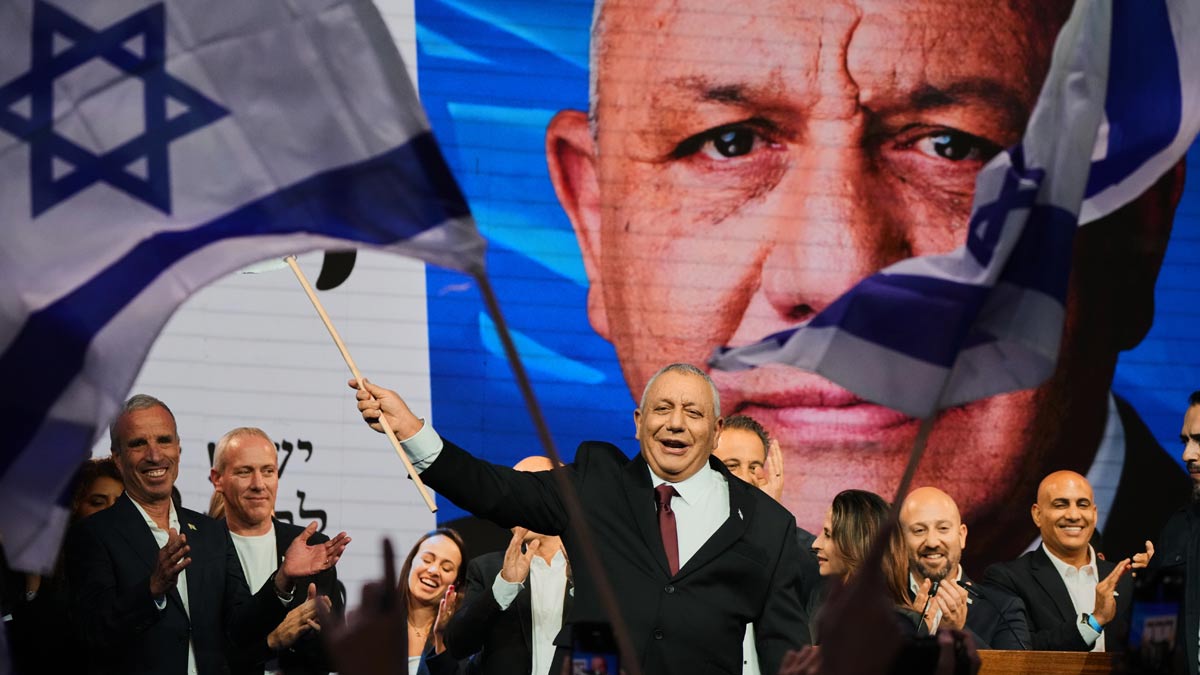
Israel’s October 27 election has opened the possibility of ending Benjamin Netanyahu’s long dominance of politics, but it has not yet produced a clear alternative. President Isaac Herzog has given Gadi Eisenkot, leader of the centre-right Yashar party and former army chief, the mandate to form the next government. The decision is a setback for Netanyahu, whose Likud emerged as the single largest party with 27 seats. But Eisenkot’s path to the premiership is far from assured.
The 120-member Knesset is divided between Netanyahu’s religious-right bloc, which has 53 seats, and the opposition’s change bloc, with 48. The two Arab-led alliances have secured a record 19 seats, giving them considerable leverage in determining who governs. During consultations with Herzog, 67 legislators recommended Eisenkot for the mandate, compared with 46 for Netanyahu. The ultra-Orthodox United Torah Judaism (UTJ), with seven seats, abstained.
The distinction between receiving a mandate and becoming prime minister is important. For instance, it is totally different from how things work in India. After a general election here, the president appoints the person considered most likely to command a majority in the Lok Sabha as prime minister. The PM takes the oath of office and subsequently demonstrates majority support through a floor test. Israel follows a different sequence. The president consults the elected factions and gives a candidate an opportunity to negotiate a coalition. Eisenkot has 28 days, with a possible 14-day extension, to secure the necessary support. He must then present his government to the Knesset and win an investiture vote. Until that happens, Netanyahu remains caretaker prime minister.
The 67 recommendations therefore represent political backing for Eisenkot to get the first opportunity, not a ready-made parliamentary majority. He needs at least 61 votes to establish a government, and his own four-party bloc is 13 short. The challenge is to find those votes without alienating the parties that have brought him this far.
Eisenkot has set out four conditions for prospective partners: acceptance of Israel as a Jewish and democratic state, adherence to the Declaration of Independence, universal military or civilian service, and a commitment to dismantling Hamas. The conditions are intended to provide a common national framework after a deeply divisive election. But they also expose the contradictions among the parties whose support he needs.
The first possibility lies with the Arab-led parties, Ra’am and the Joint List, whose combined 19 seats could provide the parliamentary support necessary to dislodge Netanyahu. Eisenkot could attempt to form a minority government with the parties supporting it from outside rather than joining the coalition. Such an arrangement would be politically contentious but not without precedent. In 2021, Naftali Bennett and Yair Lapid formed a government with the support of Ra’am, ending Netanyahu’s continuous tenure.
There are, however, considerable obstacles. Ra’am leader Mansour Abbas has condemned the October 7 attacks but has not accepted Eisenkot’s demand to designate Hamas a terrorist organisation. The Joint List rejects the constitutional formulation of Israel as a Jewish democracy. More importantly, several Jewish parties in Eisenkot’s own bloc, including Bennett’s faction, have opposed depending on Arab legislators to sustain a government. Their support could be difficult to maintain if Eisenkot relies on the Arab parties, even from outside the coalition. A minority government would also remain vulnerable to parliamentary obstruction and the threat of no-confidence motions.
The second possibility is to bring the ultra-Orthodox parties into the change bloc. UTJ’s seven seats and Shas’s six could take the opposition from 48 to 61, provided both agree to participate. This route has gained attention because of an unexpected shift in Liberman’s position. The Yisrael Beytenu leader, traditionally a strong opponent of religious privileges in public life, has indicated a willingness to make painful compromises on Haredi military conscription to avoid another election. UTJ has also shown some willingness to negotiate.
But the compromise could prove politically expensive. Eisenkot and Democrats leader Yair Golan want meaningful conscription quotas and safeguards for secular public life. Broad exemptions for ultra-Orthodox men would alienate voters who supported the change bloc precisely to end what they see as an unequal burden of military service. The issue has become particularly sensitive after the war and the pressure on Israel’s armed forces. Eisenkot would risk undermining one of the central arguments on which his coalition fought the election.
A broader national unity government involving Likud is another theoretical possibility. It could provide a more comfortable parliamentary majority, but the political obstacles are substantial. Eisenkot and his partners campaigned on replacing Netanyahu, while the prime minister wants any unity arrangement to be formed under his leadership and include his far-right allies, Otzma Yehudit and Religious Zionism. The opposition has little incentive to abandon its electoral mandate for such an arrangement.
Netanyahu, meanwhile, is unlikely to make Eisenkot’s task easier. Having spent nearly 19 years in office, he faces the prospect of losing power and the political protection that comes with it. His strategy is to exploit the contradictions within the opposition, particularly its dependence on Arab legislators. He has portrayed a government reliant on Arab support as a threat to national security and described such an arrangement as national suicide. He has also sought to delegitimise the prospect of Arab parties exercising influence over the government.
If Eisenkot fails, the mandate could pass to another candidate, potentially giving Netanyahu another opportunity to assemble a coalition. If successive attempts fail, Israel could face another election, with Netanyahu continuing as caretaker prime minister. The prospect of a fresh poll is itself a consideration for parties that may be reluctant to compromise but are equally unwilling to prolong the political deadlock.
