



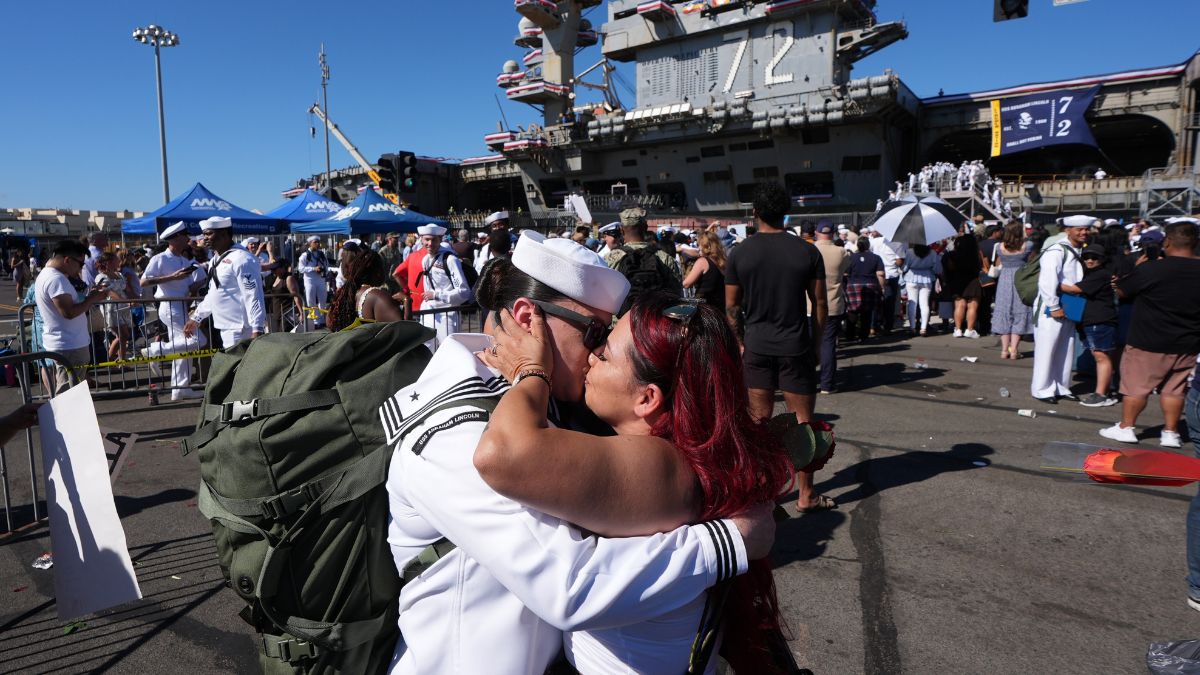
The nuclear-powered aircraft carrier USS Abraham Lincoln returned to its home port at Naval Air Station North Island in San Diego, California, following an extraordinary deployment supporting the war on Iran. Docking on Thursday afternoon Pacific time, the massive vessel brought home nearly 5,000 service members after a total deployment lasting 322 days. During this period, the ship set a post-Vietnam War record by spending 265 consecutive days at sea without a single port call, before making a brief stop in Thailand in early September. Having left California last November, the carrier completed one of the most operationally intense assignments in modern naval history before being relieved in the Middle East by the USS George Washington.
Thousands of anxious relatives and friends gathered along the quayside, waving flags and holding handmade banners as the carrier entered the bay. By long-standing naval custom, disembarkation priority was granted to 122 new fathers stepping off to embrace infants born during their 10-month absence. Ceremonial traditions also featured a raffle winner taking the traditional "first kiss" on the pier before general disembarkation commenced. Returning sailors expressed profound relief, noting plans to take rotation leave, seek counselling support and enjoy long-awaited home-cooked meals with family after months of gruelling isolation.
Originally dispatched to the Pacific, the Lincoln was swiftly redirected to the Middle East ahead of combined US-Israeli air strikes against Iran that launched on February 28. Once in theatre, the Lincoln carrier strike group conducted a relentless operational campaign, executing over 10,000 total sorties, 23,000 combat flight hours, and nearly 3,700 direct combat sorties. According to official military citations, the strike group launched 450 Tomahawk cruise missiles, destroyed 21 anti-ship cruise missiles, shot down 77 one-way attack drones, and sank 64 Iranian warships. Furthermore, carrier-borne aircraft were instrumental in enforcing a naval blockade on Iranian harbours, including tactical actions that disabled the tankers M/T Hasna and M/T Marivex.
The protracted period at sea placed immense hardship on the ship’s crew, triggering severe logistical and welfare challenges. After Iranian strikes destroyed the US Navy’s principal regional hub in Manama, Bahrain, supply lines were forced to shift 3,600km away to Diego Garcia, precipitating critical supply bottlenecks. Sailors endured rationed food supplies, reduced meal choices, intermittent water shortages and severe mail delays that severely impacted mental and physical health. Official Navy correspondence confirmed that eight sailors attempted suicide during the deployment, including two who attempted to jump overboard before being intercepted or rescued by crewmates.
Prior to the carrier docking, US Defence Secretary Pete Hegseth boarded the vessel to personally present the crew with the Presidential Unit Citation, the highest unit honour awarded for valorous combat service. Hegseth praised the sailors' resilience and vigorously defended the mission, rejecting media reports that framed the vessel as a symbol of low morale or military dysfunction. The conditions aboard had previously sparked intense political debate; President Donald Trump brushed aside mental health concerns in August, asserting the deployment was "not nearly long enough". Conversely, congressional leaders called for formal Inspector General investigations into shipboard conditions and military readiness.
The return of the Lincoln underscores broader strategic pressure on the US Navy, whose carrier fleet has been heavily strained by the ongoing Iran war. Trump, meanwhile, announced yesterday that the US would suspend military strikes against Iran till the midterm elections on November 3. However, global energy markets remained deeply unsettled; Brent crude prices rose to $104 per barrel, domestic petrol prices remained 45 per cent higher than pre-war levels and commercial shipping through the crucial Strait of Hormuz remained severely restricted.
