



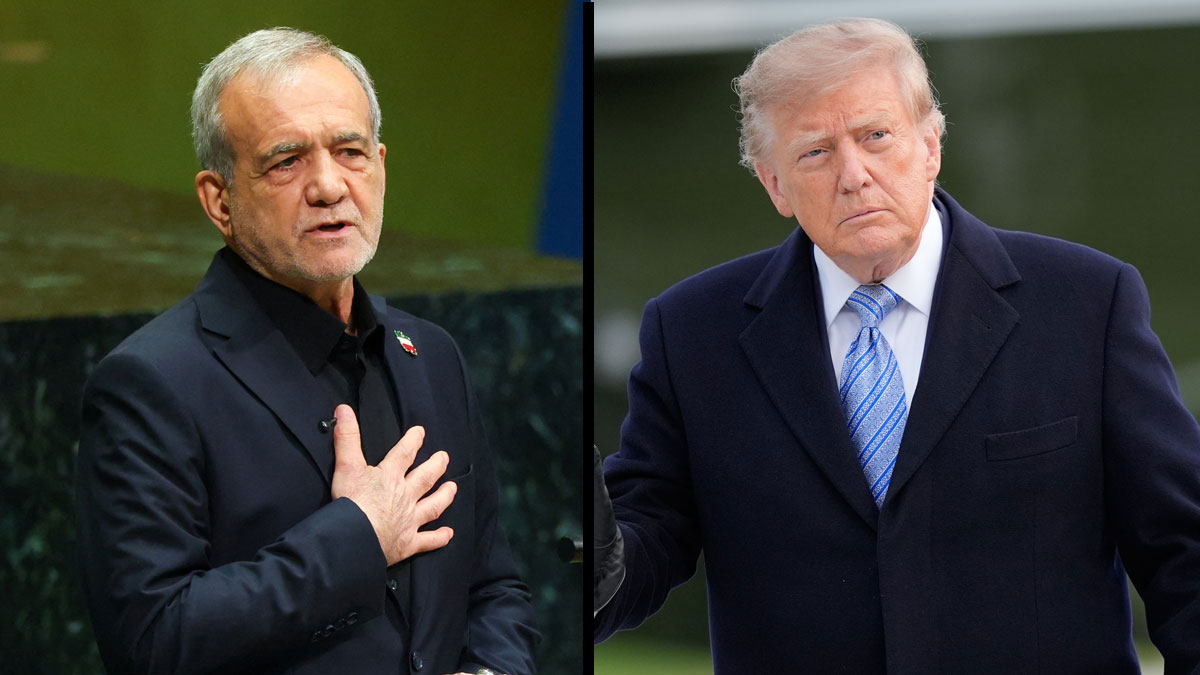
Iran's first response to Donald Trump's rejection of its seven-day peace plan was not to declare it dead, but to insist it had not yet received a formal reply. Foreign Minister Abbas Araghchi told reporters that Tehran had only registered an "initial reaction" and would wait for Washington's position to arrive through mediators—understood to be Qatar or Oman—before treating the matter as settled.
Araghchi accused Trump of issuing contradictory statements and argued that only a negotiated settlement could break the deadlock, while making clear that reopening the Strait of Hormuz remains conditional on the United States meeting Iran's terms. President Masoud Pezeshkian went further, saying Iran no longer trusts negotiations with Washington, since previous rounds of talks have been followed by fresh strikes and sanctions rather than relief. Iran would never "bend the knee", he said, though it remained open to talks conducted with mutual respect. He described the closure of the strait as a defensive response to American restrictions on Iranian shipping routes, not as an act of aggression.
Trump's rejection, delivered outside the White House, was characteristically stark. "They made a proposal, but I rejected it," he told reporters. The plan required Washington to release $12 billion in frozen Iranian assets, waive sanctions on Iranian oil exports, lift the naval blockade on Iranian ports and enforce a ceasefire across Lebanon and Yemen within four to five days, in exchange for Iran reopening Hormuz on the sixth day and restarting nuclear negotiations, including access for UN inspectors, on the seventh.
Trump's reasons for refusing were threefold. He judged the offer a sign of weakness, arguing Tehran had come forward only because it was "losing so badly" under economic and military pressure. His officials dismissed the plan as a set of half measures that stopped short of the permanent dismantling of Iran's nuclear programme and unrestricted maritime passage that Washington has demanded throughout. Gulf allies, Saudi Arabia in particular, were reportedly uneasy that the arrangement had been structured bilaterally between Iran and Oman rather than as a joint undertaking involving the wider Gulf. Trump underlined his position by posting a map on Truth Social renaming the waterway the "Trump Strait", a gesture asserting American control over a passage Iran considers its own.
Analysts have accordingly written off the seven-day proposal, even as indirect contact through Qatar continues. The more consequential timeline now runs to November. Trump has told aides he expects to resume strikes on Iran once the midterm elections have passed, a position consistent with his warning at the UN General Assembly that he would either strike a deal after the vote or "annihilate" the Islamic Republic. Analysts expect the scale of Republican losses, if any, to shape which of those paths he chooses. A poor result may push him towards unilateral military action as a show of strength before any further negotiation is attempted.
Washington's calculation rests on the assumption that time and economic pressure favour the United States. Under what officials have called Operation Economic Outcast, a naval blockade has been paired with secondary sanctions severe enough to prompt Turkey, the UAE and Iraq to suspend flights to Iran, restricting civilian access to religious centres such as Najaf. The expectation in Washington is that sustained pressure will eventually bring Tehran back on considerably less generous terms, and that accepting anything resembling the collapsed June memorandum before November carries too much domestic political risk. Trump has accused Iran of deliberately prolonging the war to keep energy prices high and damage Republican prospects at the polls.
As far as Iran is concerned, the seven-day offer was timed to test whether Trump's exposure to rising fuel prices would make him receptive to a quick de-escalation. With sanctions increasingly reaching into civilian infrastructure, the window for relief is closing, and Tehran appears unwilling to accept indefinite containment. If diplomacy remains blocked, Iran is likely to resort to “calibrated escalation”, harassment of shipping or strikes on regional energy assets intended to demonstrate that the cost of pressure runs both ways.
