



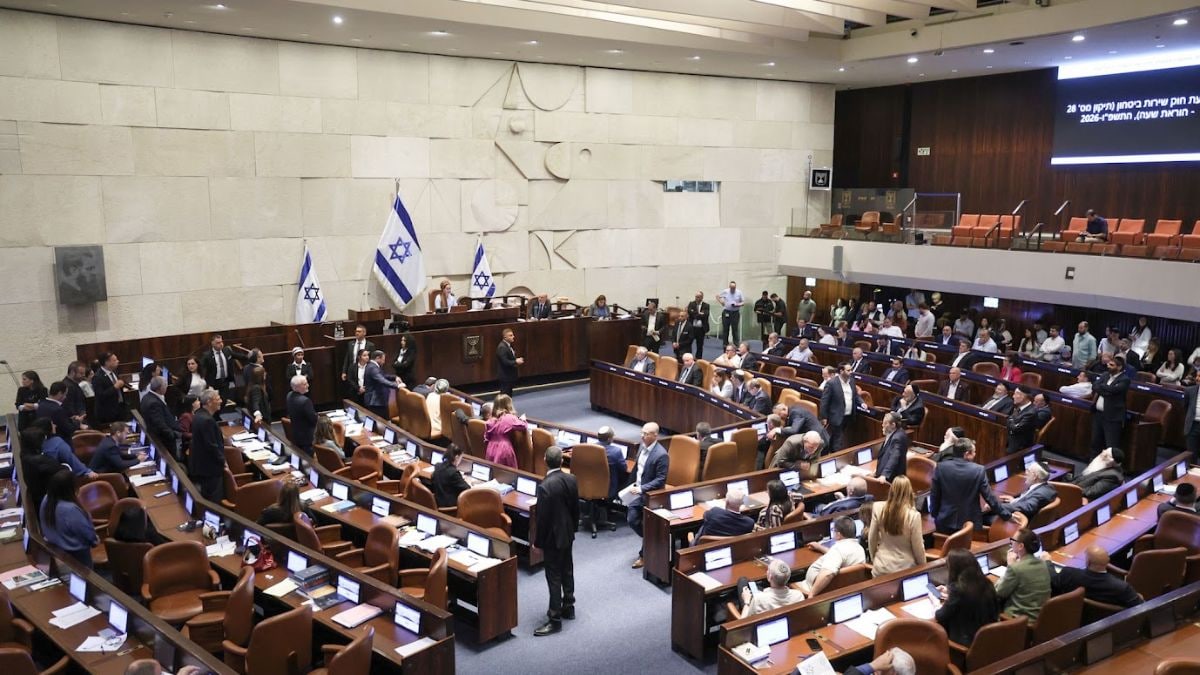
The recurring tradition in which Arab political parties and candidates in Israel face disqualification motions ahead of Knesset elections is not a coincidence; rather, it constitutes a structural feature of Israeli politics. This persistent threat of eviction operates at the nexus of constitutional doctrine and the politicised composition of the election regulatory apparatus. This also serves as the systemic electoral incentive that drives mainstream right-wing coalition building. Far from being merely technical disputes over campaign conduct, these disqualification initiatives reflect deep, institutionalised tensions between Israel’s self-identification as both a Jewish and democratic state and the legitimate political representation of its national Arab minority.
These challenges stem from Section 7A of Basic Law: The Knesset, originally enacted on 7 August 1985, and later expanded on 22 May 2002. This framework structures the authority shared by the Central Elections Committee (CEC) and the Supreme Court (SC) in disqualification decisions. The law empowers the CEC to disqualify political parties or individual candidates from participating in elections primarily on three grounds: First, the negation of Israel as a Jewish and democratic state; second, incitement to racism; and third, support for the armed struggle of an enemy state or terrorist organisation against Israel. The law also mandates judicial oversight of CEC decisions, whether through automatic referral or appeal, before a disqualification can take legal effect.
Over time, the first and third prongs have become ideological traps for Arab parliamentarians. For political parties like Balad(National Democratic Assembly), whose foundational platform envisions Israel as “a state of all its citizens,” democratic advocacy for a structural civil equality is routinely characterised by political opponents as an active negation of the state’s Jewish character. Furthermore, expressions of solidarity with Palestinians in the occupied territories or meetings with regional figures frequently face broad conflation with endorsing armed struggle.

The CEC's institutional design operationalises this statutory ambiguity. Although chaired by a Supreme Court justice, the CEC includes political party representatives, in proportion to their strength in the outgoing Knesset. The body is inherently partisan rather than neutral or quasi-judicial. Consequently, petitions brought to disqualify Arab parties are decided along majority-minority party lines. When right-wing and nationalist factions hold a legislative majority, the CEC doubles as an electoral theatre where ideological adversaries vote on the legality of their competitors and functions as a public declaration of ideological purity and nationalist resolve.
The persistence of these motions is further explained by strategic electoral utility. In a deeply polarised political landscape characterised by narrow coalition margins, delegitimising Arab political participation yields significant returns for right-wing actors. Initiating a petition before the CEC offers widespread media exposure, reinforces an us-versus-them narrative, and mobilises conservative voters without requiring extensive policy outcomes.
Moreover, even if disqualification is not expected to survive an appeal, continually framing Arab elected officials as a fifth column or illegal interlopers in the Knesset alienates Arab voters from the institutional political system. Such rhetoric reinforces the perception among the Arab minority that parliamentary participation is fundamentally constrained and unwelcome, which dampens voter turnout and gives a mathematical advantage to the right-wing parties.
The Supreme Court of Israel has historically served as the institutional buffer against this cycle. Because CEC decisions to disqualify lists or candidates are subject to mandatory confirmation or appeal before the High Court, justices have consistently intervened to overturn these bans. Grounded in the principle of defending basic democratic rights to vote and to stand for election, the Court established high evidentiary standards in landmark cases involving figures such as Azmi Bishara (Balad) and Ahmad Tibi (Ta’al). The judiciary has maintained that disqualification is an extraordinary sanction reserved only for instances where the negation of the state or support for armed struggle is clear, unequivocal, and the dominant feature of a party’s agenda.
However, this cyclical judicial intervention produces an ironic, self-perpetuating dynamic. Each time the CEC votes to ban an Arab list and the Supreme Court subsequently overturns the ban, the event feeds a broader, ongoing conflict over judicial review. Right-wing parties leverage the Court’s decision as ostensible evidence of an out-of-touch, activist judiciary shielding “supporters of terror.” Using this narrative, they justify legislative initiatives to curb judicial oversight and lower the statutory threshold for banning candidates under Section 7A.
The eviction threat confronting Arab lists before Knesset elections is not an incidental byproduct of campaign rhetoric, but a structural phenomenon. It is sustained by constitutional frameworks that prioritise ethnic nationalism over neutral civil equality, enforced by a partisan administrative body, and incentivised by the competitive mechanics of right-wing coalition mobilisation. So long as full civic equality is viewed through the lens of constitutional negotiations, Arab political participation will remain precariously situated on the threshold of parliamentary legitimacy.
The author is a doctoral candidate at the Centre for West Asian Studies, Jawaharlal Nehru University, New Delhi.
