



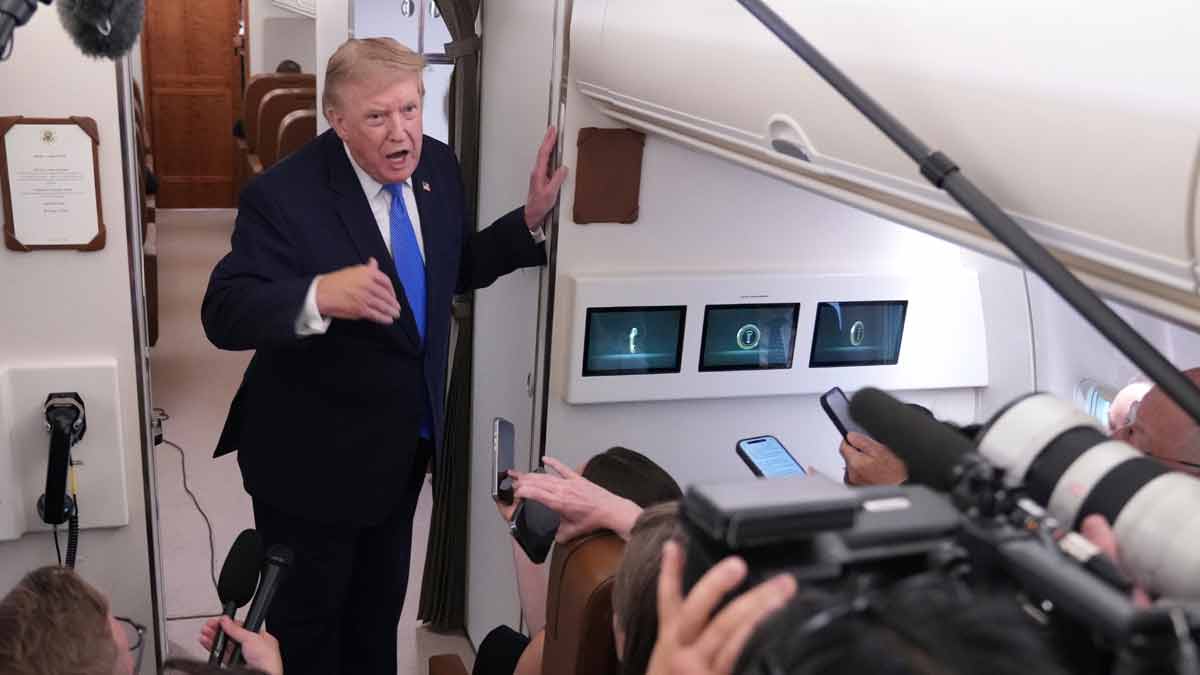
US President Donald Trump said negotiations with Iran are set to begin on Monday after the United States suspended planned military strikes against Tehran at the request of key Gulf allies.
Speaking to reporters aboard Air Force One, Trump said the talks would begin on Monday afternoon and expressed hope that diplomacy could avert further conflict.
"We are talking to them [the Iranians] in the form of a negotiation; it begins tomorrow afternoon, and we'll see how it goes. I'd love to do that. It'll save a lot of lives and a lot of unnecessary power, to be honest with you," Trump said.
The president revealed that he had refrained from authorising additional US strikes after appeals from Qatar, Saudi Arabia, and the United Arab Emirates, which urged Washington to pursue a diplomatic resolution.
"We are ready to go whenever we want. Would I rather make a deal? I'm not looking to kill people, because a lot of people die; we don't want that. So they asked us—Iran specifically, but the other three, they asked us," he said.
Trump also disclosed that the US military had prepared what he described as "the biggest attack since World War II" for Sunday. However, he said he abandoned the plan after consulting Gulf leaders, who warned that military action could further destabilise the region.
"I said to the crown prince, 'What would you rather do? Would you rather us do this or not?' They said we would much prefer a deal as opposed to an attack, because you don't know where these attacks lead," Trump said.
The shift toward diplomacy came just a day after Trump said he was "losing faith" in negotiations with Iran and warned that the US military "will be hitting them very hard."
Trump also suggested that a broader agreement could be reached covering both the management of the Strait of Hormuz and the denuclearisation of Iran.
Previous negotiations between Washington and Tehran had broken down over differing interpretations of a proposed framework. Trump maintained that the agreement would ensure the Strait of Hormuz remained permanently open to international shipping, while Iran insisted that any arrangement would preserve its sovereign control over the strategically vital waterway.
Trump on Sunday reiterated that the emerging deal would include a reopening of the Strait of Hormuz, the critical waterway where about a fifth of the world's energy flowed before the start of the war, and would resolve US concerns about Iran's nuclear programme.
