



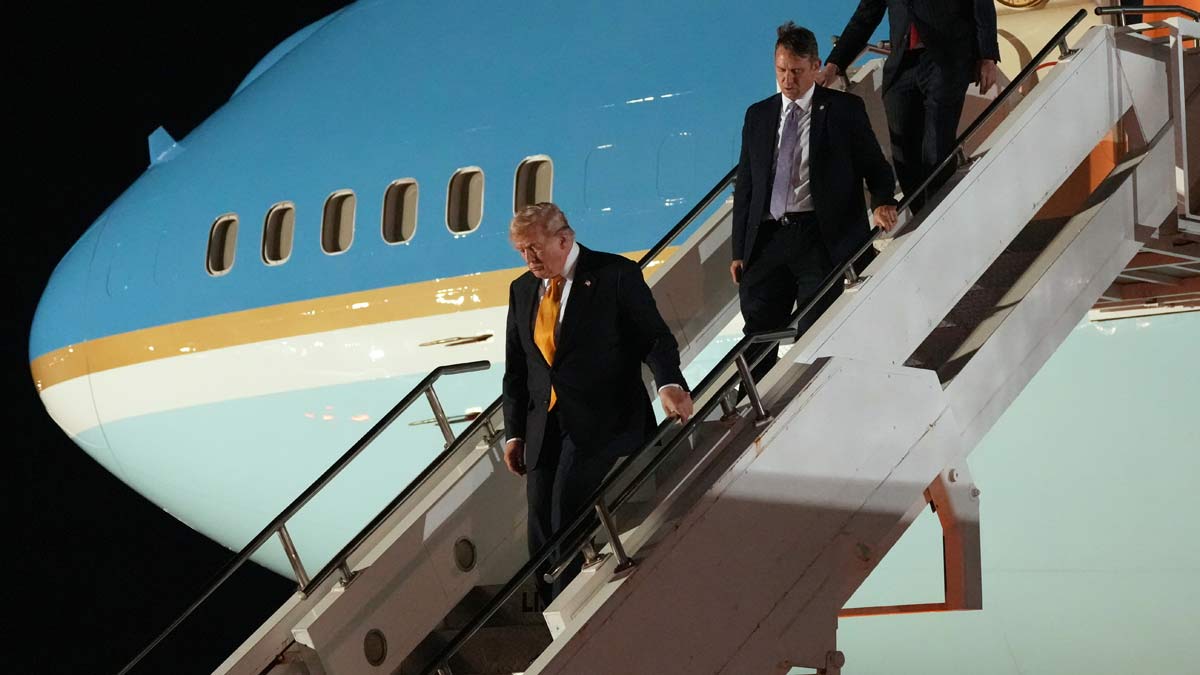
President Trump flew out of Ankara last night after the NATO summit on the old Air Force One instead of his new Boeing 747-8 donated by Qatar. The president chose the ageing blue-and-white Air Force One after the Secret Service urged an eleventh-hour change as a security precaution after the United States and Iran slid back into open military confrontation, turning the region into an increasingly dangerous environment.
While attending the summit, Trump declared that an earlier ceasefire with Iran had effectively collapsed. Soon afterwards, the US launched a wave of retaliatory airstrikes on more than 80 Iranian targets in response to attacks on merchant vessels in the Strait of Hormuz, one of the world's most strategically important shipping lanes.
Turkey's location amplified the risks. Ankara lies around 1,700km from Tehran, well within the operational range of several Iranian weapons systems. Trump’s security planners would have taken note of the fact that Iran has drones and ballistic missiles capable of hitting targets up to 4,000km, placing much of Turkey within reach. Intelligence officials reportedly concluded that the threat to the president was credible, particularly after Iran warned that it would observe "no red lines" in defending itself against American attacks.
The decision to abandon the Qatari aircraft also highlighted the limitations of its accelerated conversion into a presidential transport. Although lavishly equipped, the aircraft has not yet undergone the extensive modifications required to match the capabilities of a fully operational Air Force One.
The existing presidential aircraft, introduced near the end of the Cold War, are effectively flying fortresses. They are hardened against electromagnetic pulses generated by nuclear explosions and fitted with sophisticated defensive systems designed to detect, confuse and defeat incoming missiles. These include electronic countermeasures capable of blinding missile guidance systems, along with dispensers that release chaff to divert radar-guided projectiles.
The newly acquired Boeing reportedly lacks many of these critical defensive features. It is not yet equipped with advanced missile detection and countermeasure systems and cannot be refuelled while airborne, limiting its operational flexibility during crises. Former Air Force officials have noted that transforming a commercial aircraft into a true Air Force One normally requires up to two years of work and costs approaching $1 billion. The accelerated schedule for the Qatari jet meant several of the most complex security upgrades had yet to be completed. Intelligence experts suggested that, in its current state, the aircraft was better suited to domestic travel than operations in an active conflict zone, lacking the secure communications and force protection systems expected of a presidential command platform.
Against that backdrop, Trump's security team reportedly organised an unusually discreet departure from Ankara. Instead of following the customary protocol that allows photographers to capture the president boarding the aircraft, Trump boarded the legacy Air Force One quickly and with minimal public exposure.
Passengers and journalists were then instructed to lower their window blinds before take-off, an extraordinary precaution that reflected the perceived threat level. Trump later confirmed the instruction, telling reporters that they were "on a dangerous flight because of the sleazebags that we have to deal with".
A further indication of the security concerns came shortly after departure, when aviation trackers observed that the aircraft's transponder had been switched off. Although uncommon during routine presidential travel, disabling a transponder is a recognised security measure during flights through high-risk areas, making it more difficult to monitor an aircraft's movements in real time.
While Trump travelled aboard the heavily protected legacy aircraft, the newer Qatari jet flew separately to Royal Air Force Mildenhall in the United Kingdom, a military base frequently used by the United States. The UK lies well beyond the effective reach of Iran's conventional missile arsenal, making it a considerably safer location for the aircraft. After landing at Mildenhall, Trump reportedly transferred back to the newer Boeing to complete the final leg of his journey across the Atlantic to Washington.
Despite the elaborate security arrangements, Trump publicly denied that the aircraft swap had been prompted by safety concerns. Instead, he insisted the change had always been planned, claiming he wanted to display the "magnificent" new aircraft to American troops stationed in Europe and had chosen to fly on the older Air Force One simply "for old time's sake".
Yet his own remarks appeared to contradict that explanation. Throughout the summit, Trump repeatedly described himself as Iran's "number one" assassination target. Reflecting on the dangers of the presidency, he pointed to the historical mortality rate of US presidents before remarking, "I may be gone too because I'm their number one target."
The White House continued to maintain that the new aircraft possessed "state-of-the-art" security features. However, the combination of an emergency aircraft change, shuttered cabin windows, a disabled transponder and the Secret Service's reported insistence on using the older Air Force One suggested a very different reality: that the president's security team believed the established aircraft remained the safest option as tensions with Iran escalated dramatically.
