



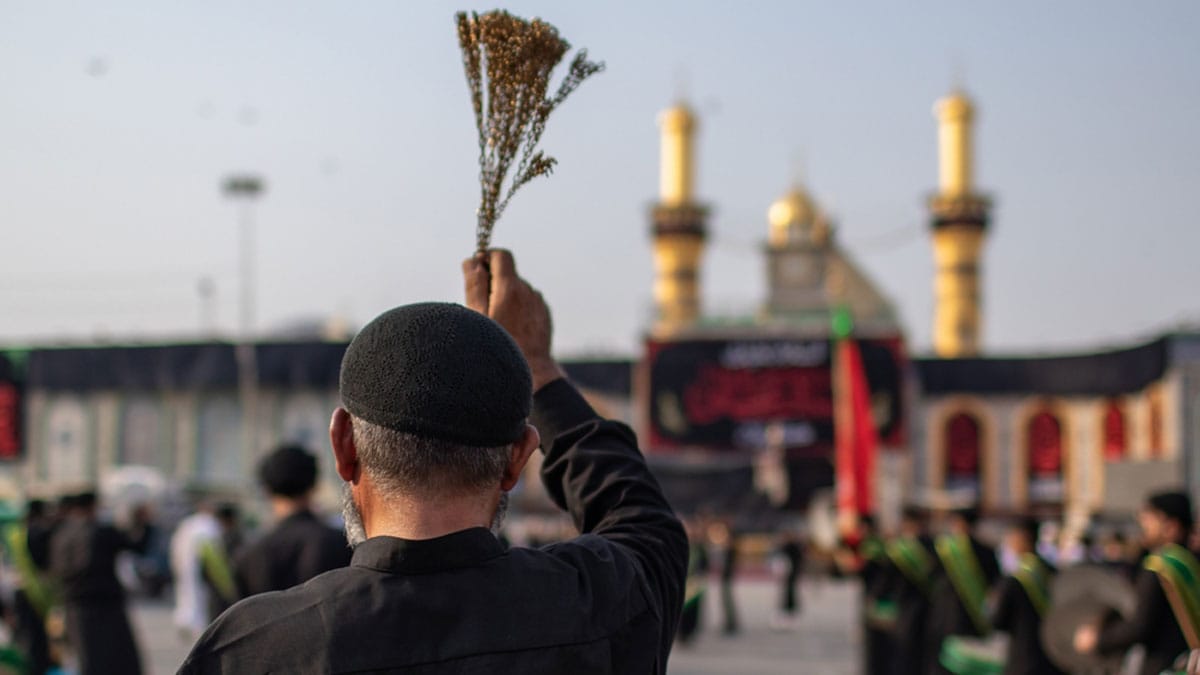
This year marked the 1366th lunar anniversary (1366 AH) of the Battle of Karbala, fought in 680 CE (61 AH). Colloquially known as Ashura or Muharram commemorations, a decade ago this period looked something like this: a dimly lit Imambargah (congregation hall for Shia Muslims), rows of listeners seated on the floor, a reciter's voice rising and falling over the crackle of an old microphone, and grief passed down the way it always had been, through memory and proximity. Today, that same evening would be livestreamed in 4K to a diaspora audience three continents away and set to a professionally mixed noha (mournful poetic recitation) that a teenager first heard on YouTube shorts or Instagram reels rather than from an elder. The scene has changed almost beyond recognition.

The most significant change is the rise of what one might call a digital majlis, where HD live-streaming, dedicated YouTube channels and an app for the purpose have taken over what used to be a quintessentially local experience. An individual in Auckland can now follow a majlis happening in Karbala itself in real time, without stepping out of their living room. Physical attendance is not a prior condition for a participating member. The noha and marsiya (Islamic poetry and lamentation used primarily by the Shia community) have also witnessed a parallel transformation in recent times.
A decade ago, these mourning chants were mainly recited locally or passed along hand to hand on cassettes and CDs. They are now recorded with studio-level production quality and released on streaming platforms, sometimes going viral far from their original religious context. People who may not know the history of Karbala respond to the emotions conveyed in the music. The hashtag commemoration has added an entirely new layer to social media. Instagram carousels of calligraphy, TikTok clips of processions, and X threads quoting Imam Hussain's stand against tyranny have witnessed the young generations finding a way to mourn publicly and digitally. This constitutes a decentralised, borderless community of remembrance that did not exist in this form not long ago.
Alongside the transition in technology, the demand for change has been influenced by a quieter but equally powerful generational shift happening. Many Gen Z and younger millennial organisers have started to frame Karbala not as an insular event but as a universal narrative of justice, resistance, and standing against oppression, a narrative that transcends any singular sect or community. This change of frame can be seen in action. The Sabeel, which offered free water and food to travellers and mourners, has been transformed into something bigger. Over the last 10 years, there have been many instances where an effort has been made to reduce plastics, along with biodegradable packaging and clean-up drives, which begin right after an event. The concept of "living Karbala", bringing the lessons of Karbala into our practical lives, is now translated into action, rather than just symbolism.
Increasingly, Muharram is the way contemporary grief is processed in sections. In several instances over the last decade, the processions have folded in silence for those who died in recent local or global tragedies. In places with a tradition of interfaith harmony, such as Najaf, Lucknow, and Hyderabad, among others, the Muharram commemorations, in which non-Muslims partake in poetry, storytelling, processions, and more, endure. Of course, it continues to adapt to contemporary pressures created by politics and the testing of that co-existence.
However, it is worth noting that not everyone views this transformation as a straightforward gain. Some elders and traditional scholars have argued that the intimacy of grief is lost in translation to a screen; a livestreamed majlis, however high-definition, will never have the physical weight of a shared room. Another worry taps into performance when mourning becomes content. If mourning is optimised for shares and view counts, does that also mean it risks being measured by reach rather than depth? These are not complaints against progress but rather reminders that visibility and intimacy are not always mutually additive, and that while the digital age has given Muharram many things, it has also handed the tradition a new tension to sit with.
Over the past decade, Muharram has transformed from a semi-insulated and largely localised observance into a globally synchronised, hyper-visible and socially active commemoration which lives, like an Imambargah, on the screen of a smartphone. Perhaps the biggest paradox is this: when we remove the cameras, the viral clips and the logistics of modern-day crowd management, the emotional essence of the first 10 days of Muharram is entirely recognisable to what it was centuries ago. The sorrow being experienced is the same. It’s just that the technology has modified how the story moves, not what the story means.
The author is a doctoral candidate at the Centre for West Asian Studies, Jawaharlal Nehru University, New Delhi.
The opinions expressed in this article are those of the author and do not purport to reflect the opinions or views of THE WEEK.
