



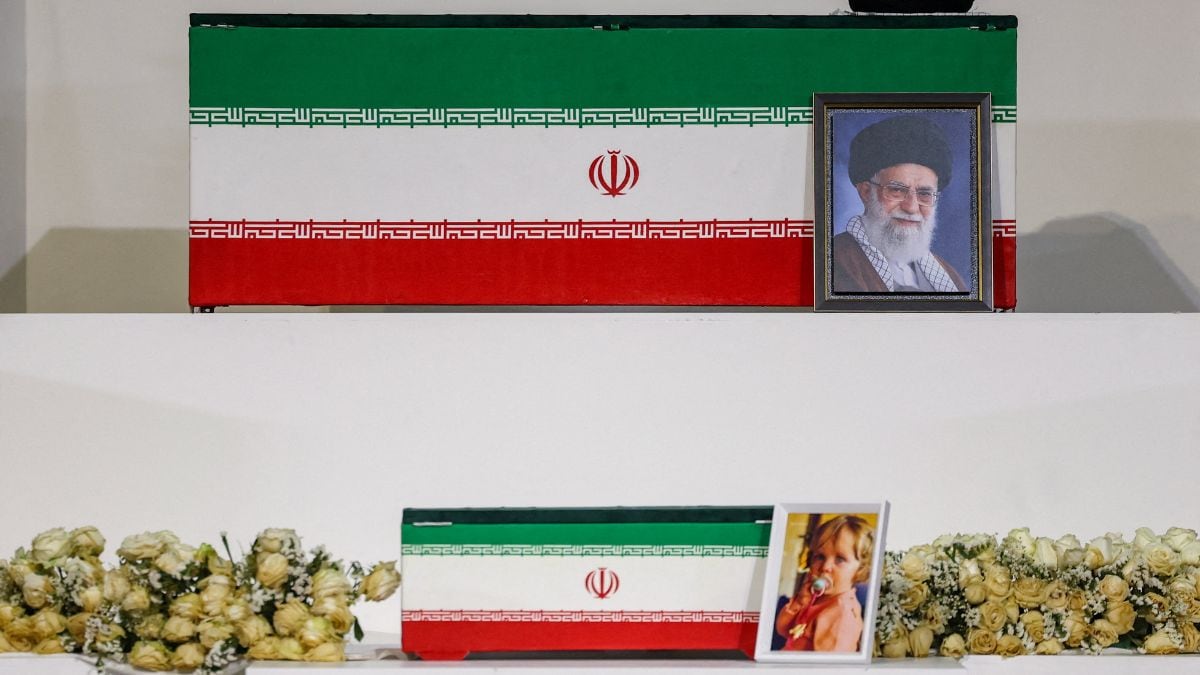
Iran's massive, days-long funeral ceremony for its slain ex-Supreme Leader Ayatollah Ali Khamenei is all set to be a grand affair, with a number of world leaders in attendance.
The multi-day funeral, which is taking place amid a fragile pause in hostilities between Iran and US-Israel forces, marks a key turning point in the four-month-long war.
Estimates from state-linked news broadcaster IRIB say that representatives from more than 100 countries are expected at the funeral of Khamenei, who was killed in a joint US-Israel air strikes on his compound on February 28 this year, the first day of the war in the Gulf.
Due to the fragile security situation, his son and incumbent Supreme Leader Mojtaba Khamenei, will not be in attendance.
Among the countries that will be attending, Georgia, Pakistan, Tajikistan, and Armenia will be sending heads of state/government.
This includes Pakistan's PM Shehbaz Sharif, military chief Asim Munir, and Interior Minister Mohsin Naqvi, in addition to President of Tajikistan Emomali Rahmon, Armenia PM Nikol Pashinyan, and Georgian President Mikheil Kavelashvili.
Countries like India and Russia, however, have chosen to send senior government leaders.
The Indian delegation incudes Bihar Governor Syed Ata Hasnain—the seniormost Shia holding public office in India—and Deputy Foreign Minister Pabitra Margherita, in addition to Opposition leaders Salman Khurshid and Mehbooba Mufti.
Moscow has chosen to send Russian Security Council Deputy Chairman Dmitry Medvedev for the funeral.
Similarly, Afghanistan has chosen to send the Taliban government's Foreign Minister Amir Khan Muttaqi, while Bangladeshi Parliament Speaker Hafizuddin Ahmed and Senior Chinese parliamentary lawmaker He Wei are also expected to show up.
What happens after Friday?
Touted as one of the biggest state funerals in Tehran's history since the demise of former Supreme Leader Ayatollah Ruhollah Khomenei, the event will see world leaders in attendance mainly on Friday.
On Saturday and Sunday, the coffin of Khamenei will be placed alongside that of several of his family members for public ceremonies at the Grand Mosalla, one of Iran's largest prayer complexes.
By Tuesday, the funeral procession will move southwards towards Qom, and on Wednesday, a ceremony will be held to receive the coffins at the Najaf International Airport in Iraq, as per an Al Jazeera report.
After public processions in the Iraqi cities of Najaf and Karbala, the body will come back to Iran for a final ceremony at the shrine of Imam Reza in Mashhad on Friday.
This is significant not only because Mashhad is the city in which Khamenei was born, but also because Imam Reza holds a significant place in Islamic (Shia) history.
