



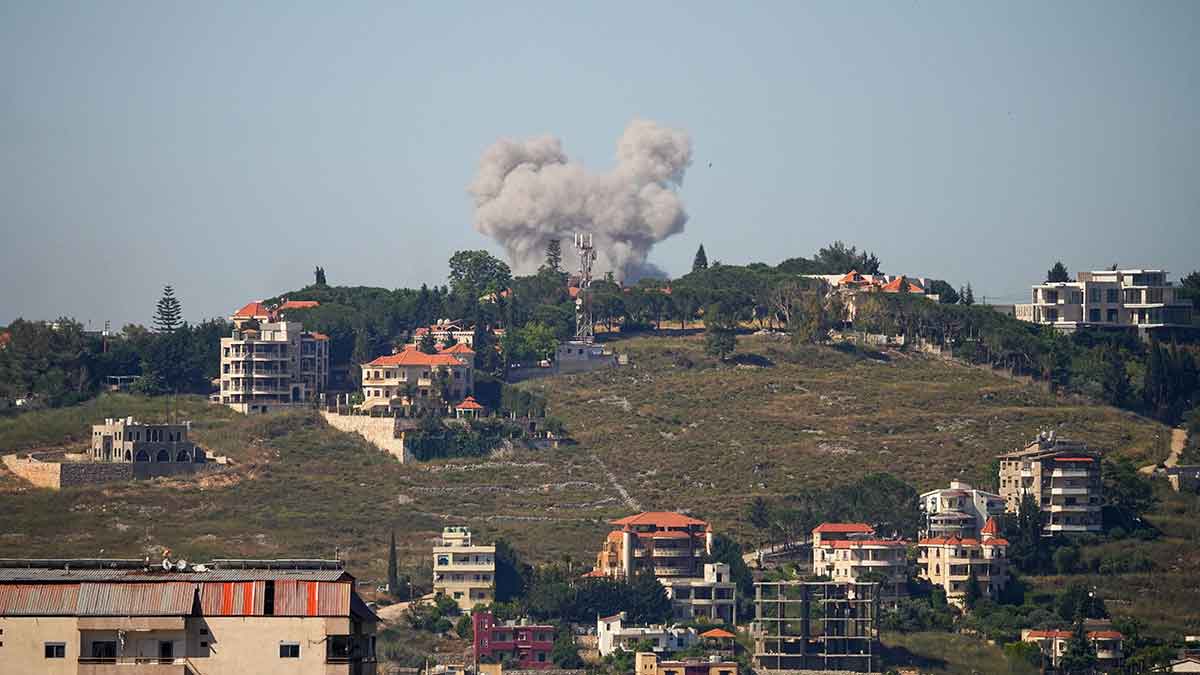
It is now clear that the safe passage of ships through the Strait of Hormuz depends oddly on peace in faraway Lebanon. At least this is what the Islamic Republic demands. ‘Peace in Lebanon’ appears in the very first clause of the recently concluded MoU between the US and Iran. Following the ‘signing,’ Iranian Foreign Minister Abbas Araghchi observed that the US bore the “commitment and responsibility towards ending the war on all fronts, including Lebanon.”
One hears different voices in Beirut. According to Prime Minister Nawaf Salam, “We want a state in which the citizen feels that his future is not dependent on his political and sectarian affiliation, and which has the power to decide on matters of war and peace.” He added that the government is determined “not to be lenient in restricting weapons to the legitimate forces alone.” This is a clarion call against sectarian foreign policy and for the disarmament of Hezbollah.
Not to be left behind, Lebanese President Joseph Aoun declared that his country’s negotiations with Israel in Washington were independent of the US-Iran deal. “The assurances we have received, and what we insist on, is that Lebanon’s path in the negotiations is independent, though we are certainly for a ceasefire and for any country that helps us, including Iran,” Aoun said. “Interference in Lebanese affairs is not permitted,” he added. “The Lebanese state is sovereign in its decision-making, and for the first time, it is the one conducting the negotiations, and nobody is negotiating for us,” he said. “I reassure the Lebanese that nobody is tying us to any other country, and any settlement will be through us, not at our expense,” he added. In short, though weak and less resourced, Lebanon cannot be decided for by the foreign policy calculations of other states or their agents.
While Lebanon appears in the US-Iran MoU, it is not a direct party to the conflict, let alone involved in the negotiations. For over two decades, Hizballah, the Iranian proxy and a key part of the ‘Axis of Resistance’ as Iranian leaders describe it, has pursued a policy independent of and contrary to the Lebanese state, government, and society. It entered the Israel-Iran conflict on 2 March to avenge the killing of the Iranian supreme leader Ali Khamenei, a couple of days earlier. The militant group did the same when Israel responded to Hamas-led attacks on Israel from the Gaza Strip on 7 October 2023.
Hezbollah emerged and gained legitimacy in the wake of the Israeli invasion of Lebanon, which began in June 1982. As long as the Israeli occupation persisted, Hezbollah enjoyed legitimacy and acceptance as a resistance force. The hasty, unilateral Israeli withdrawal of May 2000 was a high point for the region, as Hezbollah emerged as the only force that compelled Israel to withdraw from the occupied territories. This ‘resistance’ label also enabled Hezbollah to sidestep the key demands of the Taif Agreement of 1989, which ended the Lebanese civil war, namely the disarmament of all militias in Lebanon. The disarmament condition was reiterated in UNSC Resolution 1701, adopted after the Second Lebanon War of 2006.
However, the ‘resistance’ label that Hezbollah continues to claim has been questioned by neutral observers following Israel’s hasty, unilateral withdrawal from South Lebanon in May 2000. What is it ‘resisting’? As the only organization with considerable military power—far exceeding that of the Lebanese state—Hezbollah could defy the disarmament clause for over two decades.
Interestingly, the Islamic Republic's domestic legitimacy depends heavily on the existence, survival, and military successes of its proxies in the region. Proxies like Hezbollah have been a plausible, diplomatically convenient, and cost-effective option for Iran. Over the years, the involvement of Hezbollah (and other proxies) in advancing Iranian regional policy ambitions was widely recognized, and the US-Iran MoU is the latest recognition of the Iranian role in Lebanon.
Peace in Lebanon is not an issue. It is vital, yet the weak state structure has been insufficient to protect itself from frequent Israeli interventions and attacks. After years of timidity and powerlessness, a segment of Lebanese society and leadership has grown tired of Hezbollah pursuing a policy that is independent of and contrary to broader Lebanese interests and welfare. Amid the recent conflict, the Lebanese government unsuccessfully tried to expel the Iranian ambassador in Beirut for interfering in internal affairs. As expected, the Iranian foreign ministry firmly rejected the move and remains determined to support its proxy.
The ongoing diplomatic negotiations between Israel and Lebanon in Washington are a clear indication of two Lebanons. One, led by Hezbollah, seeks to pursue a policy dictated by Tehran, while the other seeks to quarantine Lebanon from the larger regional plans of the Islamic Republic. The renewed tension in the Strait of Hormuz over Israeli attacks on and occupation of parts of Lebanon reflects the first trend. The alternative Lebanon is marked by public statements from leaders like Aoun and Salam, who wish to work towards Lebanon's return to being an independent, sovereign state, in which the state holds a monopoly on the use of force and foreign policy. Who wins will shape the regional peace in the coming days and determine whether Lebanon is heading for a second civil war. This time, the conflict is over the Strait of Hormuz, located nearly 2,000 km away.
The author teaches contemporary Middle East at Jawaharlal Nehru University, New Delhi.
