



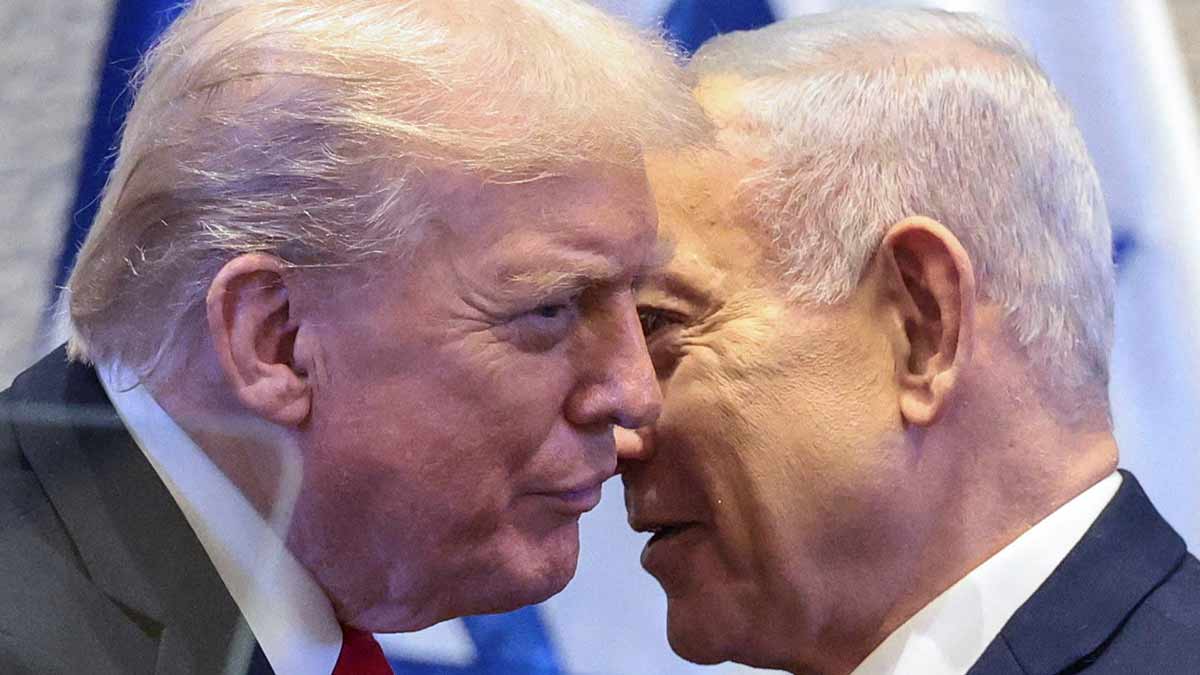
At a moment when the US President Donald Trump is once again weighing the possibility of a negotiated settlement with Iran amid the ongoing tensions in West Asia, Washington’s focus appears to be shifting back towards a diplomatic solution to the ongoing conflict. Back channels of communication via Islamabad, tentative de-escalation efforts and renewed strategic calculations suggest that the United States is searching for a way to step back from a deepening confrontation that carries significant military and economic costs. Yet beneath these efforts lies a more decisive factor, one that has historically shaped and determined the survival of past agreements between the US and Iran.
That factor is Isreal’s Prime Minister, Benjamin Netanyahu. Any arrangement that emerges between Washington and Tehran in the ongoing negotiations between the two countries cannot not be assessed in its isolation. Its durability will depend on whether it aligns with Netanyahu’s uncompromising position on Iran’s nuclear ambitions and regional influence. And as experience suggests that if any agreement is perceived in Israel as falling short of those expectations it is unlikely to hold its ground for long.
The story of the earlier US-Iran nuclear deal is often told as a contest between Washington and Tehran where the Joint Comprehensive Plan of Action (JCPOA) deal emerged out of diplomacy and defiance. But running parallel to that narrative has been another force that shaped its trajectory by the persistent and an uncompromising opposition of Benjamin Netanyahu. Across three different American presidencies, Netanyahu has demonstrated a rare consistency of purpose on Iran’s nuclear programme. His position has not shifted with the changing US administrations or the changing global sentiment. Instead, what has changed is how effectively he has been able to bend the American policy to align with Israel’s strategic red lines on Iran.
To understand why any future US-Iran agreement remains inherently fragile, one has to begin with Netanyahu’s open confrontation with the then US President Barack Obama. The signing of the JCPOA in 2015 was seen by the Obama administration as a landmark diplomatic achievement, one that would freeze Iran’s nuclear ambitions and bring it back into the global fold. Netanyahu however viewed it through an entirely different lens. For him the deal did not eliminate Iran’s nuclear capability but it merely postponed it. Worse, it legitimised Iran’s regional influence by lifting sanctions and unlocking the economic resources that could be funnelled into the proxy networks that were waging war against the Israeli and US interests across the Middle East.
Netanyahu’s response to Obama’s deal was not a subtle diplomacy conducted behind closed doors. It was a direct, public and an unprecedented confrontation that challenged the ultimate authority of the White House. In a move that broke away with the traditional diplomatic protocol he addressed the US Congress in 2015 effectively bypassing the Obama administration to make his case directly to the American lawmakers. The speech he delivered on the floor of the US Congress was not just of opposition to the US policy on Iran but it was a warning of Israel’s resolve to declare war on Iran hence completely undermining the US policy. Netanyahu openly argued that the deal would “pave Iran’s path to the bomb” rather than block it. At that moment, he was not merely disagreeing with a sitting US president but in essence he was positioning himself as a counterweight to the American policy itself.
Obama despite the pressure pushed the deal through after his re-election. But Netanyahu’s resistance had achieved something more subtle yet enduring. He ensured that the Iran deal would never gain bipartisan legitimacy within the United States. It remained a politically contested issue that was vulnerable to reversal and deeply tied to the identity of the administration that created it. In doing so, Netanyahu planted the seeds for what would come next.
That next phase unfolded under Donald Trump. When Trump entered office in 2017, the Iran deal was already politically weakened. Netanyahu seized that moment with precision. Unlike his contentious relationship with Obama, Netanyahu found in Trump a leader far more receptive to his worldview on Iran. But receptiveness alone does not translate into policy. What followed was a sustained campaign driven through Israeli intelligence briefings, public messaging and strategic alignment that reframed the Iran deal as a fundamental threat.
The turning point came in 2018 when Netanyahu publicly unveiled what Israel claimed was a trove of secret Iranian nuclear documents. The presentation was carefully staged and designed not just for intelligence circles but also for global perception. It reinforced the narrative that Iran could not be trusted and that it had concealed elements of its nuclear program hence giving credence to his long-standing argument that the deal itself was built on incomplete or misleading assurances. Shortly thereafter, Trump announced the US withdrawal from the JCPOA.
This was not just merely a policy shift by Donald Trump, it was also a structural dismantling of Obama’s diplomatic framework. Trump’s “maximum pressure” campaign that pillared on reimposing sanctions, isolating Iran economically and escalating nuclear rhetoric aligned almost perfectly with Netanyahu’s long-standing position. What Obama had constructed through negotiation, Netanyahu unravelled it through thorough persistence and strategic timing.
Yet the story does not end with the withdrawal. It evolves further in the context of Trump’s second presidency where the dynamics shifted from beyond the pressure politics into an open confrontation. The trajectory from diplomatic rollback to military escalation did not emerge as an isolated incident. It was the culmination of Netanyahu’s years of framing that Iran is not just a nuclear concern but stands as an existential and an immediate threat. Netanyahu’s influence here is less about a single decision and more about shaping the strategic environment in which those decisions are currently made.
By the time the United States finds itself engaged in a direct conflict with Iran, the conceptual groundwork has already been laid. Iran is no longer seen as a negotiable adversary but as an irreconcilable one. In such an environment the space for a compromise narrows dramatically. In this light any future agreement that even slightly resembles the original JCPOA becomes politically and strategically untenable particularly from Israel’s perspective.
This brings us to the central dilemma facing any future US-Iran negotiations. Even if Washington and Tehran manage to reach a new agreement its durability will not depend solely on the terms negotiated between them. It will depend on whether that agreement aligns with Israel’s core security expectations and more specifically with Netanyahu’s interpretation of those expectations.
Netanyahu has consistently rejected the idea of any partial solution with Iran. For him, the constraints are insufficient if they are temporary and any IAEA inspections are inadequate if they do not eliminate Iranian nuclear capability altogether. This is a fundamentally different standard from that of most of the diplomatic frameworks which are built on managing risks rather than eliminating them entirely. As a result, any deal that allows Iran to retain even a limited nuclear infrastructure or that includes sunset clauses is likely to be viewed by Netanyahu as inherently flawed.
What makes this dynamic particularly consequential is Netanyahu’s demonstrated ability to act on his opposition. His approach is not just confined to rhetoric as he has demonstrated his will to act that includes shaping the US domestic debates, leveraging intelligence disclosures, coordinating with sympathetic political actors and when necessary taking direct and indirect unilateral actions. This creates a structural instability in any agreement that does not meet Israel’s maximalist criteria.
For Washington, this presents a complex strategic issue. On one hand, there is the imperative to prevent further Iranian nuclear proliferation through diplomacy. On the other hand, there is the sense of reality that a key regional ally does not trust that diplomacy alone can deliver it a lasting security. When these two positions diverge as they have repeatedly over the past decade the result is not just a policy disagreement but it is policy disruption.
The history of the previous US-Iran deal illustrates this clearly. Obama’s agreement did not fail because it lacked technical detail or international backing. It failed because it did not survive the political and strategic contest with Israel surrounding it. Netanyahu ensured that the contest remained active, persistent and ultimately decisive.
As the United States once again navigates its new course of relationship with Iran this underlying tension remains a stumbling block in the pathway of finding lasting peace. Any deal that appears even marginally to concede space to Tehran will face scrutiny not only just from the domestic critics in Washington but also from a leadership in Israel that has shown little willingness to compromise on this issue.
In that sense, the future of US-Iran diplomacy is not just a question of negotiations between the two adversaries. It is a three-layered equation where the Israeli strategic doctrine plays a critical and a determining role. And as long as Netanyahu remains a central figure in that equation, the threshold for what constitutes an “acceptable” deal will remain extraordinarily high, even perhaps too high for any lasting agreement to survive.
The author is an independent journalist and columnist.
