



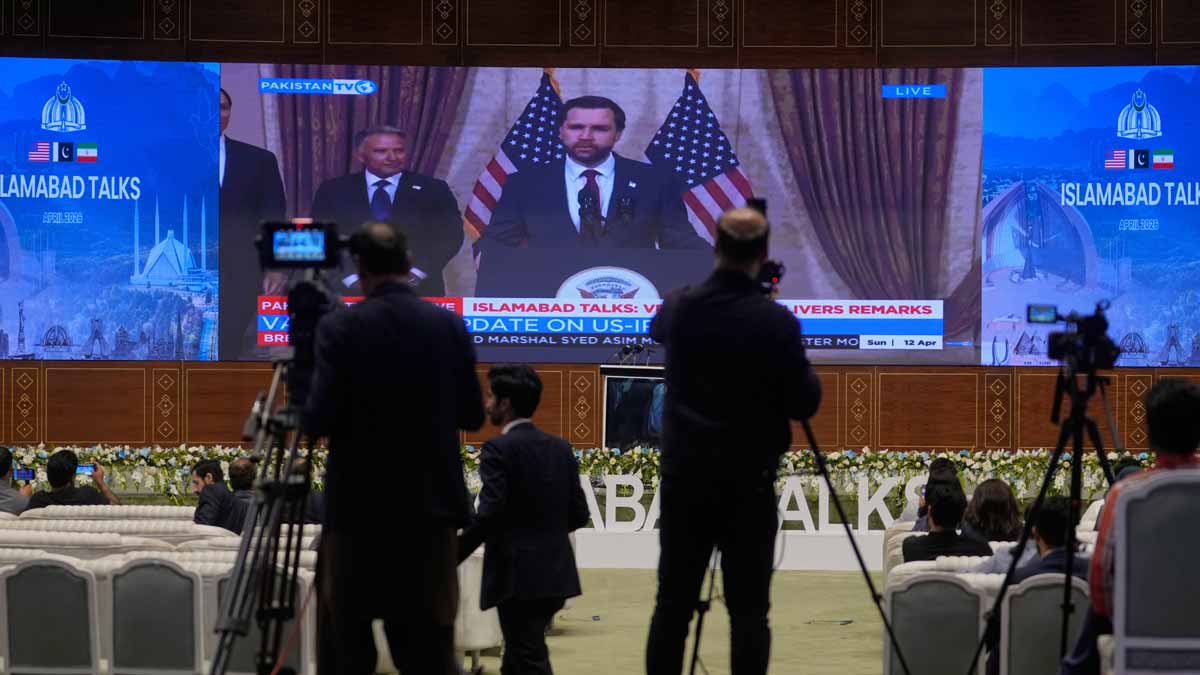
Negotiations between the United States and Iran have concluded for now following a series of talks in Islamabad aimed at ending the six-week-long conflict in the Middle East.
This marked the first direct engagement between the two nations in over a decade and the highest-level discussions since the 1979 Islamic Revolution. However, the talks ended without an agreement, primarily due to disagreements over Tehran’s nuclear programme.
US Vice President J. D. Vance, who led Washington’s delegation, said Iran had not committed to abandoning its pursuit of nuclear weapons.
“The question is, ‘Do we see a fundamental commitment of will for the Iranians not to develop a nuclear weapon not just now, not just two years from now but for the long term?’ We haven’t seen that yet, we hope we will,” he said.
Speaking to CNN, he emphasised that the United States is seeking an affirmative commitment from Iran’s side that they will neither pursue nuclear weapons nor seek the tools that would enable them to quickly achieve a nuclear weapon.
“The bad news is that we have not reached an agreement,” Vance said. “And I think that’s bad news for Iran much more than it’s bad news for the United States of America. So we go back to the United States having not come to an agreement.”
In a statement posted on X, the Iranian government confirmed that the talks lasted 14 hours and that technical teams from both sides would continue exchanging documents.
“Negotiations will continue despite some remaining differences,” the statement said.
While no official timeline has been announced, unconfirmed reports suggest that discussions could resume as early as Sunday.
The US delegation also included special envoy Steve Witkoff and Jared Kushner. Iran's team comprised Parliamentary Speaker Mohammad Baqer Qalibaf and Foreign Minister Abbas Araqchi.
According to a Pakistani source cited by Reuters, "there were mood swings from the two sides and the temperature went up and down during the meeting".
Iran has reportedly demanded control over the Strait of Hormuz, payment of war reparations, and a broader regional ceasefire, including in Lebanon. Tehran has also sought the right to impose transit fees in the strategic waterway.
