



Ask Vandana Sawant, 82, how she is, and she responds with a smile. “Main mast hoon [I am doing great],” she said. Living in Mumbai’s Sion with her daughter, Sawant’s days revolve around a place she hasn’t missed in 14 years—Adhata Trust, a community-based initiative that works closely with senior citizens. It is here that she paints, dances, acts and simply shows up as herself. “Adhata has given me an identity that goes beyond my kitchen, which I had become a slave to for most of my life,” she said. “It brought me from the kitchen to the stage. I spent my entire life running behind my kids, husband, family, and then at the age of 68 I found Adhata.”
What followed was a transformation Sawant hadn’t imagined possible in her later years. “The first time I learnt how to dance on stage was at 68. I experienced that kind of freedom for the first time,” she said. Today, her world is filled with rehearsals, friendships and small joys she once never had the time or permission to pursue.
More than activity, it is the sense of belonging that anchors her. “I have found so many friends,” she said. “I feel valued, seen and acknowledged—that too in the last leg of my life.”

At a modest fitness studio in Mumbai, Anita Gupta, 75, moves with careful intent, lifting her feet over a line of low hurdles, pausing between each step to steady herself, her body swaying slightly before regaining balance. The exercise is simple, almost childlike in design, but for Gupta, it represents something far more hard-won: control over a body that had once stopped responding the way she needed it to.
Living in Chembur with her daughter and grandchildren, she had gradually withdrawn from physical activity as spinocerebellar ataxia, a genetic disorder, began to affect her balance and mobility. “In India, gym trainers are not geared towards senior citizens,” rued Gupta. “They only care for young adults. But here at Golden Hearts, there is a space for older people like me.”
What makes Golden Hearts, founded by Dr Sunil Wagh, stand out is that it is built only for the elderly. In a landscape where ageing bodies are either sidelined or expected to adapt, spaces like this remain few and far between. When Gupta first walked in, she was “very unsure, weak and lacked balance” after years of inactivity. What followed was a slow, consistent rebuilding through exercises designed not for performance, but for function. Today, Gupta trains alongside others in their 80s and 90s, a rare sight in any conventional workout setting. The sessions come at a cost, but for Gupta, the value is clear.
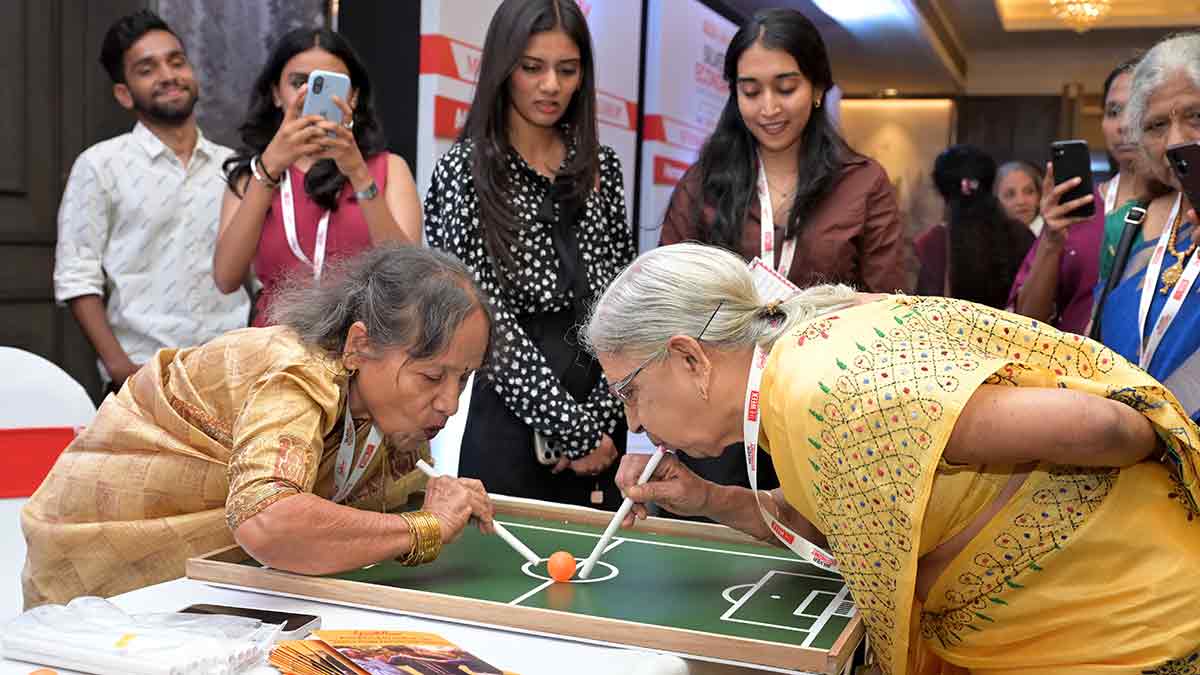
At the recently concluded Silver Economy summit in Mumbai, hosted jointly by THE WEEK and The Goodfellows, Pratibha Kerkar, an octogenarian, was immersed in a conversation with Rupesh Thakur, in his early twenties. What appeared at first like a casual exchange was, in fact, part of a deeper, sustained bond built through The Goodfellows, a social enterprise that pairs young adults with senior citizens seeking companionship. For years now, Rupesh and others like him have been a steady presence in the Kerkar home in Thane, helping them navigate not just daily routines, but the quieter weight of loneliness.
Taken together, these stories point to something larger quietly taking shape—a new ecosystem catering to India’s elderly, one that is beginning to recognise ageing not just as decline, but as a stage of life with its own needs, aspirations and markets. This is the silver economy, a growing network of services, products and interventions, spanning care, companionship, finance and lifestyle, designed to respond to a demography that has long remained underserved.

And this is why, April 5 marked a historic moment when stakeholders invested in silver economy came under one roof. At this one-of-its-kind umbrella event, companies from diverse domains including technology, advanced digital care and health care, nonprofits, startups and senior citizens came together to discuss what it is like to age in India and how one can redefine one’s sunset years.
In India, where the number of people above 60 is expected to nearly double in the coming decades, this economy is beginning to take shape in visible ways.
“The future of this country belongs to the elderly,” said Irudaya Rajan, chairperson, International Institute of Migration and Development, who was part of a panel discussion on ‘Shaping an age-ready India: Policy for a changing demography’ at the summit. “Those with silver hair are our second demographic dividend, which will have a long-lasting impact on India’s economy and society.”

Highlighting the potential of ‘old age’, Rajan terms years beyond 60 as part 2, like a movie sequel that does better than the original. “The seniors do not just have to be receivers, rather they can be producers of wealth,” he said. “They are great assets. Being retired does not mean life is over, rather it is only the beginning of the second innings. We need to look at them as contributors to national income.”
Experts agreed that the longevity game had already been aced. “I think longevity is taken care of almost to a fault,” said Shantanu Naidu, founder, The Goodfellows. “I think the average age would very likely go to 110, 120, based on medical interventions. But what we are looking for is how do we make people feel alive while they are living whatever extended period of life we are offering them.”
Agreed Rohit Prasad, CEO, HelpAge India, who pointed out that the speed of ageing in India is unprecedented. “In the next 25 years, one in 10 Indians will be an elderly—that is close to 10 to 20 per cent of the population,” said Prasad. “We are aiming for Viksit Bharat 2047, but the truth is that we will become old as we become rich. No country will have the unique generational mix that India will witness in the next 25 years. So alongside the longevity dividend, we will have to think about intergenerational dividend as well.”
Yet, as India transitions into an ageing society, the challenges are mainly to close the gap between policy and lived reality and between longevity and dignity. Take the case of Jaya Khurana, 79, who lives in New Delhi with her family, comprising her husband, two sons, their wives and their children. “Yet, I don’t really have company,” said Khurana. “I think I am confined by the expectations of my people. If I tell them I want to go out, they say, ‘What is the need? Just tell us and we will bring you what you want.’ They instil fear in me, saying I will fall if I go to the park everyday. Maybe it is because nobody wants to take responsibility of pickup and drop. I miss the freedom of my younger days.”
And therefore, all innovation in the silver economy space should be rooted in dignity and respect for seniors, said Naidu. “This demography is so diverse and rich, and it is also so fragile,” he said. “It is almost like you are building a world for the people who built this world for us. In five years, you will see so many companies in this space because of the sheer lucrative opportunity that exists. If we lay out our value systems well, it will be a great starting point.”
Kirti C., a septuagenarian who travelled from Pune to Mumbai for the event, had an interesting take: “We want to be taught and taken seriously. There is so much I want to learn because I now have all the time in the world, but nobody to sit down and teach me. They need to begin a senior school for us so that we get to learn things we couldn’t earlier due to our busy lives.”
Nirmala Prabhavalkar, former mayor of Mumbai, seconded that. She says that the cases of dementia and Alzheimer’s disease in the elderly are rising “because we do not invest in making them mentally active”.
In a bid to emphasise upon ageing with dignity and ageing productively, HelpAge India launched a programme called Generations Together in 2024. “We need to focus on long-term care, which is different from medical care,” said Prasad. “This one involves caring for individuals when they are not sick but not too healthy either and the private, voluntary and government sectors need to think about this. It is time we move beyond the classic three-tier structure of learn, earn and retire and think about lifelong learning, which is also silver skilling, silver learning and silver volunteering. So this is a sunrise moment for people about whom we think about in terms of their sunset years.”
Startups are curating travel for seniors who want to explore without strain. Fintech platforms are rethinking retirement in a country with limited social security. Real estate developers and health care providers are building spaces where ageing comes with support. Organisations are filling a critical gap, creating communities where the elderly are not just cared for, but seen, heard and involved.
For Sujata Virdhe, a retired scientist with the Indian Space Research Organisation, planning for the future was not just about assets, but about agency. She recently moved to Pune and found herself confronting a question many prefer to postpone: who decides the terms of one’s final days?
Living alone, with her daughter settled in Canada, she chose to act early, by drafting both a legal will and a medical will through AasaanWill, a digital platform that simplifies estate planning and other forms of will making. For Virdhe, the medical will was less about legality, given its limited enforceability in India and more about clarity. “I just wanted to make sure that I am not put on life support, it is very difficult for a person who is attending on you to decide,” she explained. The will lays out her preferences with precision: no prolonged life support without meaningful recovery, organ donation where possible and a simple, non-ritualistic cremation. In a country where conversations around death are often deferred and decisions left to families in moments of crisis, Virdhe’s choice reflects a quieter shift towards asserting control and reducing ambiguity.
The conversation around ageing, however, must go beyond longevity to quality of life and access to care and emotional wellbeing, said experts. Saigita Chitturu, assistant professor, Tata Institute of Social Sciences, said that we must pay attention to the rising issues of loneliness, depression and anxiety among the ageing population. That is a sentiment shared by Dr Kersi Chavda, senior consultant psychiatrist at P.D. Hinduja hospital in Mumbai. “Loneliness is probably the biggest illness,” said Chavda, who was part of the panel discussion on ‘Ageing with dignity: Bridging mental wellbeing, health care access and innovation’. “If you are lonely, everything becomes terrible. And that is when you feel that the only way to go ahead is not to go ahead.” He cited the instances when older people were wheeled into emergency wards because they had overdosed on tablets for hypertension or heart or neurological issues. “We need to take care of our geriatric population,” he said, “because that way there is a guarantee that there will be less hospitalisations and less attempts at killing themselves.”
But even as businesses race to serve this growing demography, a larger question lingers: will the invisible majority of the ageing population—the rural elderly, widowed women, informal workers and those with no pension, insurance and dependant on children—be part of this silver economy boom?
Dr Sridhar Vaitheswaran, assistant director and consultant psychiatrist, Dementia Care (DEMCARES) and Schizophrenia Research Foundation-SCARF, believes they will be. His belief is rooted in the work that he is doing in the rural districts of Tamil Nadu. For the last five years, he has been training community health workers to raise awareness about dementia through street plays, folk music and conversations. “We have mobile clinics with experts that go to villages once every week,” he said, as part of the discussion on ‘Ageing with dignity’. He added that 350 people had been diagnosed with dementia in the rural areas as opposed to 2,000 people in urban areas, and that those in the rural areas were diagnosed in the early stages and 90 per cent of those diagnosed in cities were late stage.
In a room that brought together three generations—Gen Z, millennials and seniors—the conversation between actors Sachin and Shriya Pilgaonkar unfolded less like a panel and more like a lived example of what intergenerational connection can look like. Moderated by Naidu, the exchange between father and daughter gently pushed back against the idea of a generation gap, replacing it with something more intimate—bridge.
“I have taken his passion, his diligence and his absolute attention to detail,” said Shriya. “I think my parents have been my friends and that’s been very special.” She also emphasised on the importance of the bond with grandparents. “A lived life has the kind of wisdom that you will not get on the internet,’ she said. “Your grandparents can teach you what Google cannot.”
If Shriya’s words underscored the importance of connection, Sachin’s reflections turned inward, offering a deeply personal philosophy on ageing. “A person like me cannot think of retirement; I can only think of doing something creative. There is no age for creativity. Intelligence can be artificial, but stupidity is always natural and original. So save it, use it and embrace it. I believe that one’s mind has to remain active at all times.” His mantras for ageing well? “Start appreciating yourself,” he said. “Be in love with yourself. I say to myself, ‘Good morning, handsome’. Before going to bed, I say I love you to myself. Second, get rid of the three words from your life—Log kya kahenge (what will people say). Live life on your own terms.”
Like Sachin, singer Rekha Bhardwaj challenged the belief that ageing meant decline. She instead offered a quiet but powerful counterpoint, one of rediscovery and reinvention.
Known for the depth and texture of her voice, Bhardwaj has, in many ways, come into her own in her later years, embracing not just music but an entirely new identity as Aziza Rekha (Aziza means beloved), drawn from her engagement with Sufism. For her, the silver years have not been about slowing down, but about turning inward. “Music has helped me a lot, it also helped me recover from the physical changes my body was undergoing in my later years,” she said. “Also, when I had no work and lots of time on hand, I invested all that time in learning new things, including painting, pottery, candle making, art journaling... you name it and I have done it all.”
Her reflections moved beyond personal practice and into a larger philosophy of ageing, one that acknowledged solitude without surrendering to it. Having faced a retinal detachment three years ago and admitting to having once neglected her own health, she spoke with a clarity that was both grounding and liberating. “Loneliness is the harsh truth of ageing. Accept it,” said Bhardwaj. “But at the same time treat yourself like a child and pamper yourself and love yourself everyday! Whatever you like, do it every day and be grateful for the little things you have in life, that you are alive and breathing.”
Many kilometres away from Bhardwaj, on the outskirts of Varanasi, in a quiet, gated senior living community, 74-year-old Lakshmi S. has just signed up for a yoga session and a tele-consultation with her cardiologist—her daily life an example of the emerging ecosystem that is catering to people like her. It is high time, she emphasised, that elderly care was made a part of mainstream holistic development.
