



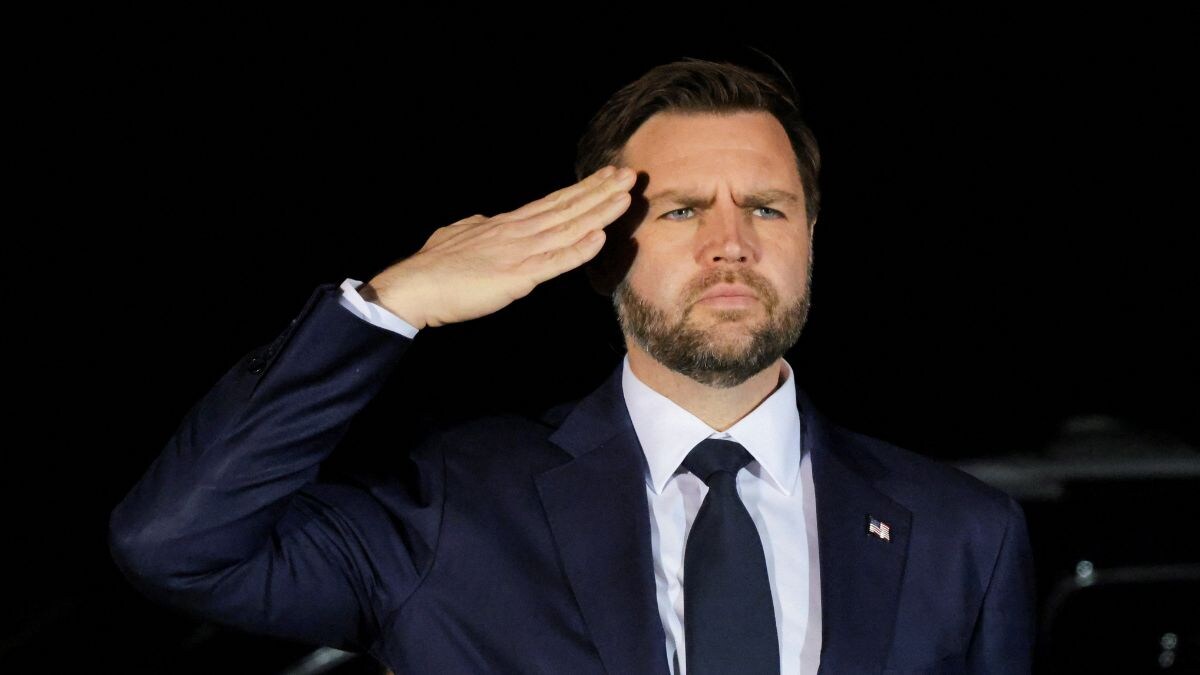
President Donald Trump has acknowledged that Vice President JD Vance was not fully aligned with him on the issue of war against Iran. Speaking to reporters, Trump said he and Vance were “philosophically a little bit different” on the question of the war. He noted that Vance was “maybe less enthusiastic about going”, although the president insisted he believed the United States had no choice but to act. According to Trump, if the US had not struck first, Iran would have eventually attacked them.
Prior to the strikes, Vance reportedly expressed reservations about the operation, outlining what he believed were the potential negative consequences of attacking Iran. However, once it became clear that Trump’s decision was final, he advocated for a swift and limited strike designed to minimise casualties and prevent operational leaks that might place American troops stationed in the region in greater danger.
Vance’s hesitation is rooted in a long-standing anti-interventionist outlook that has shaped his political identity. A veteran of the Iraq War, he served as a military journalist with the United States Marine Corps, an experience he frequently cites as the basis for his scepticism about foreign military engagements. Throughout his political rise, Vance has built his reputation on an “America First” platform, sharply criticising what he sees as the foreign-policy establishment’s tendency to “police the entire world”. He has argued that such interventions frequently trap the US in prolonged conflicts with unclear objectives and enormous financial costs.
Indeed, during the 2024 political cycle, Vance explicitly argued against military action against Iran, describing it as a “huge distraction” that would impose substantial costs on American taxpayers. Confronted with the need to defend the administration’s actions today, he has attempted to distinguish the current operation from earlier conflicts in the Middle East, particularly those in Iraq and Afghanistan. According to Vance, the key difference lies in the clarity of the mission. He has argued that Trump has set a “clearly defined objective”: preventing Iran from ever acquiring nuclear weapons. In Vance’s view, this limited objective is intended to prevent the United States from drifting into the kind of open-ended wars that characterised earlier interventions.
Despite eventually defending the operation publicly, Vance was notably absent from the media spotlight during the initial stages of the conflict. For nearly 72 hours after the strikes began, he made no substantive public comments, aside from reposting official administration messages on social media. He was also absent from the makeshift war room at Trump’s Mar-a-Lago estate, where the president and senior officials monitored the strikes. Instead, Vance operated from the White House Situation Room in Washington.
Administration officials, however, explained that during military operations, the president and vice president are not permitted to remain together outside the White House, ensuring continuity of government and operational secrecy. Vance’s aides further suggested that his public silence was deliberate, allowing Trump to serve as the administration’s sole public messenger and preventing mixed signals during a critical moment. Some political insiders interpreted the silence as a tactical display of loyalty: in an uncertain situation, waiting for the administration’s official messaging to stabilise reduced the risk of any statements diverging from Trump’s narrative.
While Vance remained largely in the background, the profile of Secretary of State and National Security Advisor Marco Rubio rose significantly. Rubio, long regarded as one of the more hawkish voices within the Republican Party, has increasingly emerged as the administration’s primary public representative on foreign policy. He was present at Mar-a-Lago during both the Iran strikes and the reported capture of Venezuelan leader Nicolás Maduro.
Trump has repeatedly praised Rubio in recent weeks, at one point suggesting that he could become the “best secretary of state in history”. The president has also contrasted Rubio’s diplomatic “velvet glove” style with what he described as Vance’s more combative political approach. Such praise has translated into growing political momentum for Rubio within Republican circles. For instance, at a recent gathering of 25 Republican donors at Mar-a-Lago, Trump inquired about whom they believed could be the nominee in the 2028 presidential election. According to reports from those present, the room overwhelmingly cheered for Rubio rather than Vance. Trump is also said to value Rubio’s strong television presence and his perceived ability to appeal to voters across party lines, attributes that the president considers valuable in a future nominee.
The unfolding conflict with Iran, combined with Rubio’s rising prominence, presents a complicated political landscape for Vance’s own presidential ambitions in 2028. At present, Vance remains the leading figure to succeed Trump, enjoying strong support from the MAGA base, from Donald Trump Jr., and from influential conservative organisers. Nevertheless, defending the Iran war could present a substantial political liability. Public opinion polls suggest that a significant majority of Americans disapprove of the decision to strike Iran, and scepticism toward foreign military interventions has grown increasingly common among the Republican Party’s “America First” wing. Some Republican strategists have warned that continued association with a controversial war could undermine his populist appeal by 2028.
Rubio’s position carries risks as well. Should the war ultimately be viewed by voters as a foreign-policy failure, his standing could decline sharply, given that he has emerged as one of the most visible advocates and architects of the strikes.
